Factors Effecting Enzymes
 Call Kai
 Learn
 Practice Test
 Spaced Repetition
 Match
 Flashcards
 Knowt Play
1/11

There's no tags or description
Looks like no tags are added yet.
12 Terms
Measuring enzyme activity
Measuring the rate of a reaction can be done in two ways:
1. How fast the product is made
There are different molecules present at the end of a chemical reaction than there are at the beginning. By measuring the amount of end product present at different times during the experiment the reaction rate can be calculated.
2. How fast the substrate is broken down
To produce the end products in a reaction, substrate molecules have to be used un. By measuring the amount of substrate molecules left at different times during the experiment the reaction rate can be calculated.
Temperature
Like any chemical reaction, the rate of an enzyme-controlled reaction increases when the temperature's increased. More heat means more kinetic energy, so molecules move faster. This makes the substrate molecules more likely to collide with the enzymes' active sites. The energy of these collisions also increases, which means each collision is more likely to result in a reaction But, if the temperature gets too high, the reaction stops. The rise in temperature makes the enzyme's molecules vibrate more. If the temperature goes above a certain level, this vibration breaks some of the bonds that hold the enzyme in shape. The active site changes shape and the enzyme and substrate no longer fit together. At this point, the enzyme is denatured
— it no longer functions as a catalyst — see Figure 1.

On a graph

PH
All enzymes have an optimum pH value. Most human enzymes work best at pH 7 (neutral), but there are exceptions. Pepsin, for example, works best at pH 2 (acidic), which is useful because it's found in the stomach. Above and below the optimum pH, the Ht and OH ions found in acids and alkalis can disrupt the ionic bonds and hydrogen bonds that hold the enzyme's tertiary structure in place.
The enzyme becomes denatured, and the active site changes shape.

Substrate concentration
The higher the substrate concentration, the faster the reaction - more substrate molecules means a collision between substrate and enzyme is more likely and so more active sites will be occupied. This is only true up until a 'saturation' point
Rate of Reaction
though. After that, there are so many substrate molecules that the enzymes have about as much as they can cope with (all the active sites are full), and adding more makes no difference

Enzyme concentration
The more enzyme molecules there are in a solution, the more likely a substrate molecule is to collide with one and form an enzyme-substrate complex. So increasing the concentration of the enzyme increases the rate of reaction.
But, if the amount of substrate is limited, there comes a point when there's more than enough enzyme molecules to deal with all the available substrate, so adding more enzyme has no further effect.

Interpreting line graphs

Interpreting line graphs part 2

Enzyme inhibitors
Enzyme activity can be prevented by enzyme inhibitors— molecules that bind to the enzyme that they inhibit. Inhibition can be competitive or non-competitive.
Competitive inhibitors
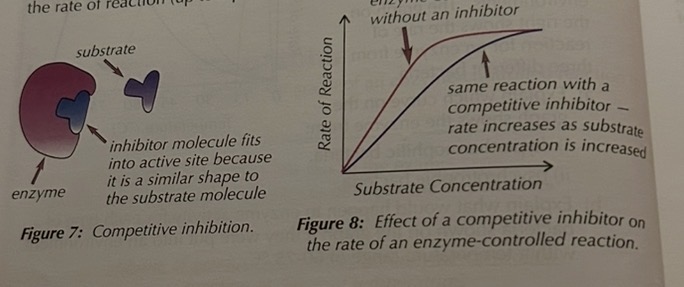
Competitive inhibitor molecules have a similar shape to that of substrate molecules. They compete with the substrate molecules to bind to the active site, but no reaction takes place. Instead they block the active site, so no substrate molecules can fit in it see Figure 7.
How much the enzyme is inhibited depends on the relative concentrations of the inhibitor and substrate. If there's a high concentration of the inhibitor, it'll take up nearly all the active sites and hardly any of the substrate will get to the enzyme. But if there's a higher concentration of substrate, then the substrate's chances of getting to an active site before the inhibitor increase. So increasing the concentration of substrate will increase the rate of reaction (up to a point.
Non- competitive inhibitors
Non-competitive inhibitor molecules bind to the enzyme away from its active site.
This causes the active site to change shape so the substrate molecules can no longer bind to it
Non-competitive inhibitor molecules don't compete with the substrate molecules to bind to the active site because they are a different shape. Increasing the concentration of substrate won't make any difference
-enzyme activity will still be inhibited.
