FIN303 concepts from review sheet
 Call Kai
 Learn
 Practice Test
 Spaced Repetition
 Match
 Flashcards
 Knowt Play
1/105

Earn XP
Description and Tags
fed
106 Terms
In financial management, how is the interest rate defined?
The cost of borrowing money, or the price of money.
What are the four fundamental factors that affect the cost of money?
Production opportunities 2. Time preference for consumption 3. Risk 4. Inflation
Production opportunities
if have more of this, borrows more → demand for money increases, interest rate increases
what affects interest rates
anything that changes the demand/supply curves
How does an increase in corporate production opportunities affect the demand for money and interest rates?
If firms have more production opportunities, the demand for money increases, pushing interest rates up.
How does a stronger consumer preference to spend money today affect the supply of money?
If more consumers prefer to spend money today rather than save, the supply of money decreases (savings decrease), causing interest rates to rise
What is the relationship between security risk and required investor return?
The higher the risk a security carries, the higher the return an investor requires (higher interest rate)
How does expected inflation impact nominal interest rates?
Higher expected inflation leads to higher nominal interest rates (the higher the inflation premium)
treasury securities
T-bills, T-notes, and T-bonds
Which interest rate risk premiums are equal to zero (0) by definition for Treasury securities?
Default Risk Premium (DRP) and Liquidity Premium (LP).
t-bills
short-term (no maturity risk premium)
How is the nominal risk-free rate (rRF), such as the T-bill rate, calculated?
rRF=r∗+IP (Real risk-free rate plus Inflation Premium).
What does an upward sloping (normal) yield curve indicate about future interest rates according to expectation theory?
Investors expect future interest rates and inflation rates to rise.
What does a downward sloping (abnormal) yield curve suggest about future economic expectations?
Investors expect future interest rates and inflation rates to drop.
fed policy
can control money supply and interest rates
Government budget deficit or surpluses
if the government runs a huge deficit and the debt must be covered by additional borrowing, which increases the demand for funds and thus pushes up interest rates.
International perspective
trade deficit/surplus, country risk, exchange rate risk
Business activity: recession
demand for funds decreases, leading to lower interest rates
Business activity: expansion
demand for funds rises, leading to higher interest rates.
Different kinds of bonds
T-bonds, municipal bonds (munis have tax advantages), and corporate bonds
municipal bonds
local government bonds. Have tax advantages → purposefully sell at high price or give low coupon rate
What primary tax advantage do municipal bonds (munis) possess over corporate bonds?
Interest income from municipal bonds is generally exempt from federal income taxes.
Characteristics of bonds
Face value (par value), maturity, coupon interest rate, call provision, and market required rate of return (discount rate to calculate the fair value or intrinsic value of a bond)
What key bond characteristic represents the principal amount paid back when a bond matures?
Face value (or par value).
What is a zero-coupon bond?
A bond that pays no periodic interest (coupon rate is zero) and is sold at a discount below par value. Discount → price less than face value
A 6-year zero-coupon bond selling for 675 dollars has a par value of 1,000 dollars. What is its expected annual return (I/YR)?
6.77% (calculated using PV=−675, PMT=0, N=6, FV=1000).
PV → from bondholders pov (you pay $675 to get discount bond)
FV → positive. company will pay you $1,000
Interest rate → annual return from investing in zero coupon bond
semi-annually
$60 in each 6 months
Bond valuation
Intrinsic value, yield to maturity (YTM), yield to call (YTC), and current yield (CY)
Intrinsic value
present value (PV), what believe should be worth (fair value/what willing to pay)
market value
actual price
yield to maturity (YTM)
buy bond at market price, hold until matures (need to multiply by 2 → semi-annually)
If a bond's market price exceeds its intrinsic (fair) value, how is the bond evaluated in the market? When market value (price) > intrinsic value
The bond is overpriced.
If a bond's market price is less than its intrinsic value, how is it classified? When market value (price) < intrinsic value
The bond is underpriced.
When market value (price) = intrinsic value
the bond is fairly priced in the market
If the market required rate of return is greater than the expected rate of return (YTM), is the bond overpriced or underpriced? Market required rate of return > expected rate of return (YTM)
Overpriced.
Market required rate of return < expected rate of return (YTM)
the bond is underpriced in the market.
Market required rate of return = Expected rate of return (YTM)
the bond is fairly priced in the market (equilibrium)
When market interest rates rise, what happens to bond prices and current yield (CY)?
Bond prices decrease and current yield (CY) increases (vice versa)
The value of a bond is inversely related to changes in the investor’s required rate of return (or interest rate)
As market interest rates rise, the value (price) of an existing bond falls.
what happens to price when interest rate decreases
price increases
Interest rate risk
the variability in a bond value caused by changing interest rates
What is interest rate price risk?
The risk that an increase in market interest rates causes a decrease in bond price/value.
What is interest rate reinvestment risk?
The risk that a decrease in market interest rates leads to a decline in reinvestment income from a bond.
If the required rate of return (or discount rate) is higher than the coupon rate, the value (price) of the bond
will be less than its par value (a discount bond)
If the required rate of return (or discount rate) is less than the coupon rate, the value (price) of the bond
will be higher than its par value (a premium bond)
As a bond approaches its maturity date, what value does its market price converge toward?
Its face or par value ($1,000).
Do long-term bonds or short-term bonds experience greater interest rate price risk?
Long-term bonds experience greater interest rate price risk.
The sensitivity of a bond’s value to changing interest rates depends
not only on the length of time to maturity, but also on the pattern of cash flows provided by the bond (or coupon rates).
Bond rating: investment rated bonds
AAA - BBB
Bond rating: junk bonds
below BBB
junk bonds level of risk
high yield/high return → high risk (chance company may not pay you back coupon payment in time)
What is stand-alone risk, and how is it measured?
risk of holding one asset, measured by its standard deviation (σ).
standard deviation (σ)
dispersion from mean
Market/portfolio risk
risk of holding a well-diversified portfolio measured by beta (β).
market risk
can only diversify away company’s specific risk, NOT market risk. Driven by market forces.
Diversification: As the number of securities in a portfolio increases
the portfolio total risk decreases
Diversification: can ONLY diversify what?
firms’ specific risks or diversifiable risks but cannot diversify away/eliminate market risk or systematic risk
Diversification CANNOT do what?
diversify away/eliminate market risk or systematic risk. can ONLY diversify firms’ specific risks or diversifiable risks
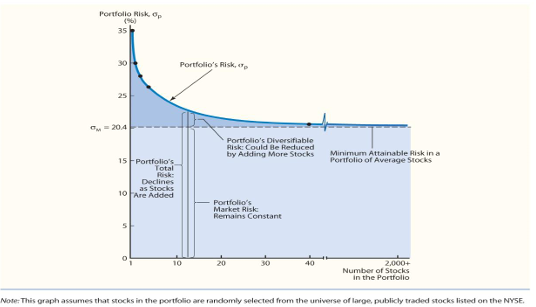
light blue area is?
market risk (beyond anyone’s control); non-diversifiable risk
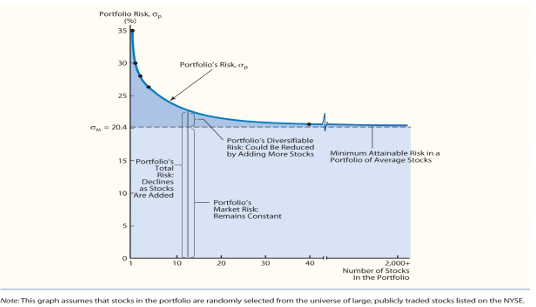
dark blue area is?
diversifiable risk (company’s specific risk)
total risk: firm
Total risk = firm’s specific risk + market risk
total risk: diversifiable
Total risk = diversifiable risk + non-diversifiable risk
total risk: unsystematic
Total risk = unsystematic risk + systematic risk
Beta coefficient - market risk = ?
1 (benchmark)
What does a stock's Beta coefficient (β) measure?
Sensitivity of an asset (or a portfolio) with respect to the market or the extent to which a given stock’s returns move up and down with the stock market
Increase in beta
high tech; higher risk from higher sensitivity
Decrease in beta
utility companies; in bad economy, still need to shower & eat; less sensitivity
Characteristic Line
Plot historical returns for a firm along with the market returns (S&P 500 index, for example) and estimate the best-fit line.
Characteristic Line: estimated slope of the line is?
the estimated beta coefficient of the stock, or the market risk of the stock.
Characteristic Line: best fit line is?
called characteristic line (CL)
Expected return on a portfolio
the weighted average of the expected returns on the assets held in the portfolio
For example, the expected rate of return on stock A is 10% and the expected rate of return on stock B is 14%. If you invest 40% of your money in stock A and 60% of your money in stock B to form your portfolio.
The expected rate of return on your portfolio will be 12.4% = (0.4)*10% + (0.6)*14%
Portfolio beta
weighted average of individual securities’ betas in the portfolio
For example, if the beta for stock A is 0.8 and the beta for stock B is 1.2, with the weights given above
the beta of the portfolio will be 1.04 = (0.4)*0.8 + (0.6)*1.2
Required rate of return
the minimum rate of return necessary to attract an investor to purchase or hold a security
CAPM
Capital Asset Pring Model. Use for required rate of return.
SML
Security Market Line
Market risk premium
the additional return over the risk-free rate that is needed to compensate investors for assuming an average amount (market) of risk
For example, if the required rate of return on the market is 11% and the risk-free rare is 6%
then the market risk premium will be 5%
Risk premium for a stock
the additional return over the risk-free rate that is needed to compensate investors for assuming the risk of that stock
For example, if the required rate of return on a stock is 15% and the risk-free rare is 6%
then the risk premium for that stock will be 9%
What does CAPM do?
relates the required rate of return of a security (or a portfolio) to its market risk (measured by beta)
What is the plot of CAPM called?
SML
What is the risk-free rate in SML?
the intercept
What is the market risk premium in SML?
the slope
Characteristics of common stocks
Ownership with residual claims
Common stock valuation model
discounted dividend model (DDM), corporate valuation model, and other approaches
Dividend Discount Model (DDM)
the fair value of a stock is equal to the present value of future dividends. (what should be fair price)
Zero growth model
the dividend growth rate, g = 0
Constant growth model
the dividend growth rate, g = constant
Non-constant growth model
part of the firm’s cycle in which it grows much faster for the first N years and gradually return to a constant growth rate
Corporate valuation model (free cash flow approach)
estimate the present value of expected future free cash flows using the formula: FCF = EBIT*(1-T) + depreciation and amortization – (capital expenditures +∆ in net working capital) with the discount rate of WACC (weighted average cost of capital)
WACC
weighted average cost of capital
Firm multiples
Price-to-Earnings (P/E) 2. Price-to-Sales (P/S) 3. Price-to-Cash Flow (P/CF)
Preferred stock
Hybrid security and can be valued as a stock with zero growth (g = 0)
Sources of capital
Debt 2. Preferred stock 3. Equity
Sources of capital: Debt
debt financing
Sources of capital: Preferred stock
preferred stock financing
Sources of capital: Equity
equity financing
Sources of capital: internal equity
retained earnings