Campbell Biology Chapter 12 Test Bank
 Call Kai
 Learn
 Practice Test
 Spaced Repetition
 Match
 Flashcards
 Knowt Play
1/27

There's no tags or description
Looks like no tags are added yet.
28 Terms
1) Eukaryotic chromosomes are composed of which of the following macromolecules?
C) DNA and proteins
2) Starting with a fertilized egg (zygote), a series of six cell divisions would produce an early embryo with how many cells?
D) 64
3) In a diploid cell with 5 chromosome pairs (2n = 10), how many centromeres will be found in a nucleus at G2 of the cell division cycle?
B) 10
5) G1 is associated with which of the following cellular events?
A) normal growth and cell function
9) Metaphase is characterized by ________.
A) alignment of chromosomes on the equator of the cell
13) FtsZ is a bacterial cytoskeletal protein that forms a contractile ring involved in binary fission. Its function is analogous to ________.
A) the cleavage furrow of eukaryotic animal cells
15) In a diploid cell with 5 chromosome pairs (2n = 10), how many sister chromatids will be found in a nucleus at prophase of mitosis?
C) 20
16) If there are 40 centromeres in a cell at anaphase of mitosis, how many chromosomes will be found in each daughter cell following cytokinesis?
B) 20
17) If a cell at metaphase of mitosis contains 20 sister chromatids, how many chromosomes will be present in a G1 cell?
B) 10
19) Movement of the chromosomes during anaphase would be most affected by a drug that prevents which of the following events in mitosis and cell division?
C) shortening of microtubules
20) Measurements of the amount of DNA per nucleus were taken on a large number of cells from a growing fungus. The measured DNA levels ranged from 3 to 6 picograms per nucleus. In which stage of the cell cycle did the nucleus contain 6 picograms of DNA?
C) G2
21) A group of cells is assayed for DNA content immediately following mitosis and is found to have an average of 8 picograms of DNA per nucleus. How many picograms of DNA would be found in a nucleus at prophase of mitosis?
C) 16
27) Use the figure to answer the question below. If the cell whose nuclear material is shown in the figure continues toward completion of mitosis, which of the following events would occur next?
C) formation of telophase nuclei

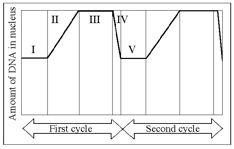
30) Use the figure to answer the question below. In the figure, at which of the numbered regions would you expect to find cells at metaphase?
C) III only

36) Through a microscope, you can see a cell plate beginning to develop across the middle of a cell and nuclei forming on either side of the cell plate. This cell is most likely ________.
C) a plant cell in the process of cytokinesis
37) Which of the following events occurs during interphase of the cell cycle?
D) replication of the DNA
42) What two components constitute an active MPF?
D) cyclin and a cyclin-dependent kinase
43) Which of the following properties is associated with a cyclin-dependent kinase (Cdk)?
D) A Cdk is an enzyme that attaches phosphate groups to other proteins.
46) The M phase checkpoint ensures that all chromosomes are attached to the mitotic spindle. If this does not happen, cells would most likely be arrested in ________.
D) metaphase
48) Which of the following molecules is a protein synthesized at specific times during the cell cycle that associates with a kinase to form a catalytically active complex?
C) cyclin
49) Which of the following molecules is a protein maintained at steady levels throughout the cell cycle that requires cyclin to become catalytically active?
D) Cdk
50) Which of the following molecules triggers the cell's passage past the G2 checkpoint into mitosis?
B) MPF
51) At what stage of the cell cycle is the cyclin component of MPF destroyed?
D) in late M
52) Use the figure to answer the question below. In the figure, MPF reaches its highest concentration during this stage.
C) III
4) The decline of MPF activity at the end of mitosis is due to
C) the degradation of cyclin.
6) Which of the following does not occur during mitosis?
B) replication of the DNA
7) Cell A has half as much DNA as cells B, C, and D in a mitotically active tissue. Cell A is most likely in
A) G1.
8) The drug cytochalasin B blocks the function of actin. Which of the following aspects of the animal cell cycle would be most disrupted by cytochalasin B?
D) cleavage furrow formation and cytokinesis