Speech acoustics quiz 4 - production of speech sounds
 Call Kai
 Learn
 Practice Test
 Spaced Repetition
 Match
 Flashcards
 Knowt Play
1/85

There's no tags or description
Looks like no tags are added yet.
86 Terms
What are the valves of the vocal tract?
Labial, lingual, velopharyngeal, and laryngeal
Labial valve consists of
lips
What is the labial valve resposible for?
the lips shape and restrict air flow
In the labial valve, what contacts each other?
lips contact each other and the teeth
Lingual refers to…
tongue
Lingual valve can contact
the teeth, alveolar ridge, and hard/soft palate
The lingual valve is responsible for?
external extension (lets us extend our tongue outside of our mouth) and changing the volume of the oral cavity (from small to large)
Velopharyngeal velum consists of
velum (soft palate), posterior & lateral pharyngeal wall
What is the velopharyngeal valve responsible for?
directing airflow to the oral or nasal cavity
The laryngeal valve consists of…
vocal folds
What is the laryngeal valve responsible for?
voicing
Where do speech sounds come from?
Features a source, a filter, and output
What is the source where speech sounds come from?
Vocal folds! They create a glottal wave which produces fundamental frequency and harmonics. Fundamental frequency depends upon the rate and tension of vocal fold vibration.
True or false: True vocal folds move the air through rarefaction and compression
True
What is the filter that speech sounds come from?
The vocal tract! It contains valves (tongue, lips, velum, pharynx) that change pharyngeal, oral, and lip volumes. These changes create resonances called formants.
The vocal tract is also known as the…
resonating tube
Formants are based on…
length and width of vocal tract
What is the output that speech sounds come from?
output at the lips which creates speech, the fundamental frequency and harmonics are unchanged but the amplitude changes
Periodic complex sounds
a series of frequencies that are related to each other
In periodic complex sounds, what are fundamental frequencies?
the lowest frequency of the sound
In periodic complex sounds, what are harmonic frequencies?
frequencies above the fundamental frequency (these are even multiples of the fundamental frequency)
Examples of periodic complex sounds
a musical instrument or producing speech
Examples of fundamental frequencies (F0) and harmonic frequencies (just look at briefly)
F0 (fundamental frequency) = 100 Hz. Harmonics = 200 Hz, 300 Hz, 400 Hz, etc.
F0 (fundamental frequency) = 300 Hz. Harmonics = 600 Hz, 900 Hz, 1200 Hz.
Aperiodic complex sounds
two or more frequencies, but they’re not related to each other.
In aperiodic complex sounds, what happens with the fundamental frequency?
These sounds will still have a fundamental frequency, but the later frequencies (harmonics) are all over the place and will not increase in even multiples like a periodic complex sound. The later frequencies will not be related to the fundamental frequency.
Examples of aperiodic complex sounds (just look at briefly)
contains all frequencies between 100Hz and 600Hz or contains all frequencies between 2000Hz and 5000Hz
Examples of aperiodic complex sounds
clapping hands
If we have the source of speech sounds, we need the resonator, which is…
the vocal tract that serves the vocal tract transfer function (which is how the vocal tract changes the sound coming from the vocal folds)
Two types of resonators
mechanical and acoustic
Mechanical resonator
an actual object is set into vibration
Acoustic resonator
a receptacle is filled with air
What resonator do we use for speech?
acoustic resonator
Mechanical resonator resonance details
Driving frequency - the frequency produced by the first object. Resonator - the second object that receives the sound and vibrates in response. The closer the driving frequency is to the resonator's frequency, it causes a larger amplitude.
Acoustic Resonators resonance details
Air can resonate in an enclosed space. Smaller volumes of air will resonate at higher frequences, larger volumes of air will resonate at lower frequencies.
Is the vocal tract a series of tubes or one long tube?
One long tube (known as the resonating tube)
Helmholtz Resonators
a space filled with air that can resonate
True or false: Valving of Vocal Tract results in a series of Helmholtz Resonators
true
Valving of Vocal Tract
The vocal tract contains air-filled cavities (pharynx, oral, and nasal). Vocal tract valves open and close these cavities. These cavities vibrate/resonate in response to sound waves from the vocal folds. Vocal tract resonances aren’t dependent on fundamental frequency, but instead of length and width of the cavities.
Anterior border of oral cavity
teeth/gums
Superior border of oral cavity
hard palate/soft palate
Floor of oral cavity
mylohyoid and geniohyoid
Posterior border of oral cavity
palatoglossal arch
Functions of the tongue
Swallowing and articulation
Oral tongue
anterior (front) 2/3rds of the tongue, within the oral cavity
The oral tongue includes the…
tip, blade, front, and back
Pharyngeal tongue
posterior (back) 1/3rd of the tongue (aka the tongue base).
Is the oral tongue or pharyngeal tongue within the oropharynx?
Pharyngeal tongue
What happens with a tongue tie?
The frenulum becomes short. The person will potentially have speech production and swallowing issues. Severity varies based on the length of the frenulum. Sometimes, there is no issue for them to produce speech sounds.

This is showing…
a short frenulum

This is showing…
a normal frenulum

This is showing…
double frenulum, very rare
Features of the oral tongue
Has thick, rough covering and features a midline depression called the longitudinal sulcus
Pharyngeal tongue features
smooth thin, nodular covering due to presence of tonsils in submucosa
The tongue assists with…
Fine motor movements, acts as a valve, and modifies airsteam
Anatomical parts of the tongue?
tip/apex, blade, front (under hard palate), back (under soft palate), dorsum (broad superior surface - runs from front to the back of the tongue)

Anatomical parts of the tongue shown flat
Anatomical parts of the tongue shown flat

What is b?
tip/apex

What is c?
blade
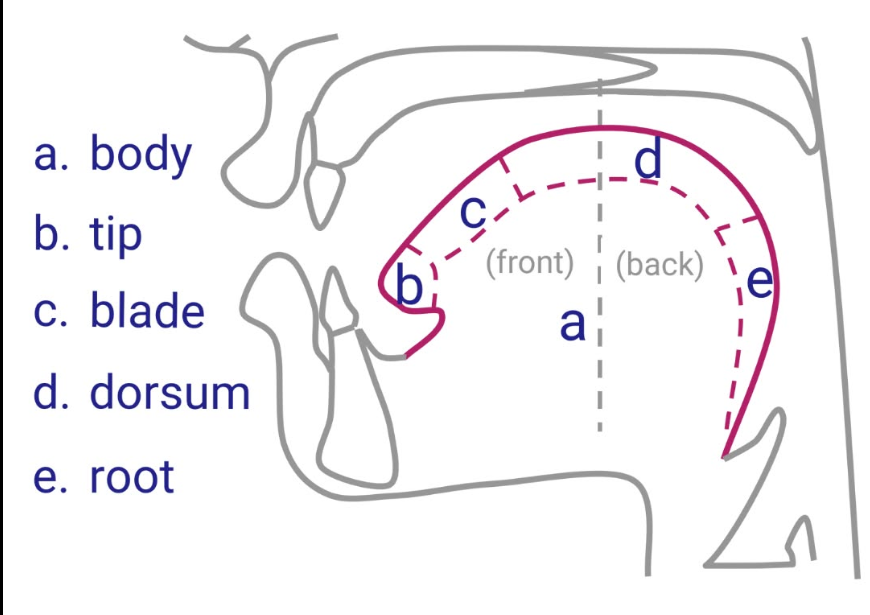
What is d?
dorsum (body)

What is e?
root

In this image, where would the front and back be?
Front of d and back of d
Are muscles of the tongue bilateral or unilateral?
bilateral, with 2 sides separated by the median septum
Median septum
a fibrous divide that runs from tongue tip to hyoid bone (doesn’t reach surface of tongue)

What is I pointing to?
median septum
Intrinsic muscles of the tongue (FUNCTION)
Shape the tongue and makes fine motor movements for speech
Extrinsic muscles of the tongue (FUNCTION)
Positions and shapes the tongue for speech and swallowing
What are the intrinsic muscles of the tongue?
Superior longitudinal, inferior longitudinal, transverse, vertical
Superior longitudinal muscle
Shortens tongue; turns tip upward; unilateral turning of tip
Inferior longitudinal muscle
shortens tongue; pulls tongue tip downward
Transverse muscle
narrows and elongates tongue
Vertical muscle
flattens and widens tongue
Extrinsic Muscles of the tongue
genioglossus, styloglossus, hyoglossus, palatoglossus
genioglossus muscle
protrudes tongue, and depresses central portion
styloglossus muscle
lifts sides of tongue, pulls tongue backward
hyoglossus muscle
pulls down sides of tongue, pulls tongue backward (retracts)
palatoglossus muscle
elevates and retracts tongue base
What is CN XII (12th cranial nerve)?
hypoglossal nerve
Where does the hypoglossal nerve start?
In the motor cortex of the brain
Hypoglossal nerve
Information from the motor cortex is projected bilaterally to the hypoglossal nuclei/nerve to control most tongue muscles, except for one.
What is the exception to the hypoglossal nerve?
The genioglossus muscle. Neurons that drive this muscle project only to the contralateral hypoglossal nuclei/nerve
Therefore, to test integrity of the hypoglossal nerve (CN XII), what would you do?
Test the action of the genioglossus. An example would be sticking your tongue out. Any damage to this area will result in the patient sticking their tongue out to the side rather than straight out
The tongue can be described as a muscular hydrostat, which means…
It is like a fluid filled, incompressible bag. The muscles serve as the fluid.
The tongue is a “constant volume” system, meaning…
any reduction in volume in one part of the tongue will result in an equal increase in volume in another part of the tongue
What muscle is used for protrusion (sticking the tongue out)?
Genioglossus
What muscle is used for retraction (pulling the tongue back)?
Styloglossus (major), hyoglossus (minor)
What muscle(s) is used for lateralization (moving the tongue back and forth)?
genioglossus, styloglossus, hyoglossus