Adult Acquired Lang Disorders
 Call Kai
 Learn
 Practice Test
 Spaced Repetition
 Match
 Flashcards
 Knowt Play
1/87

Earn XP
Description and Tags
Also includes cognitive based dysfunction
88 Terms
blood supply to the brain
Strokes disrupt the __________ or the blood that circulates to the brain (leads to tissue damage)
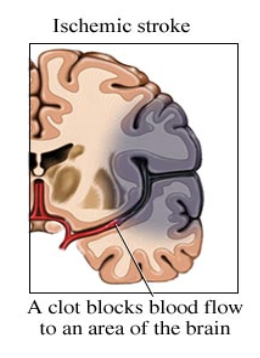
Ischemic stroke
Occurs due to an occlusion in an artery (blockage can be a thrombosis or embolism)
80
________% of strokes are ischemic
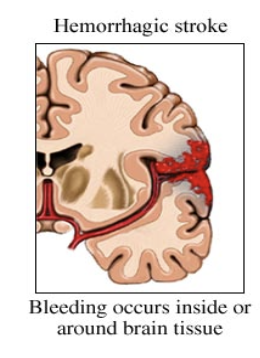
Hemorrhagic stroke
Occur due to bleeding in the brain from rupture of an artery
20
_______% of strokes are hemorrhagic
thrombosis
Stationary ischemic occlusion
embolism
Traveling ischemic occlusion
False
True or false: thrombotic (ischemic) strokes result from traveling blood clots
False
True or false: embolic (ischemic) strokes result from stationary blood clots
Face, arms, speech, time
What does the FAST mnemonic stand for?
True
True or false: hemorrhagic strokes lead to bleeding into brain tissues
uncontrollable
The following are ________ risk factors: age, sex, racial or ethnic background, family hx
False
True or false: strokes affect more females than males
True
True or false: African Americans are twice as likely to suffer a stroke compared to Anglo Americans
modifiable
The following are ________ risk factors: hypertension, diabetes, smoking, alcohol use
brain, spinal cord
The CNS is composed of…
peripheral nerves
The PNS is composed of…
speech production
Broca’s area is responsible for language and __________
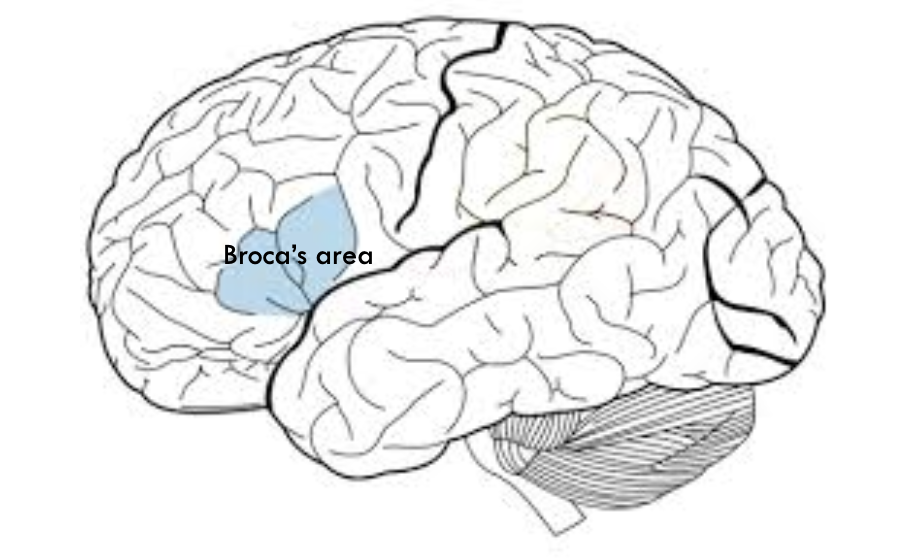
posterior portion of the left frontal lobe
Broca’s area is located in the________
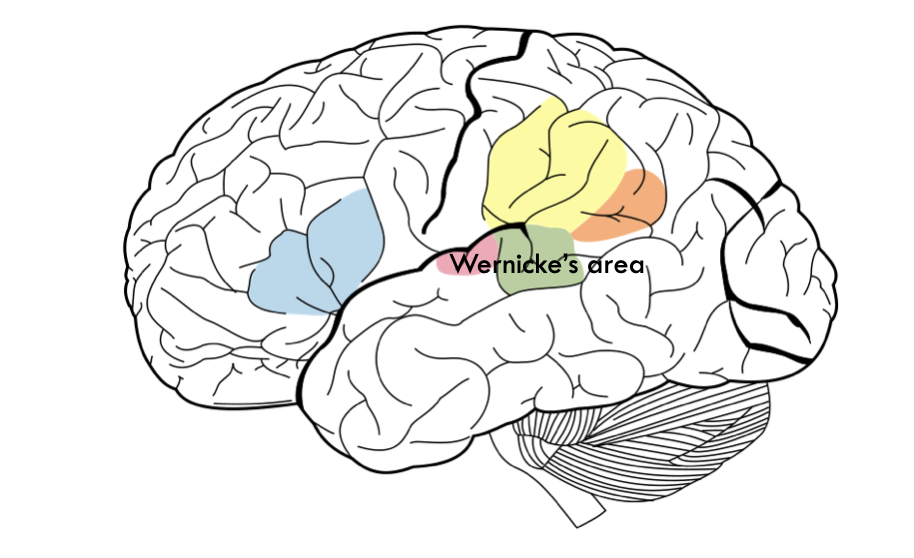
comprehension
Wernicke’s area is responsible for language___________
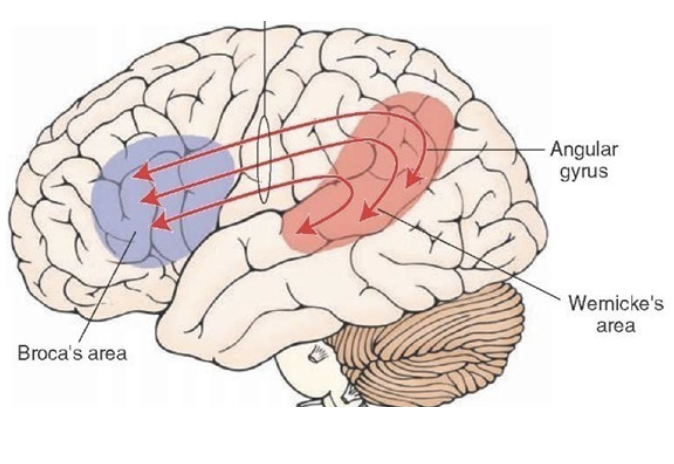
Arcuate fasciculus
The _________ connects Broca’s area to Wernicke’s area, which is a fiber tract that connects and allows for communication between these areas
Broca’s area, Wernicke’s area, Arcuate fasciculus in left hemisphere
‘Language areas’ of the brain include these structures and surrounding areas
Aphasia
Describes language disorders due to damage to the language areas of the brain
strokes
________ are the most common cause of aphasia
acquired, motor speech
Aphasia is an _______ disorder, not a psychiatric problem, and not a ________ disorder
nonfluent, fluent
Anterior lesions cause _______ aphasias, while posterior lesions cause ______ aphasias
production, comprehension, repetition
Aphasia can affect these three language components
agrammatism
Leaving out grammatical markers in sentences and phrases
anomia
Difficulty thinking of words or names of items
telegraphic speech
Phrases and sentences with content words, but no function words
paraphasias
Substitution of one word for another (e.g., “picture for mirror”)
jargon
Language that has no meaning
neologisms
Making up a new word (e.g. “The whozit over there.”)
Effortful articulation
Labored speech
Initiation difficulty
Difficulty or inability to initiate speech
Comprehension deficits
Difficulty or inability to understand language
Impaired repetition
Inability to repeat sounds, words, or phrases
Broca’s, Wernicke’s, transcortical motor, transcortical sensory, mixed transcortical, global, conduction, anomic
List the eight classic aphasia syndromes
Production/repetition impaired, comprehension preserved
Describe how production, comprehension, and repetition are affected in Broca’s aphasia
prefrontal cortex
Transcortical motor aphasia is caused by damage to the _______(i.e. “watershed area” around Broca’s area)
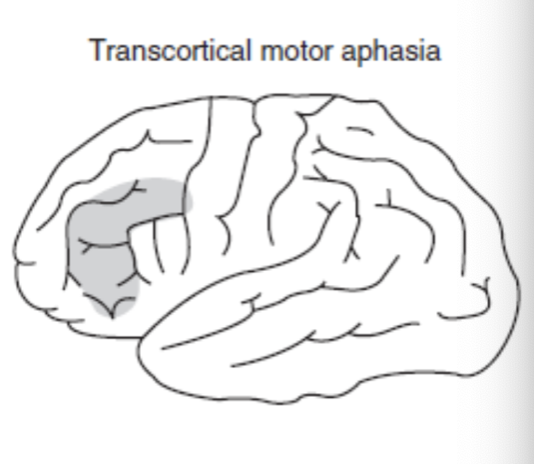
Comprehension/repetition preserved, production impaired
Describe how production, comprehension, and repetition are affected in transcortical motor aphasia
Comprehension/repetition impaired, production preserved
Describe how production, comprehension, and repetition are affected in Wernicke’s aphasia
Wernicke’s
Which type of aphasia will the person be unaware of their deficits or speech difficulties
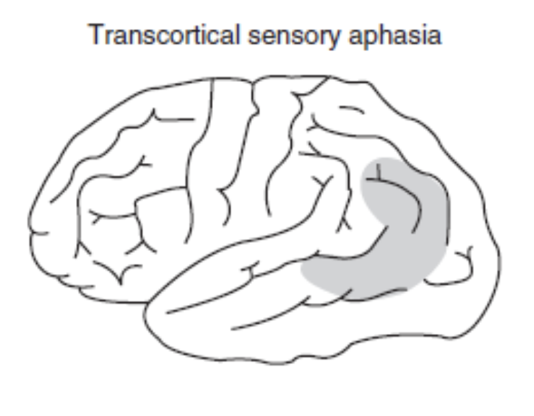
temporal & occipital lobes
Transcortical sensory aphasia is caused by damage to the ______ (i.e. “watershed area” around Wernicke’s area)
Production/repetition preserved, comprehension impaired
Describe how production, comprehension, and repetition are affected in transcortical sensory aphasia
multiple areas of the brain
Global aphasia is caused by damage to ______
True
True or false: patients with global aphasia have extensive deficits across domains
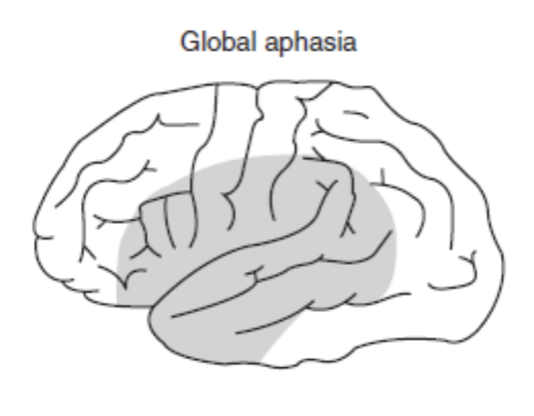
All severely impaired
Describe how production, comprehension, and repetition are affected in global aphasia
Broca’s area, Wernicke’s area, & the arcuate fasciculus
Mixed transcortical aphasia is caused by damage to “watershed areas” around ____________.
production/comprehension impaired, repetition preserved
Describe how production, comprehension, and repetition are affected in mixed transcortical aphasia
arcuate fasciculus
Conduction aphasia is caused by damage to the __________
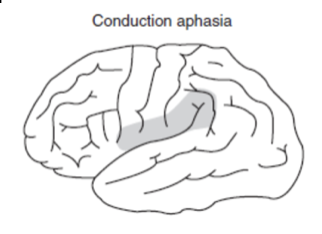
production/comprehension preserved, repetition impaired
Describe how production, comprehension, and repetition are affected in conduction aphasia
Anomic
_______ aphasia is not associated with damage to any specific brain region and is the most mild classic aphasia syndrome. But it’s the most pervasive type of chronic aphasia, after treatment
production/repetition/comprehension preserved
Describe how production, comprehension, and repetition are affected in anomic aphasia
True
True or false: Impairments in reading and writing are similar to impairments in comprehending and speaking for aphasia
neurodegenerative disease
Primary Progressive Aphasia (PPA) is aphasia due to ________
Primary Progressive Aphasia (PPA)
__________ is not a classic aphasia syndrome, acquired, due to neurodegenerative disease (i.e. progressive), and the language deficit is the most prominent aspect of the clinical picture (i.e. primary)
production
The following assessments are testing what? Answering questions, describing a picture, participating in informal or structured conversations
naming
The following assessments are testing what? identify objects/pictures, categories, completing phrases
comprehension
The following assessments are testing what? answering yes/no questions, pointing to objects or pictures as they are named, following directions
remediation
Speech-language therapy to improve skills
compensation
Implementing multimodal communication, using strategies such as circumlocution, caregiver strategies
True
True or false: The right hemisphere is responsible for many non-language functions such as comprehending visuospatial information, emotional expression
cognition, perception, & behavior
When the right hemisphere is damaged, it can lead to disruptions in
Right Hemisphere Dysfunction (RHD)
When an area of the right hemisphere does not function as it should due to damage. Can cause language impairment, but it usually looks very different from aphasia caused by left hemisphere damage
Unawareness/denial of cognitive-linguistic deficits
Unawareness/neglect of the left side of the body/external stimuli
Difficulty recognizing faces
Poor pragmatic skills
Wordy/tangential language
Difficulty understanding or using higher-level cognitive-linguistic skills (problem solving/abstract thought)
List six RHD characteristics
Improved attention to stimuli across visual fields
Higher-level cognitive-linguistic tasks (solving functional problems, understanding and using figurative language)
Pragmatics (turn taking, topic maintenance, eye contact)
Therapy targets for RHD may include…
traumatic brain injury (TBI)
Damage to the brain from external forces
Open-head TBI
Skull & meninges penetrated - tend to be more localized/focal injuries (ex: gun-shot wound)
Closed-head TBI
Brain is jostled, more diffuse (falls, concussions). More common injury.
Diffuse
Affects large area of brain
Focal
Affects only one specific region
Frontal/temporal
________ lobes are most susceptible to TBI
both sides of the brain
With closed-head injury, damage often occurs on _______
coup
Injury occurs on the side of impact
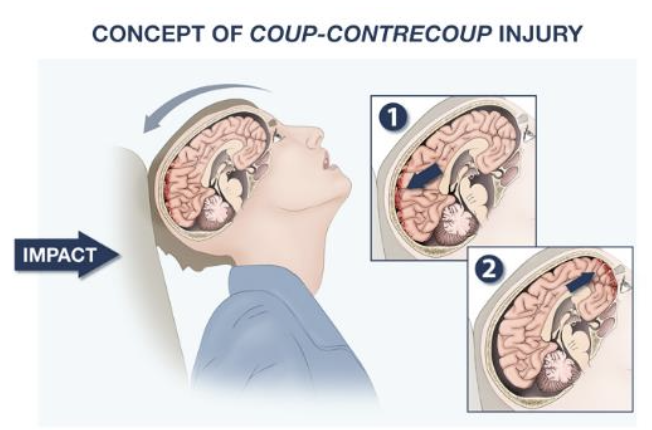
contrecoup
Injury that occurs on the side opposite the impact
Level of consciousness
TBI severity is characterized by…
Glasgow Coma Scale
Scores selected to describe an individual’s responses, lowest scores indicate serious comatose state
Rancho Los Amigos Scale
Scores individual to a level 1-8 based on level of responsiveness
Dementia
A general term to describe chronic and progressive decline in memory, cognition, language, & personality
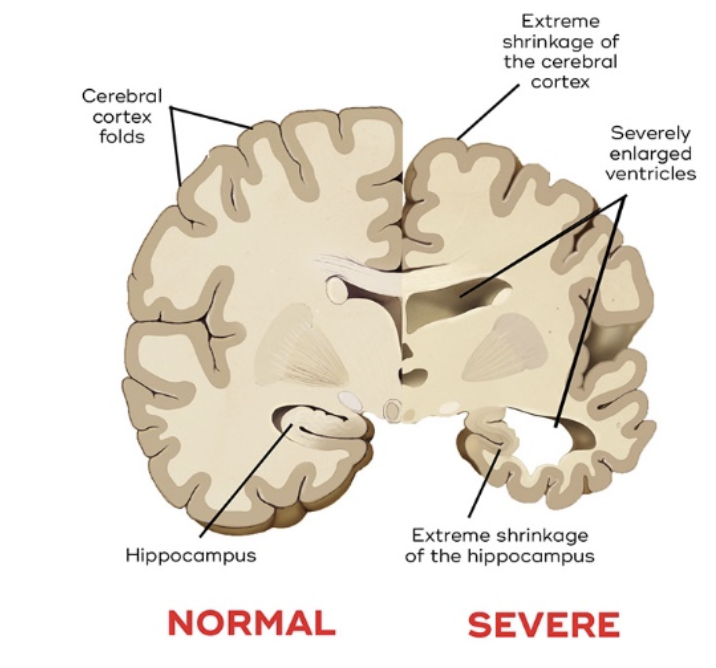
central nervous system dysfunction
Dementia is caused by …
Metabolic disturbances (“metabolic encephalopathy”)
Infections (e.g. UTI)
Drug toxicity
Vitamin deficiency
Thyroid disease
List some acute medical conditions resemble dementia but are reversible
memory/cognitive skills impairment, aphasia/apraxia/agnosia
Individuals with dementia may experience…
agnosia
Inability to recognize objects, words, sounds
mild
Identify the severity - mild,moderate, or severe: forgetfulness, decreased vocabulary, decreased length of utterances in conversation, misplaces things
moderate
Identify the severity - mild, moderate, or severe: Disoriented to time and place, poor attention and memory, significant anomia, empty conversations, tends to roam
severe
Identify the severity - mild, moderate, or severe: Extreme disorientation, profound language deficits
True
True or false: Therapy for dementia usually focuses on compensation instead of remediation. Not looking to fix/improve things (no cure).