UNIT 4 ANATOMY
 Call Kai
 Learn
 Practice Test
 Spaced Repetition
 Match
 Flashcards
 Knowt Play
1/19

There's no tags or description
Looks like no tags are added yet.
20 Terms
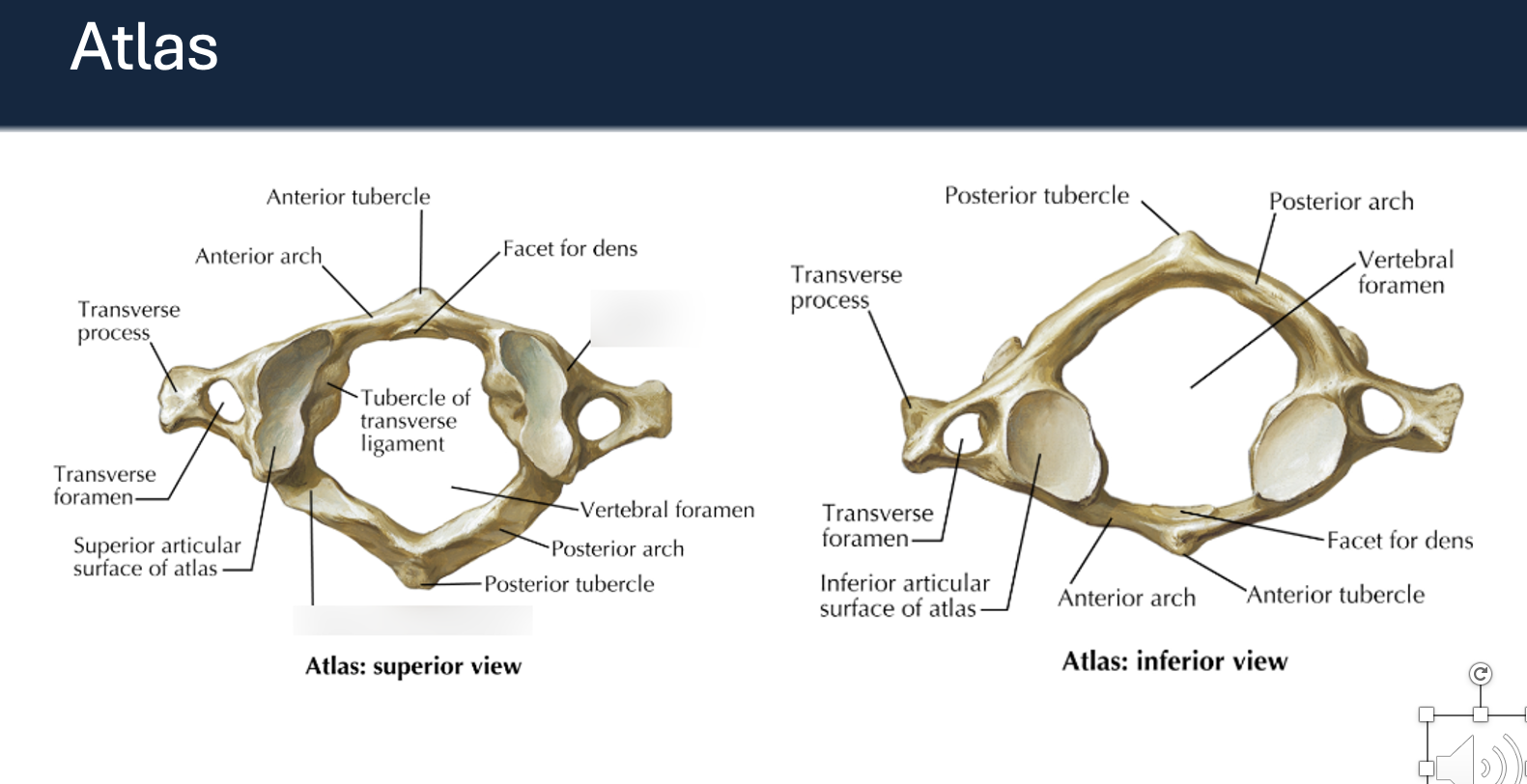
Atlas (what is unique) and occipitoatlanto joint function
Cranial flexion and extension
Only vertebral segment without a body- has arches
Has no spinous process
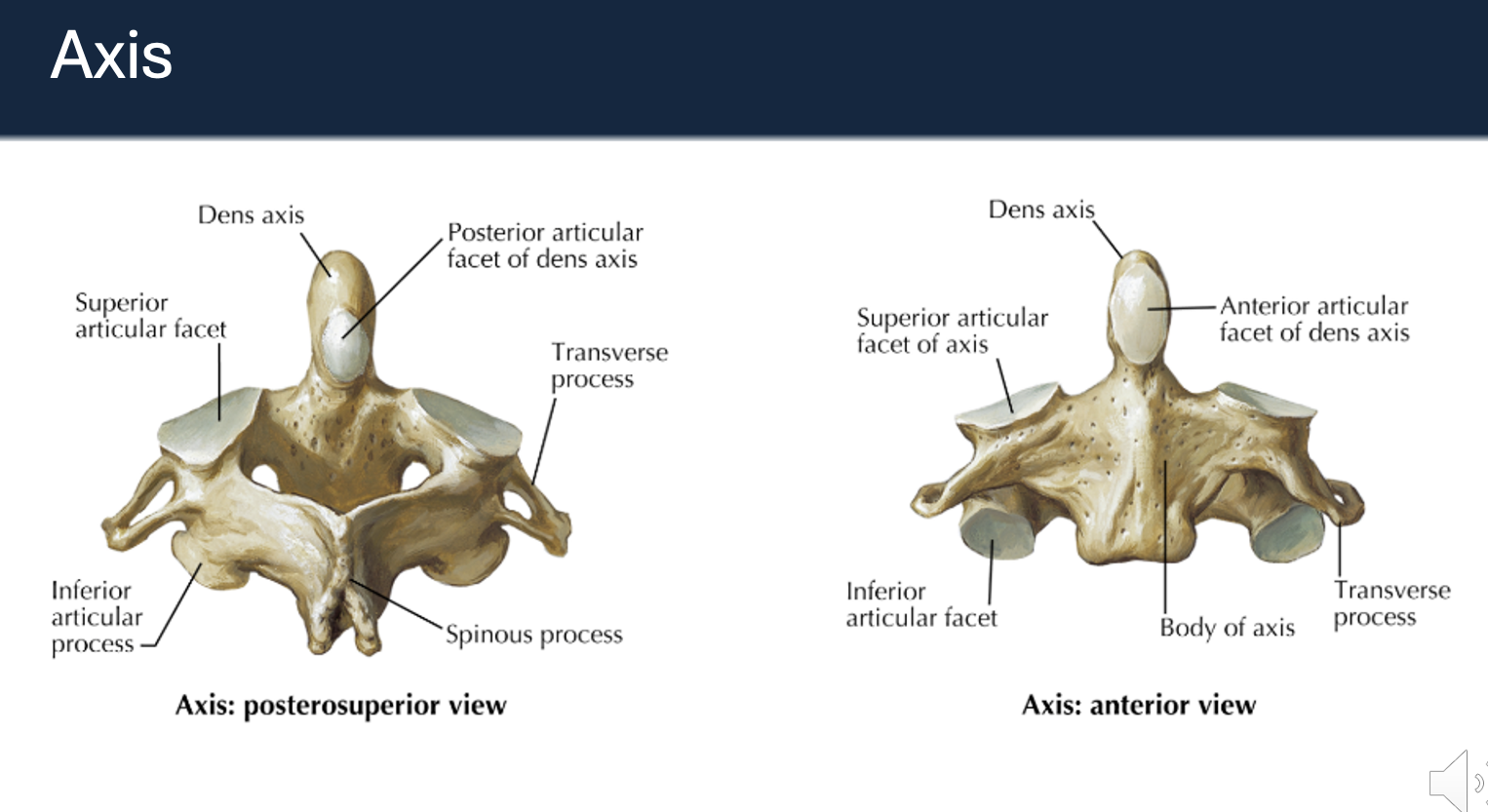
Axis and Atlantoaxis joint function
Atlantoaxis joint: Most cervical rotation occurs here
Flat superior articular facet surface helps with this
The dens (anterior) acts as the pivot around which rotation of the head takes place
Lumbar vertebrae distinction
Big strong transverse and spinous processes for muscle attachments
Kidney bean shapped
Articulate with eachother via superior and inferior articular processes

Sacrum and coccyx
Sacrum: transmits body weight to pelvis, 5 fused vertebrae, 4 pairs of sacral foramina
Coccyx: Co1 is often not fused, no pedicles, laminae, or spine (does have transverse process?)
What cervical vertebrae have bifid spinous processes
C2-C6, C7 has long single spinous process
Thoracic vertebrae distinctions
Long spinous process that slopes posteriorinferiorly to overlap next vertebra
Vertebra are always going to have superior and inferior articular process to articulate with vertebra above and below- BUTT thoracic vertebrae has exyta facets on their transverse process for rib articulation


Alar ligament
Extends from lateral sides of the dens to edges of foramen magnum

Cruciate ligament
Transverse ligament of the atlas: support dens in place
Superior and inferior longitudnial bands: extend from transverse ligament of atlas to anterior rim of foramen magnum and body of C2 inferiorly (superior ligament is stronger)

Posterior longitudinal ligament
Posterior to vertebral bodies, lives inside spinal canal
Restricts excess flexion and protects posterior intervertebral discs living in between vertebral bodies
Broadens into tectorial membrane of cervical spine to attach to skull
In lumbar spine
Narrows off and does not support posterior lateral vertebral discs, so most herniation and protrusions commonly occur here in lumbar spine
Nerve roots run posterior and lateral


Nuchal ligament
Functions to increase surfadce area of spinous process for muscle attachments
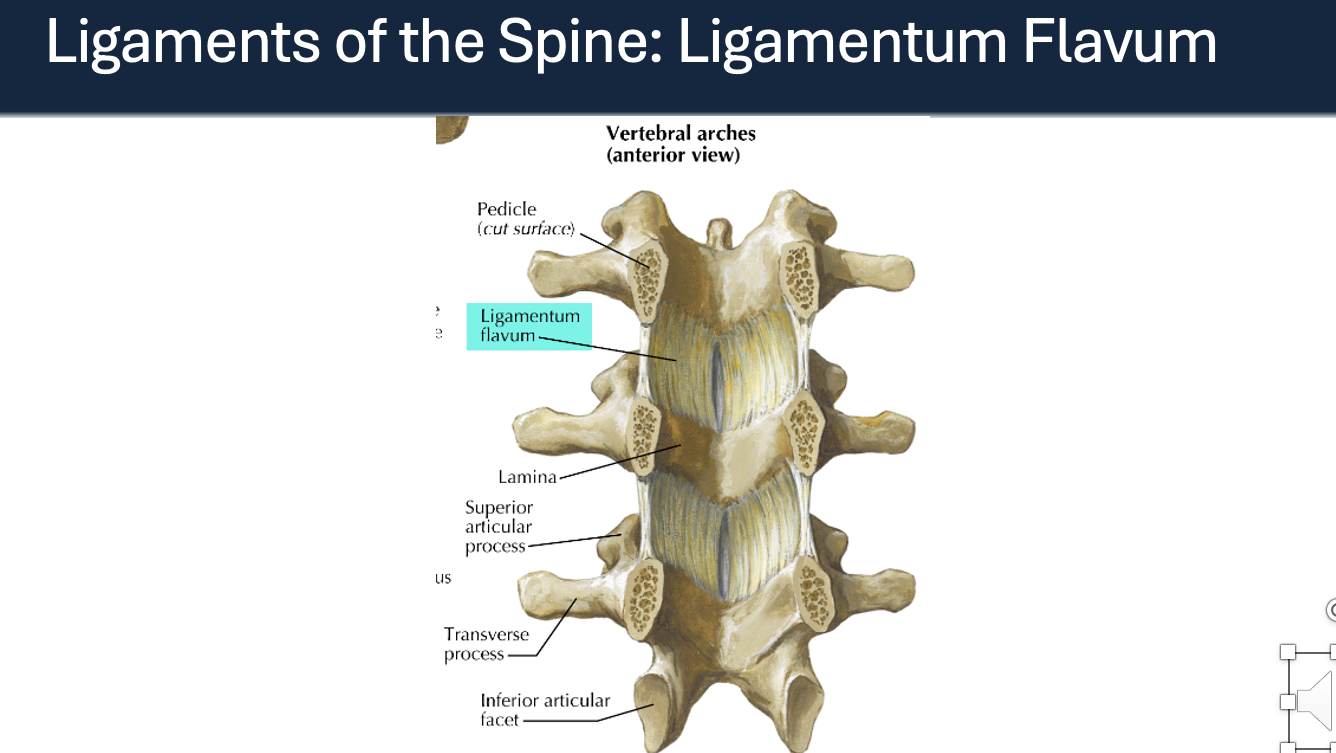
Ligamentum flavum (elastic properties)
Runs between pedicles and lamina of entire spine
Gets tight (stretched) during flexion, elastic properties to assist spine to return from flexion into neutral position
Joints of spine
Symphysis joint: what intervertebral disc serves as
Rigid, should not see movement
Zygapophysial (facet) joint: true synovial joint
Facets covered in hylaine cartilage

Characteristics of intervertebral discs
Inner circle of nucleus pulposus: softer, made up of hydrophilic (draws water) collagen
As we age- nucleus pulposus assumes role of anulus fibrosus and becomes ‘dryer, rigid disc’
Less common to have disc pain when were older
Outer layer of anulus fibrosus: firmer, hydrophobic (pushes water away)
*Get nutrition via osmosis

Where do nerve roots exit
intervertebral foramen (formed by inferior and superior vertebral notches)

Why is it hard to identify back pain
Facet joints are innervated by posterior rami from two spinal levels
Osteophytes
When bones bump into eachother it stimulates growth and can cause nerve compression (impingement) and stress the joint capsule
Intracapsular swelling
Can be mediated, inflamation causes a swollen joint capsule
can result in mechanical irritation of the joint capsule, chemical irritation of the sensory nerves and impingement on the nerve root.
Disc protrusion vs herniation
Protrusion: deformation of outer annulus fibrosus without nucleus pulposus escaping, but it pushes against outer wall
Herniation: complete rupture of annulus fibrosus where nucleus pulposes tissue escapes and can affect nerve and spinal cord
Nucleus pulposus is a chemical irritant that can make nerve angry
Angry nerve vs compressed nerve
Angry nerve: can still send and receieve info (conduct)
Compressed nerve: cannot conduct because compression is damaging axonal fibers
There is objective sensory loss and weakness