PT 780 - Appraising evidence (Clinical Prediction Rules)
 Call Kai
 Learn
 Practice Test
 Spaced Repetition
 Match
 Flashcards
 Knowt Play
1/45

There's no tags or description
Looks like no tags are added yet.
46 Terms
What is a clinical prediction rule (CPR)?
A tool that quantifies contributions of different variables to the diagnosis, prognosis, or likely response/outcome for an individual patient

A CPR may include info derived from where?
History, physical exam, lab test, or complaints

A CPR is used to make predictions about outcomes in which categories?
Diagnostic categories
Prognostic Estimates
Treatment responses

How is a CPR used in a diagnostic category?
Assist in the diagnosis of a disorder based on clinical signs
(ex. guidelines for detecting disease or injury)
What test is used to determine if there is an ankle fracture?
Ottawa Ankle Rule

In the Ottawa ankle rule, an x-ray is required if?
There is pain in the posterior edge of either malleolus or inability to weight bear

How is a CPR used in a prognostic estimate?
Used to determine the degree to which certain outcomes can be expected
(ex. identifying risk for functional decline in older community-dwelling women)

How is a CPR used in a treatment response?
Determine the likelihood that a patient will respond positively to intervention
(ex. if someone has neck pain which patients with neck pain will benefit from thoracic thrust)
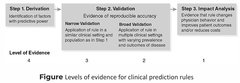
What are the three steps for development of a CPR?
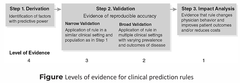
1) Creation/derivation of CPR
2) Validation of CPR
3) Assessment of impact on clinical practice

What does, creation/derivation of a CPR, mean?
Identifying factors with predictive power
What level of evidence is identifying factors with predictive power (derivation of CPR)?
Level 4
What does, validation of CPR, mean?
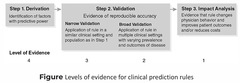
Evidence of reproducible accuracy

What are the 2 different types of validation of a CPR?
Narrow Validation
Broad Validation

What is narrow validation of a CPR?
Application of rule in a similar clinical setting and population

What level of evidence is narrow application of a CPR?
Level 3

What is broad validation of a CPR?
Application of rule in multiple clinical settings with varying prevalence and outcomes of disease
What level of evidence is broad application of a CPR?
Level 2

What does, impact analysis of a CPR (assessment of impact on clinical practice), mean?
Evidence that the rule changes the physicians behavior and improves patient outcomes and/or reduces cost

What level of evidence is impact analysis of a CPR?
Level 1

Questions to assess study credibility for CPR derivation.

What does, did investigators operationally define the sample in their study, mean and address? (CPR derivation)
Was there clearly articulated inclusion and exclusion criteria that addressed issue of sample homogeneity and its potential to achieve outcome of interest

What does, were the subjects representative of the population from which they were drawn, mean and address? (CPR derivation)
Is the sample representative of the population of interest and addresses issue of sample bias

What does, did the investigators include all relevant predictive factors in the development process, mean and address? (CPR derivation)
Start with list of all possible predictive factors and narrow down to set with most predictive value
Addresses methods for factor identification and selection
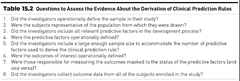
How many subjects should a study have per predictive factor? (CPR derivation)
10 subjects per predictive factor

What does, were the predictive factors operationally defined, mean and address? (CPR derivation)
Clear definition to avoid misidentification
Addresses validity of measures used to identify and quantify predictive factors

What does, did the investigators include a large enough sample size to accommodate the number of predictive factors used to derive the CPR, address? (CPR derivation)
Addresses issue of statistical power and accuracy of predictive model (10 subjects per predictive factor)

What does, were the outcomes of interest operationally defined, mean and address? (CPR derivation)
Clear definition to avoid misidentification
Addresses validity of measures used to capture outcomes

What does, were those responsible for measuring the outcomes masked to the status of the predictive factors, address? (CPR derivation)
Addresses issue for tester bias

What does, did investigators collect outcome data from all of the subjects enrolled in the study, mean and address? (CPR derivation)
Attrition for any reason may skewer outcome representation so need to do ITT analysis (5% and 20% rule)
Addresses issue of statistical power and inaccuracy

Questions to assess the evidence about the validation of clinical prediction rules.
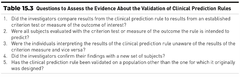
What does, did the investigators compare results from the CPR to results from a criterion test or measure for the outcome of interest, mean and address? (CPR validation)
Confirms whether outcome that CPR is intended to predict occurred
Addresses validity of CPR

What does, were all subjects evaluated with the criterion test or measure of the outcome that rule is intended to predict, address? (CPR validation)
Addresses accuracy of CPR

What does, were the individuals applying the criterion test or measure unaware/masked of the results of the CPR and vice versa, address? (CPR validation)
Issue of tester bias
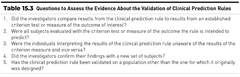
What does, did investigators confirm their findings with a new set of subjects, mean and address? (CPR validation)
Repeating on a second set of subjects matching inclusion and exclusion criteria
Addresses reproducibility of results
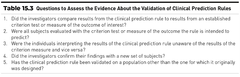
What does, has the clinical prediction rule been validated on a population other than the one for which it originally was designed, address? (CPR validation)
Usefulness of CPR in other clinical scenarios (ex. test for adults on children with similar condition)

What are additional consideration when assessing the validity of a CPR?
Is there a detailed description of:
- Setting (external validity)
- Protocol for test and measures (so clinician can perform test)
- Characteristics of sample (external validity)

Which statistics would be used for a derivation study of a CPR and why?
Regression to determine factors with most predictive value
Which statistics would be used with a validation study of a CPR and why?
Correlation coefficients to determine criterion and/or predictive validity
Which additional statistics would be used for CPR for diagnostic categories?
Sensitivity
Specificity
PPV
NPV
LR+
LR-
Which additional statistics would be used for CPR for prognostic categories?
Odds ratio
Risk ratio
Which additional statistics would be used in a CPR for response to treatment?
Combination of those used for diagnosis and prognosis
If the Ottawa ankle rule had a sensitivity of 95 to 100% what would that mean?
Negative result would rule out fracture accurately making x-ray unnecessary
(does not account for false positive so you cant rule in)
If the Ottawa ankle rule had a specificity of 40 to 50% what would that mean?
A positive test does not confirm a fracture is present so an x-ray is required
For the nomogram figure out the post-test probability based on a pre-test probability of 15%, LR- of 0.08, and LR+ of 1.5
1.5% chance of false negative
20% chance of true positive

What does a CI that includes 1 mean for LR, OR, RR?
Not significant

What additional questions should you ask before using evidence?
Is study high quality?
Are results important?
Is patient represented in sample?
Does my patient desire to know future?
Does patient believe in value of evidence?
Patient previous experiences.