Nervous Tissue
 Call Kai
 Learn
 Practice Test
 Spaced Repetition
 Match
 Flashcards
 Knowt Play
1/41

There's no tags or description
Looks like no tags are added yet.
42 Terms
Compare and contrast the various types of sensory receptors
Special sensory receptors - monitor smell, taste, vision, balance, hearing
Visceral sensory receptors - monitor internal organs
Somatic sensory receptors - monitor skeletal muscles, joints, and skin surface
Define soma
The cell body
Define perikaryon
Cytoplasm of the neuron where organelles supplying energy and organic material/neurotransmitters is
Define neurofibrils
Bundles of neurofilaments that extend into the dendrites and axon, providing internal support/prevent the cell from tearing during tensile forces
neurofilaments parallel intermediate filaments in other cells
Define dendrites
Receptive region where information is received from the internal or external environment
Dendritic spines are specialized projections that form synapses with other neurons
Define axon
Impulse generative and conducting region going away from cell
each neuron only has one
begins at axon hillock - trigger zone
lack RER and golgi apparatus so depends on the cell body to transport proteins and membrane components
Define telodendria
The terminal branches of the axon - secretory structures
Define Nissl bodies
Clusters of RER and free ribosomes in the perikaryon that stain dark purple
make up gray color of gray matter
What direction is anterograde axonal transport? What substances/components are involved?
Away from the cell body
Mitochondria
cytoskeletal elements
Membrane components for the axon plasma membrane
Enzymes needed for certain neurotransmitters
What direction is retrograde transport? What substances/components are involved?
On axon back toward cell body
organelles returning to the cell body to be degraded or recycled
For intracellular communication to let soma know about conditions at axon terminals
What are the 4 types of neuroglia in the CNS?
Astrocytes, microglia, ependymal cells, and oligodendrocytes
Major role for astrocytes
create BBB; determine capillary permeability
guide migration of young neurons and formation of synapses between neurons
mop up leaked K+; recapture and recycle neurotransmitters
Major role for microglia
Smallest and least common
phagocytic; immune roles
Major role for ependymal cells
line central canals and ventricles to produce and monitor CSF
help circulate CSF
Major role for oligodendrocytes
form myelin sheath along axons (can do for multiple)
What are the two major types of neuroglia in the PNS? What are their roles
Schwann cells - myelinate PNS
satellite cells - monitor CO2, similar to astrocytes
What are nerve fibers?
Bundles of axons that carry sensory info and motor commands in the PNS
What are the anatomical divisions of the nervous system?
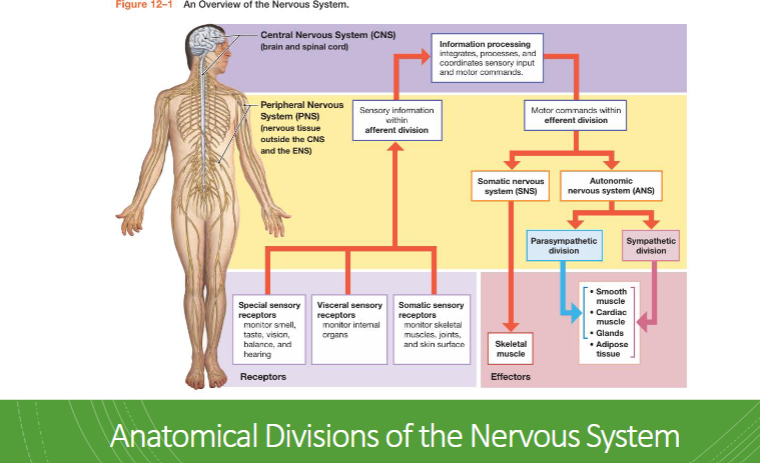
What are the major types of ion channels that influence a neuron’s membrane potential? Their roles?
Where are the different types of ion channels distributed along a neuron and how does their distribution contribute to specialized functions?
Gated
Chemical -
@ soma and dendrites
Voltage
axons - Na and K
axon terminals - Ca+
Mechanically gated
Leaky
What are the relative concentrations of Na+ and K+ inside and outside a neuron at rest?
a higher concentration of K+ in the cell
stabilized by anionic proteins
a lower concentration of Na+ outside of the cell
stabilized by Cl- ions extracellularly
Which ion channels contribute to the resting membrane potential?
Na+/K+ ATPase pumps → -5mV
stabilizing/maintains concentrations
Leaky K+ ion channels → -90 mV
Leaky Na+ ion channel → -70mV
Resting = -70mV because internal is negative
Difference in ionic composition of internal and external
Differences in permeability of plasma membrane to ions
K+ is much more able to diffuse out of the cell than for Na+ to diffuse into the cell (making inside more negative, thought Na+ also helps prevent getting to negative to some extent)

What maintains the resting membrane potential over time?
Na+/K+ ATPase
Define depolarization
Any shift away from resting membrane potential toward a less negative potential (closer to 0 or positive)
will be greater if the size of stimulus is greater (bc est. number of open Na+ channels)
Define repolarization
Process of restoring the normal resting membrane potential after depolarization
via chennels and pumps
Define hyperpolarization
An increase in the negativity of the resting membrane potential (more negative)
if gated K+ ion channels open then interior loses more K+ and become -
Define threshold
The membrane potential at which an action potential is initiated (-60mV to -55mV)
Define all-or-none response
For all excitable membranes:
size and speed of action potential are independent of the stimulus strength; either stimulus causes threshold for action potential is reached or not
Compare continuous vs saltatory propogation
How AP travel along an axon
continuous - on unmyelinated axons
relatively slow, sequential activation of VG channels each step along axon
saltatory - on myelinated axons
myelin increases resistance and allows local current to skip internodes
uses less energy because less SA and Na+ ions being pumped
How are axon fiber types classified
Axon Type A Fiber- largest myelinated axons, diameters from 4-20um, fastest
Critical sensory info: position, balance, delicate touch & pressure of skin surface
Axon Type B Fiber- smaller myelinated axons, diameters from 2-4um, intermediate speed
Temp, pain, general touch/pressure, to effectors
Axon Type C Fiber- smallest and unmyelinated, diameter < 2um, slowest
Temp, pain, general touch/pressure, CNS to effectors
What are the major differences between channel-linked and g-protein-linked receptors
Channel-linked- aka ionotropic are quicker as binding directly opens an ion channel
GPCRs- aka metabotropic are slower as effector enzymes must be activated to yield an intracellular cascade of responses
longer lasting
Compare temporal vs spatial summation
Spatial- simultaneous arrival of stimuli from different locations
Temporal- successive arrival of stimuli from the same location (at different times)
Why can’t neurons divide?
They lack centrioles, key to organizing the cytoskeleton and chromosomes during mitosis .
Only parts that can regenerate are the olfactory receptors and in the hippocampus (limbic system)
How are axons called in the CNS versus PNS?
CNS - Tracts
PNS - Nerves
How are neurons classified structurally?
Anaxonic - many small dendrites, sense organs
Bipolar - 1 axon, 1 dendrite with many processes, special sense organs
Unipolar - dendrites and axon are continuous with the cell body to the side - most sensory organs in PNS
Mulipolar - 2+ dendrites, 1 axon - motor neurons & most common
How are neurons classified functionally?
Sensory - afferent division of PNS; cell bodies in DRG; between sensory receptor and CNS (somatic and visceral) - unipolar
Motor - Away from CNS to effector organs - multipolar
Interneuron - most neurons, multipolar; do integration; between motor and sensory
Generally what are neuroglia?
nerve glue; can divide
separates and protects neurons
provides supportive FW
Phagocytes
regulate interstitial fluid
How is a change in membrane potential produced?
Anything that alters ion concentration on the two sides of the membrane
Anything that changes membrane permeability
Compare graded potentials versus action potentials
Graded - (usu.) incoming signals over a short distance (cannot go far from site of stimulation ~1mm)
Hyper or depol
Depolarization weakens with distance
no threshold
cytosol resists ion movement
summation can occur
EPSP and IPSP
action - long distance signals of axons
Depol only
has threshold before AP
no summation
no decrease in strength over tie=me
Compare the 2 types of refractory period
Absolute refractory period: First part of refractory period where all voltage-gated Na channels are either open or inactive
Relative refractory period: from whenever Na+ ions regain resting condition until membrane potential goes back to resting
Second depolarization can occur if larger-than-norm stimulus
Classify synapses - sites of communication between neurons and other cell/neuron
Electrical - has direct physical contact using connexons; potential of one cell produces local current that can affect other; fast
Chemical - more common; neurotransmitter into synaptic cleft via synaptic vesicles
e.g.
axodendritic
axosomatic
axoaxonal
dendrodendritic
somatodendritic
How are neurotransmitters functionally classified?
Effects - excit/inhib
mode of action - direct/indirect