Optics
 Call Kai
 Learn
Learn Practice Test
 Spaced Repetition
 Match
Match Flashcards
 Knowt Play
1/17

There's no tags or description
Looks like no tags are added yet.
Name | Mastery | Learn | Test | Matching | Spaced | Call with Kai | Chat |
|---|
No analytics yet
Send a link to your students to track their progress
18 Terms
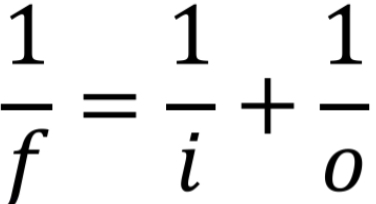
What is the mirror equation?
f
concave/converging = (+)
convex/diverging = (-)
i
real = (+)
virtual = (-)
o
always (+)
(+) > 0
(-) < 0
What is the magnification equation?
ho = height of object
always (+)
hi = height of image
upright (+) → i (-)
inverted (-) → i (+)
M
upright (+)
inverted (-)
|M|
larger (>1)
smaller (<1)
same size (=1)

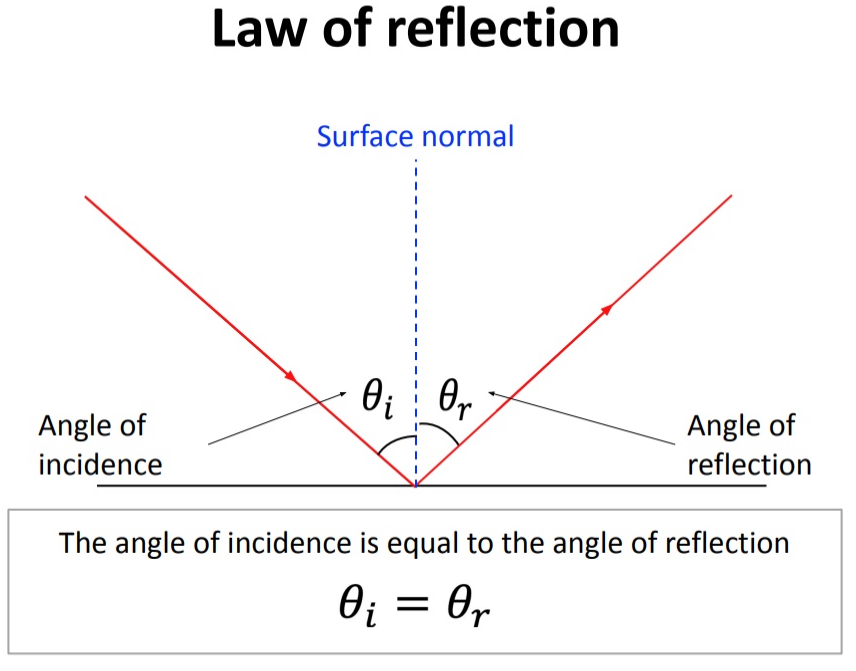
What is the law of reflection?
surface normal is perpendicular to surface from which light reflects
θi = incoming angle
θr = angle of reflection
yi and yr
Draw the diagram for concave mirrors
“inside of a spoon”
Bottom diagram
object away from focal point and mirror
real, inverted, small
Top diagram
object between focal point and mirror
virtual, upright, enlarged
Main difference
for the bottom diagram, rays don’t physically intersect
have to backtrace to make them intersect (so they’re virtual)

Real vs virtual images
Real
reflected rays physically meet
formed on same side of mirror as object
inverted
concave mirrors
Virtual
reflected rays don’t physically meet
formed on opposite side of mirror than object
upright
Sometimes concave, always convex
Concave mirrors can make _____ images, while convex mirrors can make _____ images
either real or virtual
only virtual
Draw the diagram for convex mirrors
“outside of spoon”
ALWAYS virtual, upright, smaller than object

Define each of the following:
C
R
f
What two equations can we derive from this information?
C = center of curvature
R = distance from center to mirror (aka “radius of curvature”)
f = point at which rays meet
R/2 = distance from focal point to mirror
Equations
R = 2f
f = R/2

Equations for composite multiple mirrors
M(tot) = M1 x M2 x … M(final)
M(tot) = (-i2/o2)(-i1/o1) = M1 x M2


Complete the summary table for both types of mirrors and lens
use i, o, f, and M
concave → converging
convex → diverging


What can be said about this equation?

How do o2 and i1 relate?

What are some M equations/facts we should know?

What is the most important thing to know about this system: 1 lens and 2 objects?
1 lens = 1 focal point

How to distinguish between mirrors and lens given object, focal point, or image?

How to distinguish between converging/concave and diverging/convex?
can use o and f to narrow down possibilities

If an image moves closer/farther from an mirror, how does the object move?
note: concave mirror can produce both real and virtual images

You are asked about the distance an object has moved? How can we solve this?
o2 - o1