Oligopoly
 Call Kai
 Learn
 Practice Test
 Spaced Repetition
 Match
 Flashcards
 Knowt Play
1/12

There's no tags or description
Looks like no tags are added yet.
13 Terms
Definition
a market structure in which a small number of firms dominate and control the majority of an industry or market
Characteristics
defined by the actual conduct (day to day behaviour)
imperfect competitive market industry - dominated by a few individual firms
concentration ratio measures the extent to which a market is dominated by a few leading firms
rule of thumb is that an oligopoly exists when the top 5 firms account for 60% of the market share
high barriers to enter/exit
can be homogeneous or differentiated
interdependent
Examples
Airlines
Broadband provider
vehicle manufactures
high street banks
pharmaceuticals
cinema chains
Interdependent
when decisions are made and consider the likely reaction of rival firms
few sellers, firms are aware of other firms behaviour
decision influences other firms
results in firms taking account reaction of rival firms
high level of uncertainty
causes firms be at high risk of tactic or explicit collusion
Diagram
Kinked demand curve
a. rivals do not follow price increase, leads to a loss in market share - therefore demand will be relatively elastic and rise in price will lead to a fall in revenue
b. rivals are likely to match a price fall by one firm to avoid a loss of market share. the demand curve will be more inelastic.
Kinked demand curve diagram

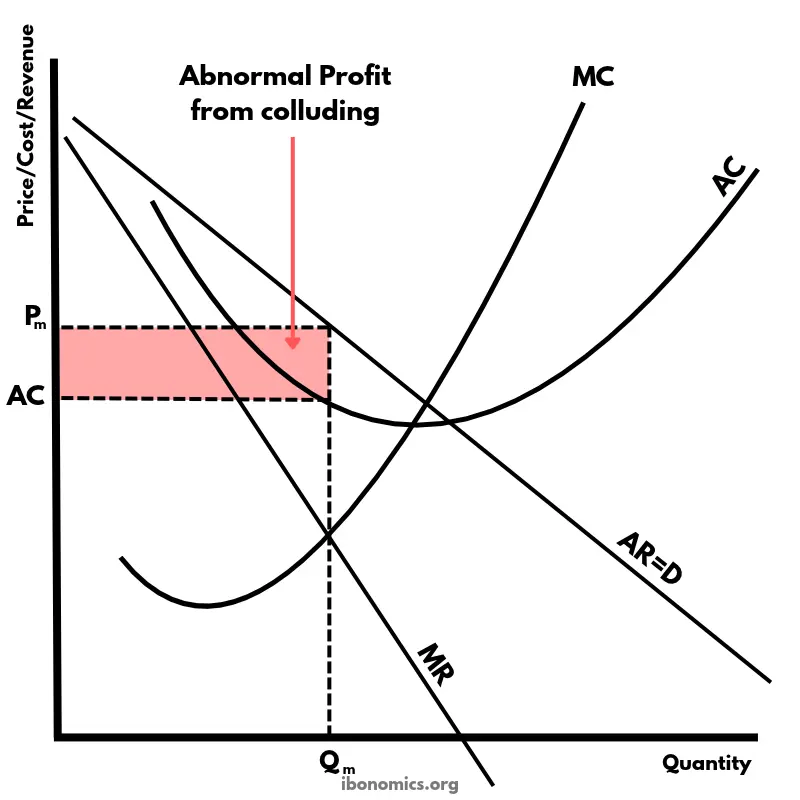
Collusion and Cartels
Collusion is a form of anti-competitive behaviour
can be horizontal, vertical, explicit v tactic collusion
some collusion between businesses is legal
legal collusion
not all instances of collusive behaviour are deemed to be illegal by the European Union Competition
Practices are not prohibited if the respective agreements contribute to improving the production of goods or to promote technical progress in a market
3 key aims of business collusion
firms in a cartel recognise their mutual interdependence and act together - main aim is to maximise joint profits
collusion lowers costs of competition
reduces uncertainty in a market and higher profits increase consumer surplus.
Price fixing (collusion) is easier when
industry regulators are weak/ineffective
penalties for collusion are low relative to the potential gains in revenues/operating profits
participating firms have a high percentage of total sales - this allows them to control the market supply.
Game theory
Model the actual behaviour of firms in a concentrated market.
Prison dilemma
select their own dominant strategy
equilibrium to where they are both on a worse option
nash suggests difficult cooperation
better to cooperate.