Electricity
 Call Kai
 Learn
 Practice Test
 Spaced Repetition
 Match
 Flashcards
 Knowt Play
1/94

There's no tags or description
Looks like no tags are added yet.
95 Terms
Electric Charge
Property of matter that experiences a force near other charges. Can be positive or negative.
What is charge measured in?
Coulombs
When do charges attract, repel or experience no force
Like charges repel, Opposite charges attract, neutral attracts to both positive and negative but does not experience any force near another neutral.
What are electrical conductors?
Conduct electricity cause they have free moving electrons
Examples of electric conductors
Copper, iron aluminum and all metals
Electric insulators
Can not conduct electricity because they dont have free moving electrons
Examples of electric insulators
Rubber, plastic wood
Which kind of material can be statically charged?
insulators
How and why can insulators be statically charged?
Rubbing as friction causes electrons to be transferred from one insulator to the other
Do protons and electrons have a charge of one ( or negative one) coulomb
NO
Why are nuetral charges attracted to positive/ negative
The neutral charge contains both negative and positive charges which balance each other out
It re arranges itself so the part of it opposite to the charge goes to the side where the charge is and the part the same and so repelled goes on the other side
What is an electric Field?
Region where charges experience a force
Field direction
Force on a positive charge at that point.
How to draw field lines
Positive to negative
When the space lines between the fields decrease, what happens
Strength of field increases
When you put oppositely charged plates next to each other what is the field called and what does it mean
Uniform field, evenly spaced field lines mostly except on the sides where it is curved kinda
If you place a charge right in between two repelling forces what happens
Nothing as there is a null space
Repelling charges diagram

Attraction between charges diagram
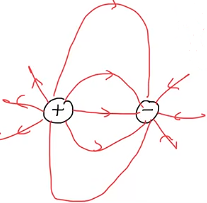
Oppositely charged plates diagram

Positive charge field lines

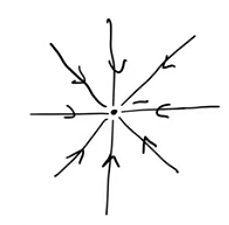
Negative charge field line
Current
Amount of charge passing through a point per unit time
Current unit
Amperes
Current formula
I = Q/t, I is current, Q is charge, t is time in seconds
What measures current
ammeter
Direct current
Current which has fixed direction and value.
Examples of direct current
Batteries and cells
Alternating Current
Current which has continuously changing direction and value
Examples of alternating current
Generator, main supplies
Conventional Flow
Current goes from positive to negative
Electron flow is from
Negative to positive
Electromotive force
Electrical work done by a source in moving a unit charge across a complete circuit
Potential Difference
Work done by a unit charge passing through a component
Voltage Formula
V = W/Q, V is voltage, W is work done and Q is charge
What measured Voltage?
Voltmeter
How is voltmeter connected?
Parallel
Resistance Voltage Current formula
R = V/I at constant temperature
Resistance formula
p L/a, p is,resistivity (dont need to know) l is length, a is area
If the radius doubles what happens to resistivity
x2² so x4
How to measure resistance of component
Measure voltage
Measure current
Use formula
Change voltage and repeat, find average
Fixed resistor at constant temperature’s resistance always
stays constant
Filament lamp’s resistance
Increases as voltage and current increase as the temperature increases causing resistance also when too cold
Current and voltage rate of increase decrease
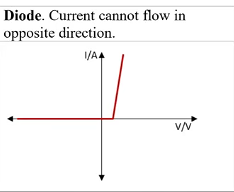
Diode IV graph and why?
Power
Transfer of energy per unit time
In cell how is energy changed
Chemical to electrical
In resistor how is energy changed
Electrical to heat
Power Formula
P = IV
Energy Formula
E = IVt I is current. V is voltage, T is time in seconds
Power unit
Watt
Kilowatt hour
Measure of electrical energy consumed by 1000W of power in one hour
How do you convert Kilo watt hour into Joules
E (kWh) x1000 ×3600 = E (J)
Variable Resistor
Length and Resistance are directly proportional, resistance can be changed
Variable resistor diagram

Thermistor
Temperature and resistance are inversely proportional.
Temperature can be changed to change resistance
Light dependent Resistor
Light intensity and resistance are inversely proportional. Light can be used to change resistance
Diode
Allows current to flow in only one direction (the direction of the arrow)
Current can not flow in the opposite direction
How can you convert AC to DC
Diode using half wave rectifier or full wave rectifier bridge
How does half way rectifier work?
Diode placed so that only when the current is passed in the right way does it flow otherwise it does not
Half way rectifier diagram of current and circuit

Full wave rectifier bridge
2 diode facing up, other facing opposite direction, connected in parallel
Full wave rectifier bridge diagram of circuit and current diagram

Light emitting diode
Emits light when current flows through it in the direction of the diode
Current in series circuit
Stays the same
Resistance in series
Total resistance is sum of all resistors
Voltage in series
Splits across components,
Calculated by finding current and resistance of component or using ratios of components
Current in parallel
Current splits, total is the sum off all the currents in junctions and stays the same
Resistance in parallel
1/ R total = 1/R1 + 1/R2, combined resistance is less than individual components
Voltage in parallel
Stays the same
Advantages of parallel over series (3)
Each component can be controlled independently having their own switch
If one component breaks it will not affect the others
Each component gets full voltage from supply
Opposite cells total voltage is
Subtracted from each other
Cells next to each other in series total voltage
Added
Potential divider
Circuit which splits voltage across two resistors in proportion to resistance
Potential divider circuit diagram

Variable potential divider
Controls potential difference across a component
Variable resistor diagram

What are the electric sockets at home called
Mains circuit
Which wires are in the mains circuit
Live, neutral, earth
What is the voltage of live wire
220 V
Which kind of current does the live wire carry
AC current
What does the live wire do?
Brings current to the appliances at high voltage
How much voltage does the neutral wire carry
0 V
What does the neutral wire do?
Carries the current back out the circuit so it closes the circuit
What does the earth wire do?
Safety feature, preventing electric shocks if a live wire touches the outer metal casing of appliances which are not insulated
Hazards of electricity
Electric shocks
Electric Fires
What causes the hazards of electricity
Damaged Insulation
Overheating Cables
Damp conditions
Excess current from overloading of plugs,extension leads, single and multiple sockets while using a mains supply
What does a fuse do?
Stops current from flowing into a circuit when the current is too high by melting
Fuse shape
Rectangle long with a straight line through
Which Fuse rating (Amperes) is the fuse set to
1-3 Ampere above what the device needs?
What does a circuit breaker do?
Stops the current from flowing into a circuit when the current is too high by using an electromagnet to trip an iron switch
Which breaking rating (amperes) should a circuit breaker be set to
1-3 Amperes above the normal operating current of a device
Circuit breaker shape
Lump with long rectangle above
Earth wire Function
Protects user from getting electrically shocked if they touch a live metal case which is not insulated
How do Fuse and earth wire work together
Due to the low resistance of the earth wire,it causes current to increase blowing the fuse, cutting off current