mcb140 miller
 Call Kai
 Learn
 Practice Test
 Spaced Repetition
 Match
 Flashcards
 Knowt Play
1/58

There's no tags or description
Looks like no tags are added yet.
59 Terms
why did thomas hunt morgan find few mutant fruitflies in the first two years of his lab?
he did not know about mutagens and how energy and chemicals can induce mutations in DNA which can then be used to accelerate mutant discovery
how can one find genes required for a biological process?
induce random mutations and do a forward genetic screen looking for mutations that disrupt that process
forward genetic screen
a genetic screen in which mutations are randomly induced across a genome and mutants display a specific phenotypic trait (e.g. curly wings)
how would you know if two recessive mutations are allelic (structural change in DNA)?
perform a systematic set of complementation tests (cross heterozygotes for each gene to heterozygotes for every other gene)
ask if a phenotype is seen in 25% of the progeny: if yes, the two mutations failed to complement and are allelic and in the same gene; if not, they complement and are in different genes
how are segments generated in fruit flies?
a genetic hierarchy of gap, pair-rule, and segment polarity in genes
segmentation gene mutation: gap genes
divides the embryo into broad multi-segment regional domains along the anterior-posterior axis
deletes contiguous blocks of segments (a large “gap” in the body plan)
specifies broad domains of segments
segmentation gene mutation: pair-rule genes
divide the embryo into periodic 7-stripe patterns corresponding to alternative segment boundaries
deletes portion of every second segment (reduces total segment number by half)
specifies every other segment
segmentation gene mutation: segment polarity genes
divides the embryo into 14 individual segment-wide units and sets anterior-posterior orientation within each segment
deletes a portion within every segment and replaces it with a mirror-image duplication of the remaining portion
specifies anterior-posterior polarity
how would you know if a genetic screen is saturated?
all loci have more than 1 allele
you stop finding new loci (genes), but find more alleles (mutants) of the same loci
problem solving tip: if there are 2+ 1s in the table = not saturated
how could you ask where the fruitfly odd-skipped mRNA is expressed in space and time in fruitfly embryos?
fix fruitfly embryos at different stages (time)
stain for odd-skipped mRNA using in situ hybridization (space): incubate the fixed embryos with the single-stranded antisense RNA probe; the probe binds specifically to target mRNA in situ (in its original place), revealing its exact spatial localization across embryonic tissues under a microscope
in situ hybridization
molecular technique used to visualize the precise spatial location of specific RNA or DNA sequences directly within intact cells or tissues
what is the key reagent of in situ hybridization?
a labeled single-stranded nucleic acid probe (antisense RNA or DNA) complementary to the target sequence
how could a riboprobe used for in situ hybridization stick to some cells but not others?
because it is complementary in sequence to a specific mRNA, if that specific mRNA is not present in a cell, the probe will not hybridize or stick to those cells
how could you ask where the fruitfly odd-skipped protein is expressed in space and time in fruitfly embryos?
fix fruitfly embryos at different stages (time)
stain for odd-skipped protein expression using immunolocalization with an antibody that recognizes and binds to the odd-skipped protein
immunolocalization
molecular technique used to visualize the precise spatial location of specific proteins directly within intact cells or tissues
what is the key reagent of immunolocalization?
specific labeled antibodies that bind target proteins
balancer chromosome
genetically engineered chromosome that carry a dominant marker (e.g. curly wings) and have large inversions that prevent recombination with wild-type chromosomes
how are balancer chromosomes useful in genetic crosses?
prevent genetic recombination (if crossing over occurs between a normal chromosome and balancer chromosome, the recombinant offspring are non-viable—> only non-recombinant chromosomes survive where surviving offspring inherit the target mutation)
carry a dominant marker that allows identification of organisms carrying the balancer chromosome
they are recessive lethal which ensures heterozygous individuals are selected for (mutant/balancer)
dominant temperature sensitive (DTS) alleles in the heidelberg screen
having one or two copies of DTS is lethal if the flies are raised at 29 degrees
when crossing mutagenized flies to DTS/balancer flies at 29 degrees, only the mutagenized chromosome survives (over the balancer genotype)
bicoid protein
acts as a morphogen (controls tissue development and pattern formation during embryonic growth) encoding a transcription factor
molecular biology definition of an enhancer
cis-acting DNA regulatory element that binds transcription factors and positively regulates the transcription of mRNA
how could you test non-coding DNA for enhancer activity in an animal?
test non-coding DNA in reporter gene assay
ligate the non-coding DNA upstream of a promoter and reporter gene that you can visualize
inject that recombinant DNA construct into multiple 1 cell embryos
let those embryos develop
look at multiple animals at any stage to ask if any cells are consistently lit up by the reporter gene and therefore must have had the enhancer gene mRNA transcribed (and translated)
how can one ask whether non-coding DNA has enhancer activity?
reporter gene assays using a protein you can see
reporter gene
gene whose protein product can easily be visualized
(examples: green fluorescent protein, lacZ)
in situ hybridization vs. reporter gene assay
in situ hybridization: used to detect a specific mRNA to assay gene expression (transcription) of a gene
reporter gene assay: tests DNA for the ability to drive expression (transcription) when connected to a minimal promoter and a reporter gene, where it is then injected into 1-cell embryos to grow up transgenic animals to then look for reporter gene expression
minimal promoter used in reporter gene assay
a promoter that by itself is not sufficient to promote transcription of a reporter gene unless an enhancer is present ligated adjacent to the reporter gene
to test enhancers in reporter gene assays, what is absolutely required?
that multiple transgenic organisms are screened
what is a major caveat of reporter gene assays in animals?
enhancer trap: because animal genomes contain many endogenous enhancers, a reporter gene can randomly integrate near one. when this happens, the reporter gene incorrectly reports the activity of that nearby endogenous enhancer rather than your intended target gene.
how can one leverage this major caveat (enhancer trap; that reporter gene assays can be activated by endogenous genomic enhancers) to find enhancers?
look at multiple injected transgenic embryos
any true enhancer activity from the candidate enhancer should be present in most embryos
could you use a strong viral promoter that was active in every eukaryotic cell to test enhancer function in animal cells?
no, this would drive reporter gene expression ubiquitously in every cell and would not allow testing for tissue-specific enhancer activity
how are the seven stripes of even-skipped regulated?
regulated by a set of largely modular enhancers, each of which drives expression in one or two stripes
these enhancers bind and are regulated both positively and negatively by the transcription factors (activators/repressors) encoded by the gap genes
how to find whether even-skipped represses the transcription of odd-skipped?
in situ hybridization in WT and even-skipped mutants for the expression of odd-skipped using a single-stranded antisense riboprobe complementary to the odd-skipped mRNA sequence
if even-skipped represses odd-skipped, you would expect to see ectopic odd-skipped expression in even segments (appearing where they don’t normally appear)
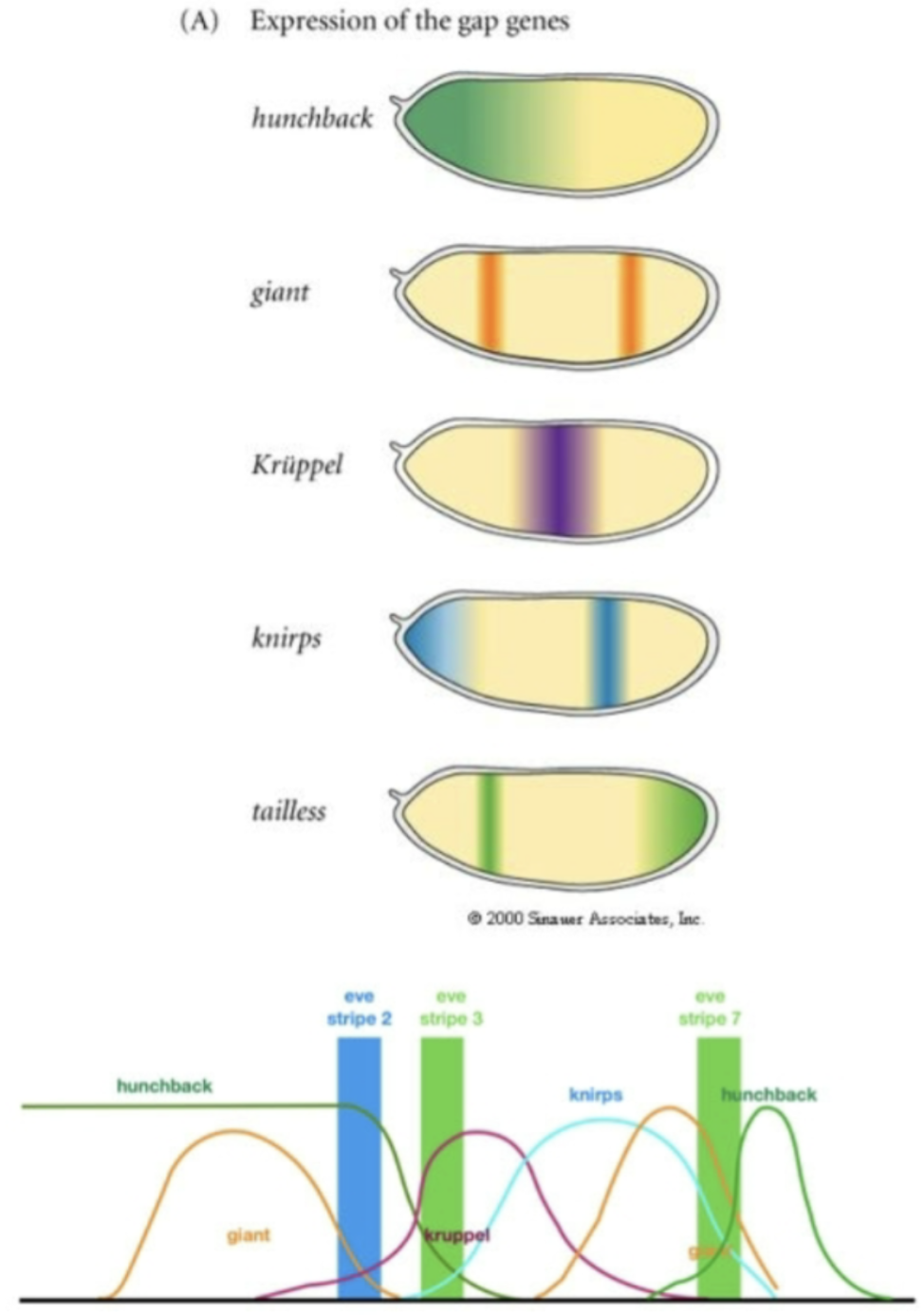
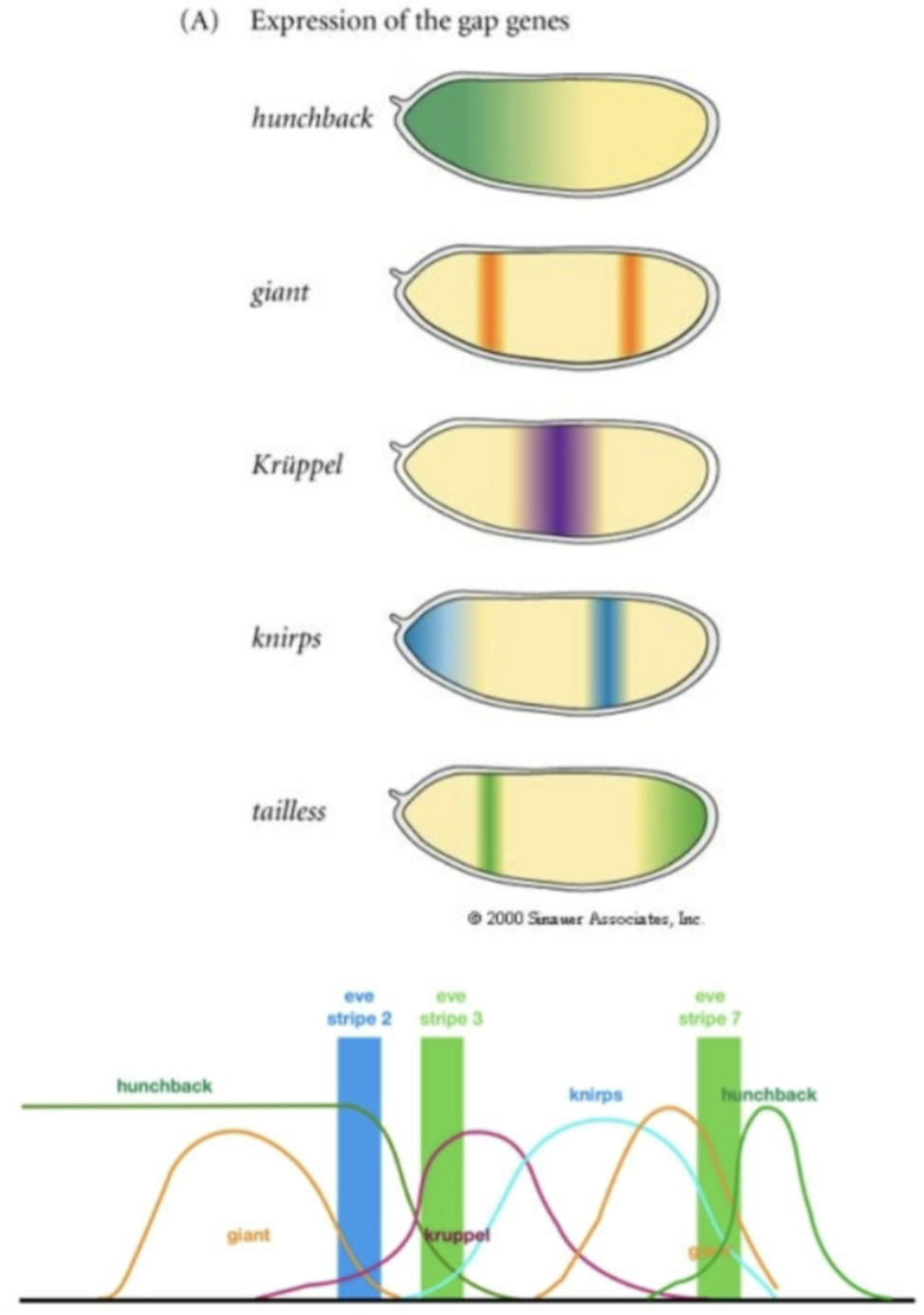
eve stripe 2
enhancer that controls the expression of the even-skipped (eve) gene in the 2nd stripe of a fruitfly embryo
activators: bicoid, hunchback
repressors: giant, kruppel

what would you expect to happen to eve stripe 2 activity if all bicoid and hunchback sites were mutated to general STAT binding sites that bind STAT activators that are ubiquitously present?
no change in expression (STAT would activate instead of bicoid and hunchback, expression would still come on in stripe 2)

what do you expect to happen to eve stripe 2 activity if all giant sites were mutated to not bind giant?
anterior expansion (giant would no longer repress stripe 2 activity in more anterior giant-expression cells)
what do you expect to happen to eve stripe 2 activity if all kruppel sites were mutated to not bind krupple?
posterior expansion (kruppel would no longer repress stripe 2 activity in more posterior kruppel-expressing cells)

what would you expect to happen to eve stripe 2 activity in a homozygous giant mutant?
anterior expansion (giant would no longer repress stripe 2 activity in more anterior giant-expressing cells)
what would you expect to happen to eve stripe 2 activity in a homozygous kruppel mutant?
posterior expansion (kruppel would no longer repress stripe 2 activity in more posterior kruppel-expressing cells)
eve stripe 3
enhancer that controls the expression of the even-skipped (eve) gene in the 3rd stripe of a fruitfly embryo
controlled by an enhancer
activators: bicoid and hunchback (low concentration)
repressors: hunchback (high concentration), giant, kruppel
eve stripe 3/7
enhancer that drives the expression of the even-skipped (eve) gene in the 3rd and 7th stripe of a fruitfly embryo simultaneously
activators: hunchback
repressors: knirps

how could kruppel repress eve stripe 3 if there are zero kruppel binding sites in the eve stripe 3/7 enhancer?
kruppel directly regulates the other gap genes, which directly regulate eve stripe 3/7 enhancer
if a dominant regulatory allele was in trans to a null allele, why would phenotype still appear?
enhancers in general work in cis not trans
what is one way that neomorphic mutations (entirely new function) can arise?
structural changes (deletions, inversions, translocations) place an intact gene coding sequence under the control of a foreign cis-regulatory element (promoter/enhancer)
(example: a genomic deletion removes the normal agouti promoter and fuses the agouti coding sequence to the strong, ubiquitous promoter of the upstream gene Raly. this causes dominant yellow fur and obesity)
what is epistasis?
when one mutation masks the effect of a mutation at another gene; a type of genetic interaction between two loci
how could you test whether two mutations with opposite phenotypes are epistatic?
make the double mutant and ask what the phenotype is
what was the specific locus test (SLT)?
mouse strain heterozygous for 7 viable visible recessive mutations
what features did the 7 genes used in the SLT share that made them useful for genetics?
all are dispensable and not required for life or health
all 7 have visible homozygous recessive phenotypes that affect the coat and eye color or ear presence so these mutant phenotypes can quickly be screened
the genotype for homozygous mice of these 7 genes are as follows: (a/a; b/b; p cch/p cch; d
se/d se; s/s). what indictes linkage? what do the semicolons represent?
linkage (same chromosome) is indicated by alleles listed between the same semicolons (e.g. d and se, p and c)
semicolons denote different chromosomes
why would new mutations be found when T-stock (test-stock) SLT males were crossed to WT, non-mutagenized females?
because mammals have a baseline spontaneous mutation rate, non-mutagenized control crosses still yield a low frequency of spontaneous loss-of-function mutations at the tested loci
how could one quantify the rate of deletions vs. point mutations?
systematic complementation crosses with the SLT comparing rate of two linked markers both being mutagenized vs. single gene rates
what is the molecular mechanism that causes Ay mice to have yellow fur?
agouti inhibits pigmentation and Ay is a gain-of-function allele resulting in ubiquitous high expression of agouti (due to a deletion that results in the regulatory elements of the 5’ gene Raly now regulating agouti), resulting in no brown/black pigment
why do Ay mice develop obesity?
ectopic (out of place) expression of agouti in the brain results in ASIP (non-agouti) mimicking the effect of AgRP (appetite-stimulating agouti-related protein) in the brain
why is the Ay allele recessive lethal in homozygous (Ay/Ay) mice?
it deletes the 5’ gene Raly which is required for embryonic development
enhancer in cis vs trans action
cis action (normal): enhancer regulates a gene on the same chromosome
trans action (extremely rare): enhancer influences a promoter located on a different chromosome
how could you test whether a dominant regulatory mutation acts in cis or trans to a linked gene of interest?
use recombination to place the dominant regulatory mutation on the same physical chromosome (cis) as a coding null allele of the gene of interest
if the dominant phenotype disappears: the mutation acts in cis (as an enhancer/promoter). it fails to drive the phenotype because the gene right next to it on the same chromosome is inactivated
if the dominant phenotype persists: the mutation acts in trans. it can still activate the functional copy on the homologous chromosome
how can one order genes into a pathway?
making double mutants and determining epistasis
is epistasis universal across alleles and species?
no, it is always context-dependent
(example: lab mice vs beach mice)
why is MC1R epistatic to agouti in lab mice?
agouti acts upstream of MC1R
agouti protein works by binding and inhibiting the MC1R receptor to block black pigment. if the MC1R receptor is mutated/missing, agouti has no receptor to inhibit (and without functional MC1R, the agouti genotype is completely irrelevant to the phenotype)
how could you test whether a mutant MC1R gene has a different function than a WT MC1R gene?
transfect cultured cells with WT or mutant MC1R, add increasing concentrations of MSH ligand (melanocyte-stimulating hormone), and measure intracellular cAMP levels (the second messenger output).
null (loss-of-function) outcome: zero cAMP production
hypomorphic (reduced function) outcome: responds to MSH, but reaches lower maximum cAMP levels than WT
constitutively active (gain-of-function) outcome: high cAMP levels