BIO 221 Exam 1
 Call Kai
 Learn
Learn Practice Test
 Spaced Repetition
 Match
Match Flashcards
 Knowt Play
1/291

There's no tags or description
Looks like no tags are added yet.
Name | Mastery | Learn | Test | Matching | Spaced | Call with Kai | Chat |
|---|
No analytics yet
Send a link to your students to track their progress
292 Terms
Which of the following structures is found only in Bacteria?
A. cell wall
B. flagellum
C. cell membrane
D. nucleus
E. lipopolysaccharide
E. lipopolysaccharide
Which of the following statements about viruses is true?
A. They have an active chemical metabolism.
B. Viruses that infect bacteria cannot infect humans.
C. They have only RNA, no protein.
D. They cannot infect bacteria.
E. They are usually surrounded by a lipid envelope.
B. Viruses that infect bacteria cannot infect humans
Which of the following is NOT caused by hydrogen bonding?
A. protein alpha helices
B. ice floats in water
C. DNA double helix
D. NaCl dissolves in water
E. Hydronium ions form in water
E. Hydronium ions form in water
What are prions?
A. Infectious proteins with no nucleic acid.
B. Very tiny virus-like particles.
C. Infectious RNA with no protein.
D. Peptidoglycan particles that affect the immune system.
E. Small cells that lack a cell membrane.
A. Infectious proteins with no nucleic acid
Taken together, the experiments of Pasteur, Tyndall and Koch demonstrated that ___________.
A. some bacteria cannot be killed
B. as long as air can be kept out, a solution can be kept sterile
C. as long as no living organisms enter a solution, it can be kept sterile indefinitely
D. sometimes an experiment must be repeated for it to work right
E. some forms of bacteria are not living organisms
C. as long as no living organisms enter a solution, it can be kept sterile indefinitely
There is much interest in using bacteriophages to kill the bacteria that cause infectious diseases in humans.
Which of the following is a valid concern about such therapy?
A. The bacterial viruses might also infect humans.
B. The bacterial viruses might carry bacterial DNA into human cells.
C. Bacterial viruses might mutate into uncontrollable “superbugs.”
D. The virus preparation might be contaminated with a few live bacterial cells.
E. The viruses might evolve into new bacterial cells.
D. The virus preparation might be contaminated with a few live bacterial cells.
Viroids are __________.
A. small virus-like particles
B. small pieces of RNA without a protein coat
C. empty protein coats without any nucleic acid
D. infectious proteins that serve as folding templates for other proteins
E. another name for plant viruses
B. small pieces of RNA without a protein coat
Archaea have ___________.
A. a nucleus
B. a cell membrane
C. peptidoglycan
D. chloroplasts
E. phosphotransferase systems
B. a cell membrane
In Pasteur's famous experiment that finally disproved spontaneous generation, bacteria grew __________
A. only in the flasks with a swan neck.
B. only in media that came in contact with air.
C. only in media that came in contact with other bacteria.
D. only once the media had been boiled.
E. in all flasks, regardless of how they were treated experimentally.
C. only in media that came in contact with other bacteria.
Tyndall repeated the same experiment but got different results. This was because ___________
A. he did not do the experiment right.
B. he used different flasks than Pasteur.
C. he was working in England, but Pasteur was working in France.
D. he did not boil the flasks for as long a time as Pasteur did.
E. the media he was trying to sterilize contained endospores.
E. the media he was trying to sterilize contained endospores.
Which of the following is currently believed to be a major difference between prokaryotes and
eukaryotes?
A. Eukaryotes are all multicellular.
B. Eukaryotes have a cytoskeletal framework inside the cytoplasm.
C. Prokaryotes all have cell walls made of peptidoglycan.
D. Eukaryotes have a nucleus surrounded by a nuclear membrane.
E. Prokaryotes have RNA, but eukaryotes have DNA.
D. Eukaryotes have a nucleus surrounded by a nuclear membrane.
Which of the following entities makes more copies of itself by acting as a template for protein folding?
A. Prion
B. Prokaryote
C. Provirus
D. Virus
E. Viroid
A. Prion
Single-celled photosynthetic organisms with nuclei and without cell walls are _________.
A. Cyanobacteria
B. Purple Sulfur Bacteria
C. Algae
D. Plants
E. Fungi
C. Algae
Which of the following statements about bacteriophage is correct?
A. They can infect both bacteria and plants.
B. They contain both DNA and RNA.
C. They are very tiny infectious RNA particles.
D. They have a protein coat.
E. They are examples of chemolithoheterotrophs.
D. They have a protein coat.
How do prions cause diseases like mad cow disease?
A. They act as a template to misfold native proteins.
B. They reproduce by inserting their DNA into host cells.
C. Their RNA interferes with the production of RNA in host cells.
D. They use the host cell's metabolism to reproduce, very much like viruses do.
E. They produce and secrete a potent neurotoxin.
A. They act as a template to misfold native proteins.
The three main branches in the phylogenetic "tree" of life are ___________.
A. Plants, Animals and Fungi
B. Bacteria, Plants and Animals
C. Prokaryotes, Eukaryotes and Archaea
D. Protozoa, Eukaryotes and Bacteria
E. Bacteria, Archaea and Eukaryotes
E. Bacteria, Archaea and Eukaryotes
Which of the following is a hallmark of protozoa, but NOT of bacteria?
A. life in extreme environments
B. endocytosis to engulf nutrients
C. saprophytic lifestyle
D. the presence of a cytoskeleton
E. two cell forms – yeast and mold
B. endocytosis to engulf nutrients
These viruses infect the bacterium Escherichia coli. Which of the following
MUST also be true?
A. They have a lipid envelope.
B. They contain no protein.
C. They cannot infect humans.
D. The viruses are prokaryotes.
E. Their diameter (white line) is less than 1 nanometer.
C. They cannot infect humans
Prions are infectious agents that contain _________.
A. protein only
B. RNA only
C. RNA and protein
D. DNA and protein
E. RNA, DNA and protein
A. protein only
We said in an early lecture that science should be "predictive." What does this mean?
A. If you repeat the same experiment, you get the same results.
B. You know in advance which experiments will work and which will not.
C. If you change a variable in an experiment, you know how the results will change.
D. You can try a completely new experiment and know in advance what the results will be.
E. You can deduce how a biological system will evolve in the future.
C. If you change a variable in an experiment, you know how the results will change.
Which of the following correctly describes comparisons between Bacteria, Eukaryotes and Archaea?
A. Archaea have no protein, just RNA.
B. Only Eukaryotes have a cytoskeletal protein network within their cells.
C. Bacteria and Eukaryotes have a nucleus; Archaea don't.
D. Only Bacteria have peptidoglycan in their cell structures.
E. Eukaryotes are a much more diverse group than the other two.
D. Only Bacteria have peptidoglycan in their cell structures.
Last semester, when he was working with bacteriophage in the lab, a student came to me and said his doctor had told him he had a viral infection. He was pretty sure he had acquired the infection from the bacteriophage he was working with in lab. What would you have told him?
A. Bacteriophage are not viruses.
B. Bacteriophage can't infect humans.
C. Bacteriophage are dimorphic. We don't use the human variety in lab.
D. Bacteriophage don't have DNA, so the infection shouldn't be too serious.
E. The student should work on his sterile technique so something like this won't happen again.
B. Bacteriophage can't infect humans.
A structure that is 50 nanometers in diameter and is composed only of protein, RNA and lipid would most likely be an example of which of the following?
A. an enveloped virus
B. a naked virus
C. a viroid
D. a prion
E. a micelle
A. an enveloped virus
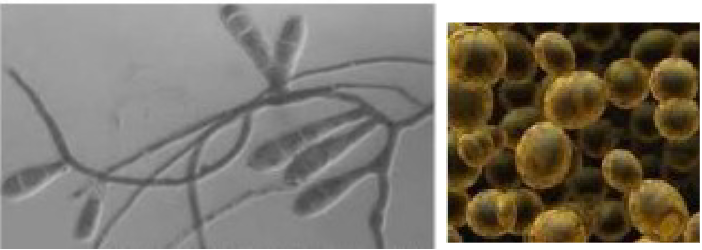
The pictures shown here represent the same organism at different stages in its life cycle. What is the organism?
A. a type of algae
B. a type of fungus
C. a protozoan
D. a bacteriophage
E. a type of archaea
B. a type of fungus
Which of the following is something that Pasteur could have concluded logically after his swan necked flask experiment?
A. Bacteria use pili to adhere to dust particles in the air.
B. Endospores are very difficult to kill and can survive boiling.
C. Bacteria need air to grow.
D. Boiling destroys microbes in broth, and they do not regrow from air.
E. Microbes can regenerate spontaneously from a "vital principle" in the broth.
D. Boiling destroys microbes in broth, and they do not regrow from air.
Saying that microbes are "diffusion limited" is the same as saying that they _____________.
A. have a cytoskeleton
B. lack an organized intracellular transport system
C. are eukaryotes
D. usually grow in an environment with a high diffusion rate
E. rely on passive diffusion for transport across their membrane
B. lack an organized intracellular transport system
What are Archaea?
A. A kingdom of Prokaryotes that lack peptidoglycan.
B. One of the two forms in the fungal life cycle.
C. An unusual type of Bacteria that grows in harsh environments.
D. One of the forms of the algal life cycle.
E. A type of virus that infects bacterial cells.
A. A kingdom of Prokaryotes that lack peptidoglycan.

What is the organism that is depicted in the
micrograph at the right (note the scale bar)?
A. A fungus
B. A bacterium
C. A virus
D. An endospore
E. A protozoan
E. A protozoan
You have discovered a new organism that is about 200 nm across its largest dimension. It contains DNA, RNA, protein and lipid. It can replicate its DNA but requires a host cell in which to do that. It appears to have no ATP generating mechanism. What is it? Why?
A. A virus because of its size.
B. A viroid because it is small but is not a virus.
C. A prokaryote because of its composition.
D. A parasitic eukaryote because of its size.
E. A prion because it has protein and can replicate.
C. A prokaryote because of its composition.
The fact that bacteria lack an endomembrane system explains their ______________.
A. small size
B. use of a peptidoglycan cell wall
C. lack of any internal structures
D. motility
E. need for a cytoskeleton
A. small size
You are examining an organism under the microscope. It is about 15 micrometers (μm) in diameter. A chemical analysis shows that it contains DNA, RNA and protein, as well as other macromolecules. You grow it on a petri dish to get a pure culture, but this time when you look at under the microscope it consists of filaments 100 μm long and 8 μm wide. Explain this.
A. You are looking at eukaryotic algae with long flagella.
B. You are looking at a culture of ciliated protozoan.
C. You are looking at a fungal culture.
D. You were looking at a virus that became contaminated with rod-shaped bacteria.
E. It is diffusion-limited when it is growing on the petri dish.
C. You are looking at a fungal culture.
We mentioned that viroids can infect and kill plant cells. How?
A. They inhibit protein synthesis by the plant cell.
B. Their DNA takes over the plant cell's nucleus.
C. They replicate to fill the plant cell's cytoplasm.
D. They cause other proteins in the plant cell to misfold.
E. Their coat interacts specifically with proteins on the plant cell wall.
A. They inhibit protein synthesis by the plant cell.
Modern Biology considers that the three domains (kingdoms) of life are _____________.
A. Bacteria, Plants and Animals
B. Prokaryotes, Eukaryotes and Viruses
C. Archaea, Eukaryotes and Plants
D. Archaea, Bacteria and Eukaryotes
E. Animal, Vegetable and Mineral
D. Archaea, Bacteria and Eukaryotes
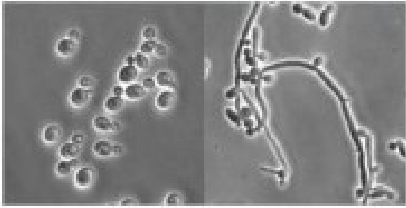
You inoculate a pure culture onto a petri dish, but when you look at the culture after it has grown, you find both organisms shown at the right. What is the best explanation for this?
A. Your pure culture was a fungus.
B. Your culture was contaminated with prokaryotes.
C. Your bacterial culture was contaminated with phage.
D. You plated a culture of algae.
E. Some of the protozoa you plated have formed spores.
A. Your pure culture was a fungus.
Eureka! You have discovered a new organism! You decide to analyze it chemically. Finding which of the following would mean that your new organism CANNOT be a virus?
A. DNA
B. RNA
C. Protein
D. Lipids
E. NADH
E. NADH
How do prions cause infectious diseases?
A. They grow inside a host cell and eventually become numerous enough to lyse it.
B. They secrete digestive enzymes that kill a host and then consume it saprophytically.
C. They misfold, and then cause other proteins to misfold, eventually damaging host cells.
D. They bind to a mRNA, preventing it from being translated into a protein that the host needs.
E. They insert their DNA into the host's DNA, thereby taking over the host cell genetically.
C. They misfold, and then cause other proteins to misfold, eventually damaging host cells.
Van der Waals (hydrophobic) interactions occur when ____.
A. one ion interacts with an ion of opposite charge
B. a random charge fluctuation sets up a transient dipole in a non-ionic molecule
C. a polar molecule interacts with an ion
D. a polar molecule with a dipole interacts with another polar molecule
E. two molecules get closer together than the\ would in a covalent bond
B. a random charge fluctuation sets up a transient dipole in a non-ionic molecule
Two molecules with polar covalent bonds are attracted to each other. The resulting bond could be a _____.
A. Hydrogen bond
B. van der Waals bond
C. Polar covalent bond
D. Nonpolar covalent bond
E. Ionic bond
A. Hydrogen bond
Weak bonds are caused by ____________.
A. partial electron sharing
B. electron sharing
C. charge interactions
D. atoms with lighter nuclei than normal
E. adding heat to strong bonds
C. charge interactions
Why is it important that most intermolecular interactions in cells are weak bonds?
A. More energy is released when it is broken.
B. It takes more energy to form them.
C. Very few strong bonds can occur in an aqueous solution.
D. Fewer of them are needed to hold molecules together.
E. They are more easily reversible.
E. They are more easily reversible.
What happens when water hydrates itself?
A. Molecules stick together and become cohesive.
B. It expands and freezes.
C. It can not be transported through aquaporins anymore.
D. H3O+ and OH- ions form.
E. Water cannot hydrate itself.
D. H3O+ and OH- ions form.
Which of the following CANNOT participate in hydrogen bond formation?
A. the C in C=O
B. the H in N-H
C. the N in N-H
D. the H in C-H
E. the O in O-H
D. the H in C-H
The pH inside a bacterial cell is 7. The pH outside is 6. What is the size of the H+ gradient?
A. You need more information to answer this question.
B. There are twice as many protons outside as inside the cell.
C. There is one more proton inside the cell than outside.
D. There are 10 times as many protons inside the cell as outside.
E. There are 10 times as many protons outside the cell as inside.
E. There are 10 times as many protons outside the cell as inside.
Which of the following can serve as a hydrogen bond donor?
A. The H in an N-H bond
B. The H in a B-H bond
C. The H in a C-H bond
D. The O in a C=O bond
E. The O in a P=O bond
A. The H in an N-H bond
A C-C bond in molecule A undergoes a random charge fluctuation. As molecule A comes close to a
C-C bond in molecule B, what will happen to molecule B?
A. It will form a covalent bond with molecule A.
B. It will form a polar-covalent bond with molecule A.
C. It will hydrogen bond with molecule A.
D. A dipole will be induced which will weakly attract molecule B to molecule A.
E. Nothing will happen. These molecules cannot interact.
D. A dipole will be induced which will weakly attract molecule B to molecule A.
The hydrophobic effect is used to explain ____.
A. the concept of pH
B. how micelles form in an aqueous environment
C. the ability of nonpolar molecules to form van der Waals bonds
D. the mechanism of dehydration synthesis reactions
E. why H2O has a high heat capacity
B. how micelles form in an aqueous environment
Which of the following pairs of atoms may be involved in hydrogen bond formation, either as donor or acceptor?
A. C-H
B. P=O
C. C=C
D. S-H
E. Na-Cl
B. P=O
A difference between strong bonds and weak bonds is that ____.
A. only strong bonds have enough energy for use in living cells
B. weak bonds can be formed by simple enzymes; strong bonds require heat input to form
C. weak bonds are polar covalent; strong bonds share electrons equally
D. weak bonds involve temporary electron sharing between two atoms
E. weak bonds involve charge attraction between two molecules or within a large molecule
E. weak bonds involve charge attraction between two molecules or within a large molecule
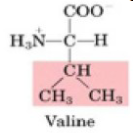
Proteins with the amino acid valine on their surface often stick together when placed in water. Why?
Here is the structure of the amino acid valine:
A. Valine forms H-bonds with water.
B. Valine forms H-bonds with other valine molecules rather than with water.
C. Valine is attached to other valine by very strong van der Waals interactions.
D. Due to the hydrophobic effect, H2O forms a network of H-bonds around collected valines.
E. Valine's R-group forms covalent bonds with other valine R-groups.
D. Due to the hydrophobic effect, H2O forms a network of H-bonds around collected valines.
The pH of bacterial cytoplasm is 7, and the pH of the environment where the bacterium is growing is 5. How much difference is there in the H+ concentration between the inside and outside of the bacterial cell?
A. The outside of the cell has 100 times as many protons as the inside.
B. The inside of the cell has 100 times as many protons as the outside.
C. The outside of the cell has twice as many protons as the inside.
D. The inside of the cell has twice as many protons as the outside.
E. The inside of the cell has 2 more protons than the outside.
A. The outside of the cell has 100 times as many protons as the inside.
Which of the following statements is true about polar covalent bonds (P.C.B.s)?
A. The atoms in a P.C.B. must have equal electronegativity values.
B. P.C.B.s are characterized by a temporary dipole moment.
C. Hydrogen bonds are one example of a P.C.B.
D. P.C.B.s are a type of weak molecular interaction.
E. Electrons in a P.C.B. spend more time around one of the bond atoms than the other.
E. Electrons in a P.C.B. spend more time around one of the bond atoms than the other.
What advantage is it for biological systems to use hundreds of weak bonds rather than one strong bond to hold two molecules together?
A. Weak bonds are better suited to enzyme-catalyzed reactions than strong bonds are.
B. It takes less energy to make hundreds of weak bonds than to make one strong bond.
C. Tetrahedral carbon atoms form weak bonds more readily than strong bonds.
D. Weak bonds can be broken with less energy input than strong bonds.
E. It is not. Biological molecules are joined more by strong bonds than by weak bonds.
D. Weak bonds can be broken with less energy input than strong bonds.
Which of the following is a consequence of water forming hydrogen bond networks?
A. Water dissolves polar molecules and ions easily.
B. Hydrophobic molecules form micelles in water.
C. Water evaporates more easily than most other solvents.
D. Water consists of mostly H3O+ and OH ions.
E. The hydrophobic effect only occurs in the absence of water.
A. Water dissolves polar molecules and ions easily.
An acidophilic bacterium lives in an environment with an external pH of 3. There are approximately _______________.
A. 4 times as many H+ outside than inside the cell
B. 4 times as many H+ inside than outside the cell
C. 10,000 times as many H+ outside than inside the cell
D. 10,000 times as many H+ inside than outside the cell
E. There is no way to estimate this without further information.
C. 10,000 times as many H+ outside than inside the cell
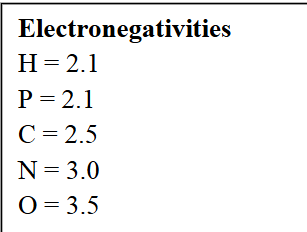
Which of the following could be a hydrogen bond acceptor?
A. The C in a C-H bond.
B. The N in a C-N bond.
C. The P in a P-O bond.
D. The N in an N-O bond.
E. The H in a C-H bond.
B. The N in a C-N bond.
What makes a biological strong bond?
A. It forms spontaneously without the involvement of enzymes.
B. A large electronegativity difference between atoms in the bond
C. A large number of charge interactions
D. Hydration by water
E. Electron sharing between atoms in the bond
E. Electron sharing between atoms in the bond
How can the R-group of leucine interact with the R-group of valine?
A. A hydrogen bond can form between the CH3 groups of the two amino acids.
B. CH3 hybridization forms tetrahedral carbon atoms that interact covalently.
C. Leucine's R-group can ionize and be attracted to opposite ions in valine.
D. A temporary dipole in leucine's R-group can induce another dipole in valine.
E. These two R-groups cannot interact since there are no bonding forces between them.
D. A temporary dipole in leucine's R-group can induce another dipole in valine.
Which of the following is a consequence of the unique structure of water molecules?
A. Water interacts with the fatty acid groups of phospholipids.
B. The density of solid H2O is greater than that of liquid H2O.
C. There are a small number of ions even in pure water.
D. Water evaporates more easily than other molecules with the same mass.
E. As water is heated, more hydrogen bonds form between H2O molecules.
C. There are a small number of ions even in pure water.
Two molecules are composed of the same atoms, but the molecules have different molecular weights. This can be explained by the existence of ________.
A. isomers
B. isotopes
C. ions
D. sp3 orbital hybridization
E. a dipole moment
B. isotopes
In a biological context, which of the following describes a strong bond?
A. All biological bonds are strong, otherwise cells would disintegrate.
B. An attraction between molecules with multiple charges.
C. Any molecular interaction that requires energy input to break apart.
D. Many hydrophobic interactions between lipid tails in the cell membrane.
E. Electron sharing between atoms with an electronegativity difference less than 1.6
E. Electron sharing between atoms with an electronegativity difference less than 1.6

Which of the atoms in the structure at the right could be a H-bond donor? A H-bond acceptor?
A. Donor = a; Acceptor = b
B. Donor = a; Acceptor = d
C. Donor = c; Acceptor = d
D. Donor = d; Acceptor = b
E. This molecule has no H-bond donors or acceptors.
A. Donor = a; Acceptor = b
Which of the following is most important in the formation of micelles from a collection of
phospholipids? Why?
A. The van der Waals interactions between the lipid tails because there are so many of them.
B. The H-bonds between the fatty acids because they hold the lipids close enough together that the micelle can form.
C. The covalent bonds between the phosphate head groups because they are strong enough to keep water out of the interior of the micelle.
D. The hydrophobic effect, since without water the micelle will fall apart.
E. ATP, because it provides the energy needed for micelles to form.
D. The hydrophobic effect, since without water the micelle will fall apart.
To make ATP, a bacterium needs a △pH of about 2. Assume ions can pass through porins freely. If the bacterium is growing in a neutral solution, what must be the proton concentration in the bacterial cytoplasm?
A. 102 molar
B. 109 molar
C. 10-9 molar
D. 10-2 molar
E. 2 molar
C. 10-9 molar
What can you say about the element Phosphorus from its entry in the periodic table?
A. It has two very common isotopes.
B. With a full outer energy shell it would be a (-3) ion.
C. One isotope has a +5 charge.
D. It has 2 unpaired electrons in bonding orbitals.
E. In its ionic form it has 15 neutrons.
B. With a full outer energy shell it would be a (-3) ion.

The amino acid depicted on the right can participate in what sort of tertiary interactions?
A. van der Waals interactions
B. Ionic interactions
C. Covalent bonds
D. Hydrogen bonds
E. Strong bonds but only if there is a lot of it
A. van der Waals interactions
Which of the following is NOT a description of the hydrophobic effect?
A. The force that causes membranes to form.
B. The surroundings of nonpolar substances by water.
C. A transient interaction between temporary dipoles.
D. The reason why nonpolar amino acids are buried inside a protein.
E. Occurs because water molecules H-bond with each other as frequently as possible.
C. A transient interaction between temporary dipoles.
Enzyme X has the amino acid threonine in its active site. A mutation that replaced threonine with valine would likely have what effect on enzyme X?
A. It would have very little effect.
B. It would cause the active site to become partially denatured.
C. It would cause the active site to become an allosteric site.
D. It would cause the enzyme to completely denature.
E. It would denature alpha helices, but not beta sheets.
B. It would cause the active site to become partially denatured.
We cannot digest cellulose, though bacteria can, because _____________.
A. we cannot deal with the many branches in the polymer
B. cellulose is too highly crosslinked by H-bonds for our digestive system
C. we cannot make cellulose storage polymers, but bacteria can
D. we cannot digest β-glycosidic bonds, but bacteria can
E. cellulose is a polymer of sugars and amino acids, much like peptidoglycan
D. we cannot digest β-glycosidic bonds, but bacteria can
Nucleic acids are put together from their monomers, nucleotides, with ___________ bonds.
A. phosphodiester
B. phosphate
C. peptide
D. parallel
E. ionic
A. phosphodiester
Rank the following lipids in order from MOST SOLID to LEAST SOLID at room temperature.
(1) Saturated lipids (2) Cis-unsaturated lipids (3) Trans-unsaturated lipids
A. MOST SOLID (1) > (2) > (3) LEAST SOLID
B. MOST SOLID (3) > (2) > (1) LEAST SOLID
C. MOST SOLID (1) > (3) > (2) LEAST SOLID
D. MOST SOLID (3) > (1) > (2) LEAST SOLID
E. MOST SOLID (2) > (1) > (3) LEAST SOLID
C. MOST SOLID (1) > (3) > (2) LEAST SOLID

In the following depiction of a phospholipid membrane, what represents the fatty acid component of the membrane?
D

What is wrong with this model of a nucleic acid molecule on the right?
A. A does not pair with U.
B. The bases are not attached to the correct carbon.
C. The phosphodiester bonds are not represented correctly.
D. G׃C should have only two hydrogen bonds and A•U one.
E. The model is not antiparallel.
E. The model is not antiparallel.
Which of the following is NOT true of cellulose?
A. It has intramolecular hydrogen bonds.
B. It is branched.
C. It is linked β-1,4.
D. It contains just one glucose isomer.
E. It is considered biodegradable, even though humans cannot digest it.
B. It is branched.
Bacteria can vary the lipids they use in their membrane, depending on the temperature. The goal is to keep the membrane from melting but not allowing it to get so solid that proteins cannot move around. How would the membrane of a psychortroph growing at 28oC compare to the membrane of the same organism growing at 5oC?
A. It would have more saturated lipids at 5oC.
B. It would melt at 5oC.
C. It would have more cis-unsaturated lipids at 5oC.
D. It would consist of all trans-unsaturated lipids at 5oC.
E. It would solidify at 5oC
C. It would have more cis-unsaturated lipids at 5oC.
Amphipathic phospholipids form a membrane bilayer if placed in water. What would happen if the membrane were placed in a nonpolar solvent?
A. The bilayer would fall apart and form a thin monolayer on top of the solvent.
B. It would form a micelle.
C. It would turn inside out.
D. The phospholipids would no longer be amphipathic
E. Nothing, because it is amphipathic. It would be the same as in water.
C. It would turn inside out.
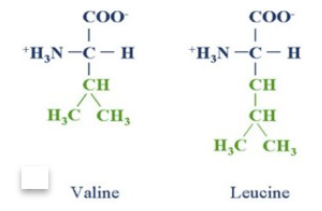
In a protein tertiary structure, the side chains (R-groups) of the amino acids valine and isoleucine could interact by ________.
A. van der Waals interactions
B. hydrogen bonding
C. ionic interactions
D. covalent bonding
E. polar covalent bonding
A. van der Waals interactions
Which of the following does NOT involve hydrogen bonding?
A. Ice floats in water.
B. DNA forms a double helix.
C. Lipids form from fatty acids and glycerol.
D. Evaporation of sweat cools your body.
E. Water striders (insects) can walk on the surface of a pond.
C. Lipids form from fatty acids and glycerol.
Which of the following describes the hydrophobic effect?
A. Temporary charge interactions between hydrophobic molecules.
B. Covalent bonds between hydrogen and carbon.
C. Hydrogen bonding of water around hydrophobic molecules.
D. Formation of H3O+and OH from 2 H2O.
E. Ions surrounded by charge-coordinated water molecules.
C. Hydrogen bonding of water around hydrophobic molecules.
In a protein alpha helix, hydrogen bonds form between ____________.
A. purine and pyrimidine nucleotides
B. R-groups (side chains) of the polar amino acids
C. the sugars ribose and deoxyribose
D. the chiral carbon atoms of the amino acids
E. atoms in the peptide bonds that join amino acids together
E. atoms in the peptide bonds that join amino acids together
A great deal of the structure of a bacterium is composed of carbohydrates. Which of the following structures does NOT involve carbohydrates?
A. LPS (lipopolysaccharide)
B. Carboxysomes
C. Peptidoglycan
D. Glycocalyx
E. Starch granules
B. Carboxysomes
A nucleic acid polymer is formed by ______________.
A. Phosphodiester bonds between 5' and 3' carbon atoms
B. Phosphodiester bonds between 5' and 2' carbon atoms
C. Phosphate -Phosphate ionic interactions
D. Peptide bonds between alpha carbon atoms
E. Parallel bonds between alpha and beta carbon atoms
A. Phosphodiester bonds between 5' and 3' carbon atoms
Which of the following lipids would be the most fluid at room temperature?
A. Phospholipids
B. Lipids with 3 saturated fatty acids
C. Lipids with mixed cis- and trans-unsaturated fatty acids
D. Lipids with 3 cis-unsaturated fatty acids
E. Lipids with 3 trans-unsaturated fatty acids
D. Lipids with 3 cis-unsaturated fatty acids
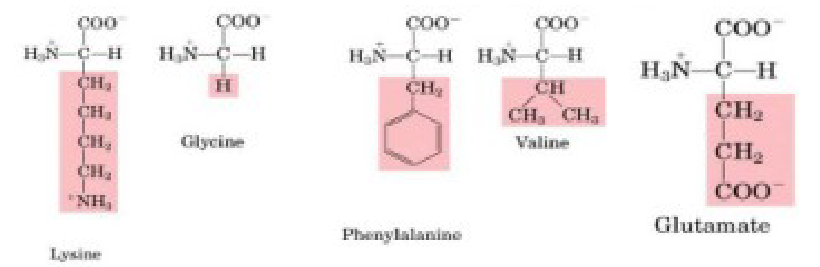
Which of the following amino acids does NOT have D- and L-stereoisomers?
A. Phenylalanine
B. Glycine
C. Glutamate
D. Valine
E. Lysine
B. Glycine
Alpha helices and beta pleated sheets ____________.
A. both involve hydrogen bonding among amino acid R-groups
B. both require enzymes for them to form
C. are both considered to be protein secondary structures
D. both involve hydrophobic interactions in addition to hydrogen bonds
E. cannot be digested by humans, but can be digested by bacteria
C. are both considered to be protein secondary structures

This reaction is an example of ______________.
A. hydrolysis
B. oxidation
C. reduction
D. condensation
E. transpeptidation
A. hydrolysis
Why is it important to understand that glycosidic bonds can have both alpha and beta anomers (that there can be α and β glycosidic bonds)?
A. Though α-glycosidic bonds are not common; they are found in peptidoglycan.
B. Alpha bonds are helical and beta are flat. This is important for protein function.
C. It is much harder to digest β-glycosidic bonds. Only bacteria can do it.
D. Beta glycosidic bonds can participate in hydrogen bonding; alpha glycosidic bonds cannot.
E. Alpha glycosidic bonds form spontaneously. Beta glycosidic bonds require enzyme catalysis.
C. It is much harder to digest β-glycosidic bonds. Only bacteria can do it.
This is the structure of the DNA synthesis inhibitor and antiviral drug AZT. How does AZT interfere with the structure of nucleic acids so much that it can be used as an antiviral?
A. Its nitrogenous base cannot form H-bonds.
B. It does not have a sugar in its structure.
C. Its 5' end cannot participate in a dehydration synthesis reaction.
D. Its 3' end cannot participate in a dehydration synthesis reaction.
E. Its base has an alpha linkage to its sugar rather than a beta linkage.
D. Its 3' end cannot participate in a dehydration synthesis reaction.
Condensation reactions ____________.
A. usually requires energy input
B. are usually catabolic
C. are classed as reduction reactions
D. are classed as oxidation reactions
E. involve an –OH from one molecule and a –C=O from another
A. usually requires energy input
How is hydrogen bonding involved in the structure of cellular lipid molecules?
A. Fatty acids join glycerol by hydrogen bonds.
B. More hydrogen bonds cause straighter phospholipids.
C. The many C-H groups in fatty acids can form an extensive hydrogen bonded network.
D. Proteins and lipids join by hydrogen bonding to form biological membranes
E. Hydrogen bonding is not involved in the structure of a lipid molecule.
E. Hydrogen bonding is not involved in the structure of a lipid molecule.
Which of the following is true about a condensation reaction?
A. It involves loss of water from the cell in a hypertonic environment.
B. It generally requires energy input.
C. It is one way cells can "break down" long polymers.
D. It is usually regarded as a catabolic reaction.
E. An example is the following reaction at right.
B. It generally requires energy input.
What is a disulfide bond?
A. A type of bond that holds carbohydrate polymers together.
B. A bond found in alpha helices and beta sheets.
C. A type of hydrophobic bond between cysteine amino acids.
D. A bond between the sulfur atoms in a DNA double helix.
E. A covalent bond that is involved in forming protein tertiary structures.
E. A covalent bond that is involved in forming protein tertiary structures.
In which of the following polymers would you find alpha glycosidic bonds?
A. Peptidoglycan
B. Proteins
C. Starch
D. Cellulose
E. DNA
C. Starch

Which of the carbon atoms in this nucleotide could be the 3' end of a DNA molecule?
A. A
B. B
C. C
D. D
E. E
D. D
Which of the following is a correct reference to a hydrolysis reaction?
A. It is a type of anabolic reaction.
B. Carrying it out releases energy.
C. It is a type of oxidation reaction.
D. It is a reaction that cells use to break weak bonds.
E. An example is the reaction at right.
B. Carrying it out releases energy.
Beta sheets _____________.
A. are bonds found in cellulose
B. involve peptide bond amino groups as H-bond donors
C. may involve H-bonds between the R-groups of nonpolar amino acids
D. may involve H-bonds between the R-groups of polar amino acids
E. are a type of structure in which D-amino acids are more common than L-amino acids
B. involve peptide bond amino groups as H-bond donors
Which of the following would NOT require enzyme catalysis?
A. Folding of a protein into an alpha helix
B. Condensation of two amino acids to form a peptide bond
C. "Breaking down" a protein's primary structure
D. Interaction between the R-groups of two cysteine amino acids
E. Rotation of proline's R-group by 180 degrees
A. Folding of a protein into an alpha helix
Which of these is NOT a correct description of a double stranded nucleic acid?
A. The 5' ends are phosphorylated, and the 3' ends are hydroxylated.
B. The 5'-to-3' direction on one strand is opposite to the 5'-to-3' direction on the other strand.
C. The sugars in the monomer structures come from the Pentose Phosphate Pathway.
D. Purines must hydrogen-bond with other purines and pyrimidines with pyrimidines.
E. Each strand is synthesized by forming covalent phosphodiester bonds between monomers.
D. Purines must hydrogen-bond with other purines and pyrimidines with pyrimidines.
It is important for a bacterium to keep its membranes from either melting or solidifying as the temperature of the environment changes. Membranes of psychrophilic bacteria must therefore have more than membranes of mesophiles.
A. cis-unsaturated lipids
B. trans-unsaturated lipids
C. saturated lipids
D. lipopolysaccharide
E. phosphate groups
A. cis-unsaturated lipids
What is our best description of a biological membrane?
A. Mostly protein with a few phospholipids scattered among the proteins.
B. Mostly phospholipids with a few peripheral and integral membrane proteins.
C. About 50% protein with phospholipids grouped in mobile rafts between the proteins.
D. The inside part of the membrane is phospholipid; the outside part is protein.
E. The outside part of the membrane is phosphate, the inside part is lipid.
C. About 50% protein with phospholipids grouped in mobile rafts between the proteins.
Which of the following is true about weak bonds in protein tertiary structure?
A. It is important for protein function that they can form and break spontaneously.
B. They only occur when cysteine is present in the protein's primary structure.
C. They form between amino groups and carboxyl groups within peptide bonds.
D. They form only between amino acids with nonpolar R-groups.
E. They include the structure O=C - - - N−H.
A. It is important for protein function that they can form and break spontaneously.