chem c16 solubility equilibria
 Call Kai
 Learn
 Practice Test
 Spaced Repetition
 Match
 Flashcards
 Knowt Play
1/8

There's no tags or description
Looks like no tags are added yet.
9 Terms
How do you predict if precipitation occurs when mixing two solutions?
Calculate new concentrations after mixing (account for increased total volume)
Calculate the ionic product using these new concentrations
Compare ionic product with ( K_{sp} ):
If ionic product \( > K_{sp} \) → precipitation occurs ✅
If ionic product \( \leq K_{sp} \) → no precipitation ❌
Can Ksp values be directly compared to determine relative solubility?
Only if the total number of ions per formula unit is the same for both salts.
e.g. ( AgCl ) and ( AgBr ) both give 2 ions → direct comparison valid → higher \( K_{sp} \) means higher solubility.
But ( AgCl ) (2 ions) vs \( Ag_2CrO_4 ) (3 ions\) → cannot directly compare \( K_{sp} \); must calculate and compare actual solubility values.
How does complex ion formation affect solubility?
Complex ion formation increases the solubility of a sparingly soluble salt.
When a ligand (e.g. ( NH_3 )) reacts with the metal ion to form a complex:
\( [M^{b+}] \) decreases
Equilibrium of dissolution shifts right
More solid dissolves
Example: ( AgCl ) dissolves in excess \( NH_3(aq) \): \( Ag^+(aq) + 2NH_3(aq) \rightleftharpoons [Ag(NH_3)_2]^+(aq) \)

Define solubility product Ksp
\( K_{sp} \) is the equilibrium constant for the equilibrium between an undissolved sparingly soluble salt and its constituent ions in a saturated solution.
For \( M_aX_b(s) \rightleftharpoons aM^{b+}(aq) + bX^{a-}(aq) \):
\( K_{sp} = [M^{b+}(aq)]^a[X^{a-}(aq)]^b \)
Units: \( (\text{mol dm}^{-3})^{a+b} \)
\( K_{sp} \) only varies with temperature

What is the ionic product and how is it used to predict precipitation?
Ionic product = \( [M^{b+}]^a[X^{a-}]^b \) using instantaneous (not equilibrium) concentrations.
Ionic product \( < K_{sp} \): unsaturated → no precipitation
Ionic product \( = K_{sp} \): just saturated → no precipitation
Ionic product \( > K_{sp} \): supersaturated → precipitation occurs until ionic product \( = K_{sp} \)

What is the common ion effect?
The common ion effect is the reduced solubility of a sparingly soluble salt in a solution that already contains an ion common to that salt.
Adding a common ion increases its concentration → equilibrium shifts left → more solid precipitates → solubility decreases.
Example: Adding ( NaCl ) to a saturated ( AgCl ) solution increases \( [Cl^-] \) → more ( AgCl ) precipitates.
How does adding acid affect solubility of salts with basic anions?
For sparingly soluble salts whose anion is the conjugate base of a weak acid (e.g. \( CO_3^{2-} ), ( PO_4^{3-} ), ( OH^- )\):
Adding ( H^+ ) reacts with the basic anion: \( PO_4^{3-}(aq) + H^+(aq) \rightleftharpoons HPO_4^{2-}(aq) \)
This decreases \( [X^{a-}] \) → equilibrium of dissolution shifts right → salt dissolves → solubility increases. 🧪

How do you calculate (Ksp) from solubility ( s )?
Let solubility \( = s\ \text{mol dm}^{-3} \)
For \( M_aX_b(s) \rightleftharpoons aM^{b+}(aq) + bX^{a-}(aq) \):
\( [M^{b+}] = as \;\; and \;\; [X^{a-}] = bs \)
\( K_{sp} = (as)^a(bs)^b \)
Example for \( Mg(OH)2 \): \( K{sp} = [Mg^{2+}][OH^-]^2 = s(2s)^2 = 4s^3 \)

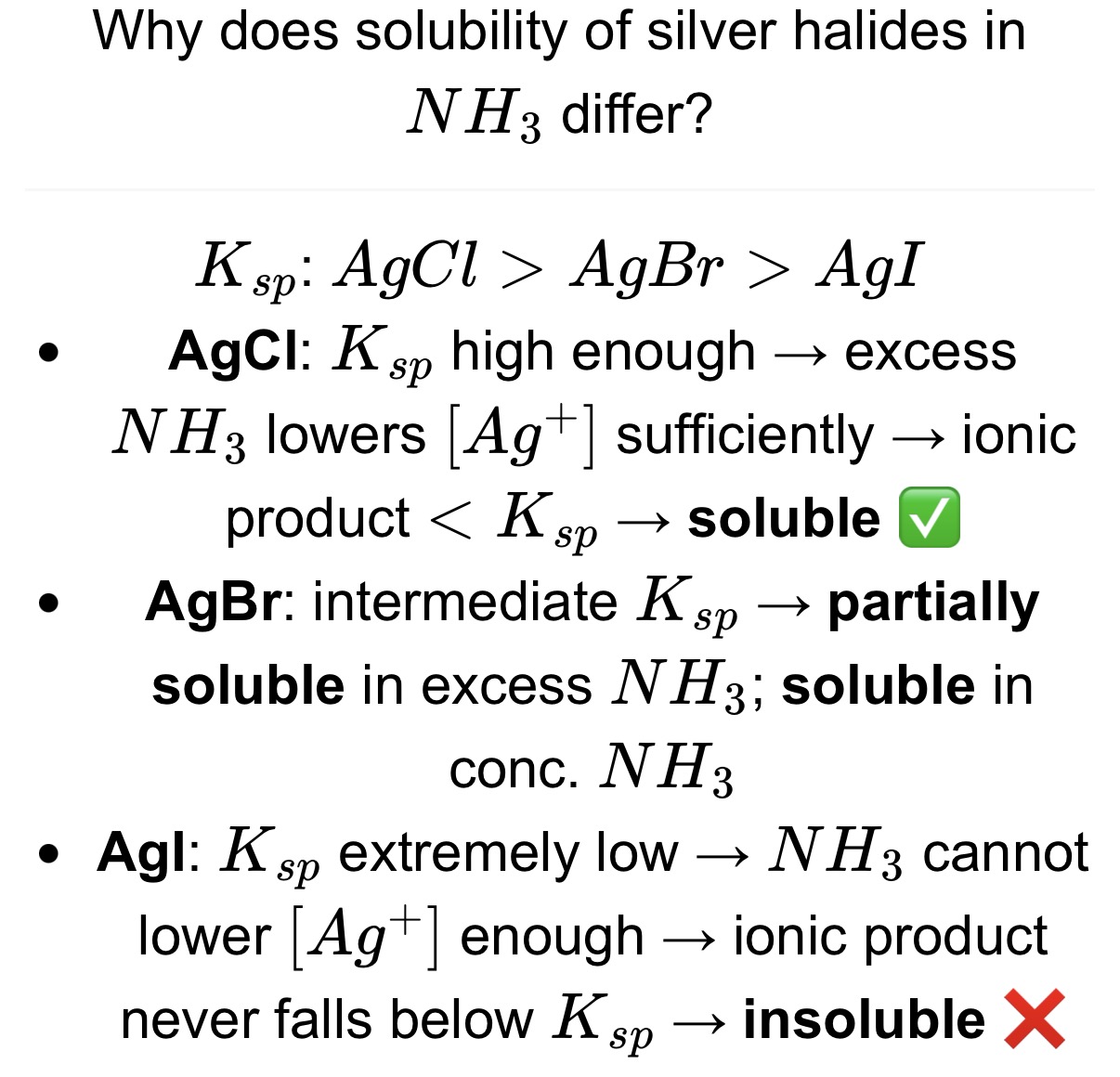
Why does solubility of silver halides in \( NH_3 \) differ?
\( K_{sp} \): \( AgCl > AgBr > AgI \)
AgCl: \( K_{sp} \) high enough → excess \( NH_3 \) lowers \( [Ag^+] \) sufficiently → ionic product \( < K_{sp} \) → soluble ✅
AgBr: intermediate \( K_{sp} \) → partially soluble in excess \( NH_3 \); soluble in conc. \( NH_3 \)
AgI: \( K_{sp} \) extremely low → \( NH_3 \) cannot lower \( [Ag^+] \) enough → ionic product never falls below \( K_{sp} \) → insoluble ❌