Lecture 15: Mass Spectrometry
 Call Kai
 Learn
 Practice Test
 Spaced Repetition
 Match
 Flashcards
 Knowt Play
1/32

There's no tags or description
Looks like no tags are added yet.
33 Terms
What can mass spec help us do?
Information gained:
Elemental composition of matter
Structure of inorganic, organic and biological molecules
Qualitative and quantitative composition of complex mixtures
Structure and composition of solid surfaces
Isotopic ratios of atoms in sample
Application for routine chemical analysis since early 1940s
Identifying structures in organic chemistry
Possible to produce ions from non-volatile or thermally labile molecules
What questions does mass spec answer?
What’s in a certain sample?
What is the structure of the molecule
How much of the substance can be quantified?
Mass Spectrometry Compounds
mass spec determines the mass of molecules by measure the mass-to-charge (m/z) ratio of its ions
ions are generated by inducing a loss or gain of a charge from a neural species
electrostatically directed unto a mass analyzed and separated acordibg to m/z ration
ion source → where the ions are made; gas charged molecules
** can be inside the vaccum or outside (when outside, it is called atmospheric ionization
mass analyzer → really a mass to charge analyzer

Sample Introduction
critical step
multiple possible techniques → direct infusion, gas chromatography, liquid chromatography, and electrospray ionization
method of choice depends on the samples physical state, chemical properties,and desired analysis
the method of introduction can influence ionization efficiency, detection limits, and overall performance of the mass spectrometer
Ion Sources
Can be through soft or hard ionization
Ionization methods:
Electron Ionization (EI) → energetic electrons
Matrix-assisted desorption/ionization (MALDI) → laser beam
Fats atom bombardment (FAB) → energetic atomic beam
Electrospray Ionization (ESI) → high electrical field
hard ionization
fragment the molecules
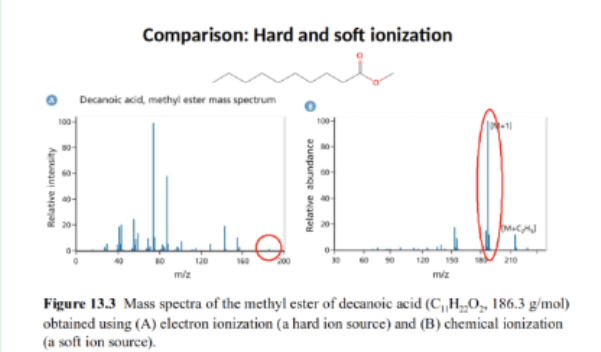
soft ionization
keep the molecules intact

Parts of Electron Ionization
Electron Source: Generates high-energy electron,s, typically from a heated filament
Ionization Chamber: Where the sample molecules are bombarded with electrons
Sample Inlet: Designed for vapor introduction, often coupled with gas chromatography
Electron multiplier: commonly used for detecting resulting ions
Quadrupole Mass Analyzer: often used for mass analysis after ionization
Characteristics of Electron Ionizzation
High Energy Process: Involves bombarding vaporized molecules with high-energy electrons, typically 70 eV causing ionization and fragmentation
Fragmentation Patterns: Procedures use distinctive fragmentation patterns for structural elucidation and compound identification, especially in organic molecules
Primary Volatile Compounds: Best suited for small, volatile, and thermally stable compounds
Common in GC-MS: Frequcntly used in combination with Gas Chromatoigraphy (GC) for analyzing gaseous and volatile compounds.
Universla Detector: Considered a ‘universal’ ionization method due to its effectiveness across a broad range of compounds
Electrospray ionization
An atmospheric-pressure ionization method allowing the transfer of dissolved macromolecules into a MS by converting them into ions via the gas phase
Used for analysis of non-volatile compounds
Can use low concentrations of analyte
Forms multiple charged ions by forming multiple adducts with the analytes
Allows for coupling of LC or CE to MS

How is Electrospray Ionization a form of soft ionization
Spray Capillary: Delivers the liquid sample and creates and aerosol
High Voltage Source: Applied to the spray capillary to induce ionization
Heated Voltage Source: Applied to the spray capillary to induce ionization
Heated Capillary and Desolvation Chamber: Used to evaporate solvent and focus ions
Ion Optics: Directs the ions from the spray source inro the mass analyzer
Mas Analyzer: Often a Time of flight, quadrupole or orbitrap for mass analysis0

Soft Ionization: Matrix Assisted Laser Desorption/Ionization (Maldi)
A sample is mixed with a matrix, most often simple organic solvents
The mixture is dried on a sample plate and ablated with a laser beam to create a plume of analyte and matrix ions
Matrix ions transfer charge to analyte
generally uses a UV laser, IR is also possible (not common) ions are formed by gas-phase proton transfer between excited matrix ions and the analyte
***generally, only single charges are observed

Resolution and mass analyzers
separates ions based on their mass to charge ration
It has very good mass accuracy and resolving power (resolution) along with measurement speed
Resolution m/Δm
“M” is the m/z of the first peak and
“Δm” is the distance between two peaks

Mass Analyzers: Quadrupoles
Most common and contains four poles, electric voltage is applied fluctuating and usually in pairs
The ions oscillate through the electric field only a select mass range can make it to the detector
Compact and less expensive
Short scan time
Varied DC source to bias rods and accelerate ions
Oscillating RF voltage signal on top of the DC bias, occasionally flip polarity

Quadrupole Ion Trap
End-cap electrodes are held at ground separated by ring electrode with a fixed frequency RF applied
Time-of-Flight Mass Analyzers
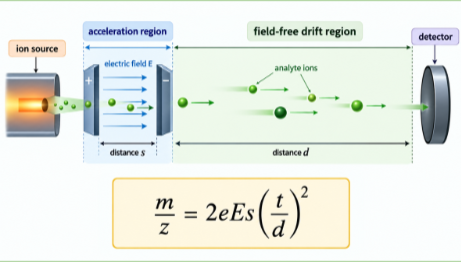
When ions have the same kinetic energy, the smaller m/z ion flies faster than the larger m/z ion
Measuring the flight time of ions can provide a mass spectrum
R = m/Δm
Tandem Mass Spectrometry
Mass Spec experiments can illustrate structural information about the analyte using precursor ions to break down into product ions, which reveal structural data about the precursor ions
MS v. MSxMS
MS → tells you the mass/elemental composition of the compound
MS x MS → tells you the structure of the compound (certain functional groups w. known masses may break off, may help us determine the structure)
How does the quadrupole act as a mass filter?
We're getting rid of the rest of the sample and measuring one m/z ratio.
The molecules that are too big or small fly to the rods and are destroyed because they can't maintain that orbit in the rods.
Block Diagram of a Mass Spectrometer

Which ionization methods are hard and which ones are soft
Hard:
Electron Ionization - the molecules are being bombarded w electrons, causing a lot of fragmentation. Because of this you are more likely to have a fragment of a full molecule
Soft
Electrospray Ionization - soft because you aren't charging the analyte directly, but instead the mobile phase and the matrix
MALDI - soft because the sample is mixed with the matrix if it was just the sample, it would've have been destroyed by the laser
How does Electrospray ionization work?
needle charges droplets. Hot gas is blown on to the solvent, so it evaporates. The droplets get smaller, and the charge density gets closer together, causes a coulombic explosion that transfers from the solvent to the analyte
False; They create singly positively charged ions
True or False: Electron Ionization can only produce singly and negatively charged ions.
True
E. True or False: An electron multiplier tube is more sensitive and has a lower limit of detection than a Faraday cup.
Faraday Cup
standard detector for mass spec
metal cup connected to a circuit
molecules flies into metal cup and trasnfers charge
resulting current from the cup is the signal measured
False; ESI uses hot gas, and MALDI is usually atmospheric.
F. True or False: All ionization methods require a vacuum to operate effectively.
True; Quadrupole, Time of Flight, and Ion Trap all require vacuums.
G. True or False: All mass analyzers require a vacuum to operate effectively.
Quadrupole and time of flight
A (quadrupole / time of flight / ion trap) can only separate out one m/z ratio at a time, requiring it to “scan” through the entire sample.
How do quadrupole mass analyzers work?
four poles, ions fly through as the em field changes, only one molecule can pass through at a time
Scan through mass to charge ratios for one molecule over a couple seconds
How do time of flight mass analyzers work
you have all of the ions in an electric tube, you give them all one push with the same KE. The objects w less mass will fly faster through the drift tube
How do Ion Trap mass analyzers work
4 metal plates creating an em field
your ions are going to stay in orbit in that magnetic field when you change the em field one at a time, you are kicking out ions that are in the trap
you are destabilizing the orbit
all of them do. the whole point of mass spec is that we are manipulating the em field to separate molecules by mass
this is why every measured molecule has be an ion
A (quadrupole / time of flight / ion trap) uses electromagnetic fields to accelerate ions
how is the fragmentation in mass spec reproducible