Diagnostic Imaging 2- Exam 3- Tumor 1 Malignant Notes- part 1
 Call Kai
 Learn
Learn Practice Test
 Spaced Repetition
 Match
Match Flashcards
 Knowt Play
1/91

There's no tags or description
Looks like no tags are added yet.
Name | Mastery | Learn | Test | Matching | Spaced | Call with Kai | Chat |
|---|
No analytics yet
Send a link to your students to track their progress
92 Terms
Cancer that begins in bone, cartilage fat muscle blood vessels or other connective or supportive tissue
Sarcoma
Malignancies derived from hematopoietic cell
Lymphoma and leukemia
Tumor which resembles an immature or embryonic tissue
Blastoma
New tumors that appear far from the original tumor
Metastasis
Differential diagnosis by predictive factors
Age
Incidence
Skeletal location
Interosseous location
Tumor appearance
Clinical presentation
What is most common form of malignancies
Metastatic disease
Most common primary malignant tumor in adults
Multiple myeloma
Must common primary malignant tumor in kids
Osteosarcoma
Most common benign osseous tumor
Osteochondroma
Most common benign spinal tumor
Hemangioma
Most common tumors are based on
Location
-hand, proximal humerus, etc.
Positions that a tumor can be in the bone or around the bone
Central/medullary
Eccentric
Cortical
Parosteal
Soft tissues

Example of a metaphyseal central tumor

Example of a metaphyseal eccentric tumor

Example of a cortical tumor location

Example of a soft tissue tumor location

How much bone destruction do you need from a tumor in order to see it on X ray
30-50%
Wha are the 3 types of bone destruction from tumors
Geographic
Moth eaten
Permeative
What is the most benign pattern of bone destruction
Geographic
What is the most progressive pattern of bone destruction
Permeative
What is the least aggressive pattern of bone destruction and has a short zone of transition
Geographic bone destruction

Geographic bone destruction is indicative of
Slow growing lesion
Example of a geographic well defined bone destruction

Example of geographic ill defined bone destruction
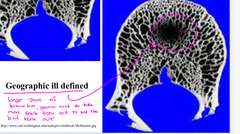
Example of geographic not well defined bone tumor

Example of geographic well defined bone tumor

What bone destruction is numerous small holes with a longer zone of transition than geographic, with margins that are not well defined
Moth eaten bone destruction

Example of moth eaten destructive changes

Example of moth eaten destructive changes with cortical destruction
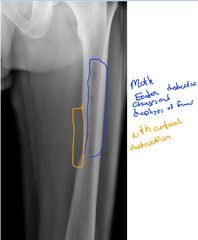
One more example of moth eaten destructive changes in the ilium this time
Confirm
Difference between Permeative and moth eaten destructive changes example
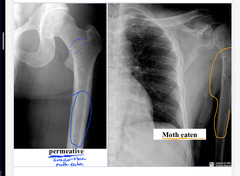
What is the most aggressive type of bone destruction with a wide zone of transition, it is a bunch of small holes, poorly demarcated or imperceptible borders
Permeative bone destruction

Example of Permeative destructive changes

Difference between all the types of destructive changes example

Difference between all the types of destructive changes, drawing this time

One more example of moth eaten destructive changes that are in the ilium
Confirm
Shorter zone of transition, means what for tumors
Less aggressive
Longer zones of transition means what for tumors
More malignant
Order the patterns of bone destruction in order form less malignant to the most malignant
Geographic (least)
Moth eaten
Permeative (most)
Example of cortical thickening (or buttressing)

Expansile and thin cortex example

Endosteal scalloping

Different types of cortical changes
Buttressing/thickening
Endosteal scalloping
Splitting or tunneling
Thinning with or without expansion
Penetration with or without periosteal reaction
What are the things that can cause a periosteum reaction
Subperiosteal extension of blood, pus or tumor or hyperemia, inflammation and edema
Patterson of periosteal reactions
Buttressing
Single layer
Multiple layers/laminated
Speculated
Codman`s triangle (worst one to have)
What is a membrane that lines the outer surface of all bones, except area covered by articular cartilage
Periosteum
Laminated periosteal reaction

Spiculated (hair on end) periosteal reaction

Solid periosteal reaction

Codman`s triangle periosteal reaction

What is the formation of new bone in response to injury or other stimuli of the periosteum surrounding the bone
Periosteal reaction
What is it when additional layers of new bone are added to the exterior creating an expanded osseous contour
Buttressing/solid periosteal reaction
Buttressing periosteal reaction

Solid (aka buttressing) periosteal reaction

Buttressing/solid periosteal reactions are usually associated with
Slow glowing lesions and usually benign
Multiple lathers of new new layers of bone
Laminated/layered/onion skin periosteal reaction
Alternating lawyers of lucency and opacity with alternating growth
Laminated/layered/onion skin periosteal racing
Laminated/layered/onion skin periosteal reaction

What type of periosteal reaction is classically associated with Ewings sarcoma
Laminated/layered/onion skin
Linear radiating spicules of new bone
Spiculated periosteal reaction
When spiculated periosteal reaction is perpendicular to the bone it is known as
Hair on end
When spiculated periosteal reaction is radiating from a central focus it is known as
Sunburst
Spiculated periosteal reaction

Example of a sunburst spiculated periosteal reaction

Example of a spicualted reaction with a codmans triangle in there too

What type of periosteal reaction is often associated with highly aggressive lesions, such as osteosarcoma
Spiculated
What is a triangular elevation of periosteum seen at the peripheral lesion-cortex junction for a periosteal reaction
Codmans triangle
Example of codmans triangle
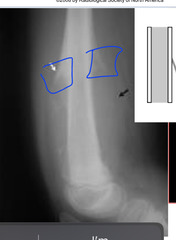
Periosteal reactions ordered from least malignant to most malignant
Solid
Sunburst (Spiculated)
Onion peel
Codmans triangle

What is one of the most aggressive forms of periosteal reaction
Codmans triangle
Different appearances of cartilaginous matrix
Ring or arc like
Flocculent
Small crystals
Popcorn like
Stippled
Benign tumors with cartilage matrix
Enchondroma
Osteochondroma
Chondroblastoma
Chrondomyxoid fibroma
Flocculant cartilage matrix

Crystal like cartilage matrix

Stippled cartilage matrix

Malignant tumors with cartilage matrix
Chondromsarcoma
What are radiodense areas that are variable in size, may occupy parts of or entire lesion and can be homogenous or inhomengous increased density changes/sclerosis
Osseous matrix
Benign tumors with osseous matrix
Osteoma
Osteoblastoma
Osteochondroma
Osteoid osteoma
Small hole with a lot of sclerosis means
Osseous matrix

Tumors with a fibrous matrix look like
Hazy, lucent, ground glass appearance

Malignant tumors with osseous matrix
Osteosarcoma
Benign tumors with fribrous matrix
Fibrous dysplasia
Desmoplastic fibroma
Non-ossifying fibroma
Fibrous cortical defect
Ossifying fibroma
Ostoeid matrix mineralization

Chondroid (rings and arcs) matrix mineralization

Fibrous matrix mineralization

Malignant tumor with fibrous matrix
Fibrosarcoma
Bone expansion typically occurs from what type of tumor
Primary
Periosteal reactions are more common in what type of tumors
Primary
Presence of soft tissue mass is more common from what type of tumors
Primary
When the size of the lesion is less than 6cm than it is typically from what type of tumor
Primary
What type of imaging looks for metabolism hot spots
Bone scan
What type of imaging looks for increased density areas
DEXA scan