Chapter 12: Mendel's Experiments and Heredity
 Call Kai
 Learn
 Practice Test
 Spaced Repetition
 Match
 Flashcards
 Knowt Play
1/92

There's no tags or description
Looks like no tags are added yet.
93 Terms

Chapter 12 big picture graphic
review the image
Before Mendel: How did people think inheritance worked (exam)
Homunculus: Sperm Contained fully formed “little people”
Everything from the eg: females controlled all traits
Paternal heredity: males control all traits
Balnding inheritance: offspring were the average between both parents
Inheritance of acquired characters: changes happening to parents could be passed on to offspring
Before Mendel: What was homunculus theory? (exam)
Sperm Contained fully formed “little (miniature) people)
Before Mendel - What was blending inheritance (exam)
Offspring were the average between both parents
Before Mendel - What was inheritance of acquired traits (exam)
Changes Happening to parents could be passed on to offspring
Mendel’s history leading to his work
Gregor John Mendel (1822 - 1884) “father of genetics
Studied philosophy and became a friar to pay for his education
Trained to become a priest and taught science
Work published in 1866 and rediscovered around 1900
What provided the first scientific basis of heredity (exam)
Gregor Mendel’s Pea experiments
Why peas?
Many simple dimchomotomous traits
— flower color, seed shape, seed color
Traits were true breeding
— An organisms, when self fertilized or mated with other of the same phenotype, reliably produces offspring with the same trait as the parent
Monoecious
— Male and female in one flower, easy to manipulate mating’s
Each pea was a new individual. Could evaluate thousands of offspring
Short Generation times
What was Gregor Mendel’s Experimental Design? (exam)
Used pea plants because they had simple, dichmotous traits, true breeding lines, were monoecious (self fertilizing) and produced many offspring quickly
Established genetic vocabulary: trait, phenotype, genotype, allele, dominant, recessive, homozygous, heterozygous.
Characteristic (exam)
Flower Color (the feature)
Trait (flowers) (exam)
Violet or white (the form of a characteristic)
Phenotype (exam)
Observable trait. Example: purple flower or blue eyes
Alleles (exam)
Versions of a gene.
Dominant/recessive = relationship between alleles in a heterozygote
Example of an Allele
P or p
Genotype (exam)
Allele combination for a gene or genes being considered - all of the genes you are considering in an individual organism
For a gene with two alleles, we can have:
PP (homozygous dominant)
Pp (heterozygous)
pp (homozygous recessive)
homozygote (exam)
When both alleles for the same trait are the same. Example PP (dominant) or pp (recessive). Homozygotes are always true breeding based on simple Mendelian genetics
Example of a homozygote
PP (dominant) or pp (recessive)
Heterozygote (exam)
When alleles for the same trait differ. Example — Pp. Heterozygotes are always non-true breeding.
Example of a heterozygote
Pp
Zygote (exam)
First diploid (2n, 2 sets of chromosomes) cell produced by fertilization
Which is a genotype and which is a phenotype:
Pp
Purple
PP = Genotype, Purple = Phenotype
Gene (exam)
DNA sequence that encodes information causing a trait (Mendel’s heridary particles)
Locus/Loci (exam)
Physical location on a chromosome, usually a gene
Alleles(exam)
Alternative versions of the gene
Mendel’s Generations (exam)
P1, F1, F2, F3 F4 F5
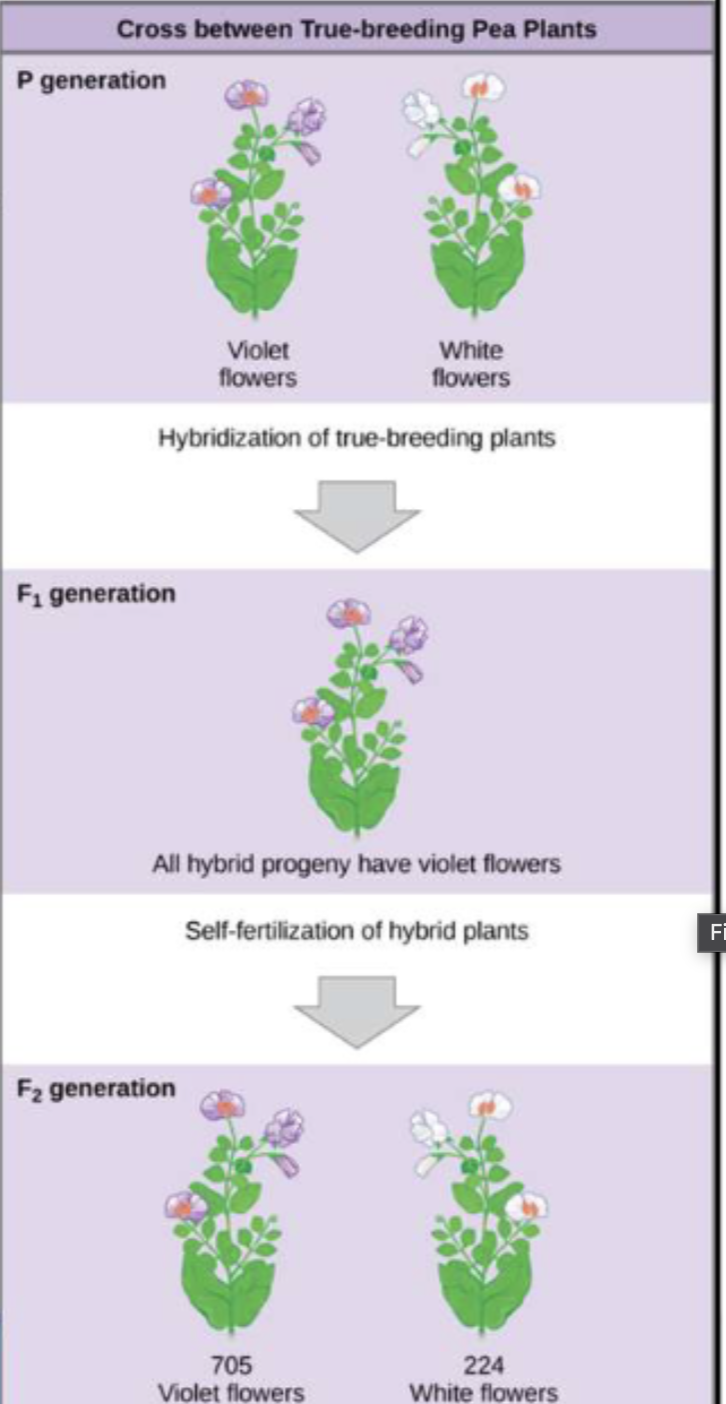
Medenl’s Generations: P
Parent generation of true breeding plants

Mendel’s Generations: F1
First filial generation of offspring (brothers and sisters) from a cross between parents

Mendel’s Generations: F2
Second filial generation of offspring produce by crossing 2 F1 individuals with each other

Mendel’s Generation: F3, F4, F5
Succeeding generations
Mendel’s Monohybrid Cross Punnett Squares example (exam)


What did Mendel Observe in result of the monohybrid cross?
True breeding for violet flower color with plants true-breeding for white flower color
Results:
F1 - all violet flowers
F2: 3 violet : 1 white ratio (705 violet: 224 white)
3:1 ratio from a formal monohybrid cross held true for other monohybrid crosses with different traits
Defining monohybrid Crosses (exam)
F1 all purple, F2 has a 3:1 purple to white ratio
Can do this by completing the punett squares

What did Mendel conclude from monohybrid cross
Traits do not blend
— The information for white flowers was stilll present in the F1
Indviduals carry two alleles for a gene
— The F1 plants were Pp
In a heterozygote, one allele may mask another
— P = dominant; p = recessive
The two alleles separate when gametes are produced and come together again at fertilization
The recessive allele disappeared from the phenotype; not from the genotype

Where did the white trait go in F1, and why did it return in F2 in monohybrid cross
White trait got masked in the F1 punett squares by the dominant violet allele (P) which caused all purple flowers with a Pp phenotype for each square, but returned in F2 because of the 3:1 ratio result of the punett square combining a Pp plant with a Pp plant (right corner box turns into pp recessive allele phenotype)
Mendel’s First Law: The Law of Segregation (exam)
Alleles separate during gamete formation and recombine randomly at fertilization
A diploid organism has two alleles for a gene
During gamete formation, the two alleles separate so each gamete receive one allele
Fertilization randomly combine one allele from each parent
Why? Homologous chromosomes separate during Meiosis I.
Punett square F1 Generation in a monohybrid cross of a flower (image with color in description)
Turn out all purple

Punett square F2 Generation of a monohybrid cross (image with color in description)
turns out with a 3:1 purple-white ratio
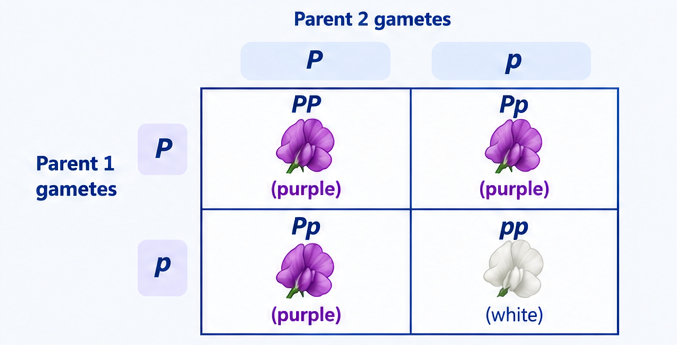
Testcross (exam) - how can we tell with purple flowers flowers if they are PP or Pp
Cross it with a homozygous recessive plant (pp)
If the unknown plant is dominant (PP)
→ 100% PP
→ All purple plants result Because punett square would have purple (big P) in all of the squares
If unknown is recessive (Pp)
½ of punett square results is Pp, ½ of punett square is pp
→ 1 Purple : 1 white
Punett square can predict ______
Medialian cross outcomes
In Pea plants, Yellow seeds (Y) are dominant to green seeds (y)
What gametes can each parent produce
Yy
In Pea plants, Yellow seeds (Y) are dominant to green seeds (y)
Complete the punett square
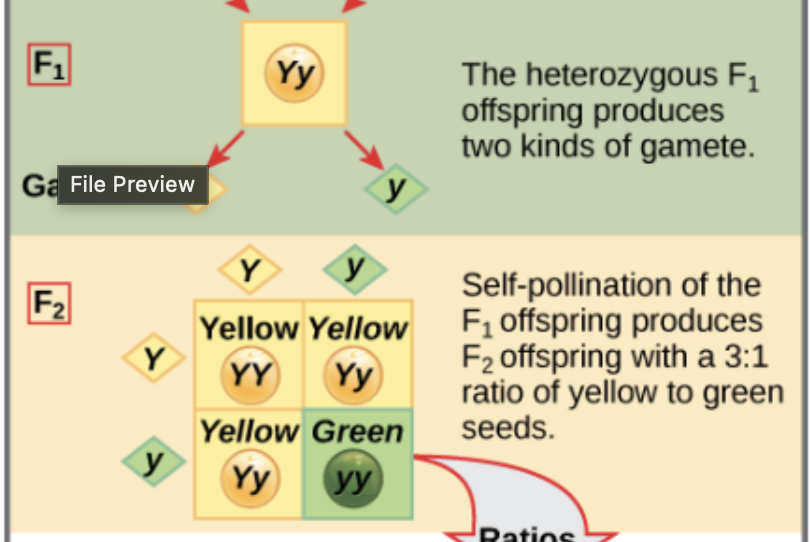

In Pea plants, Yellow seeds (Y) are dominant to green seeds (y)
Complete the punett square
What is the genotype ratio?
1 YY : 2 Yy : 1 yy

In Pea plants, Yellow seeds (Y) are dominant to green seeds (y)
Complete the punett square
What is the phenotype ratio
3 Yellow : 1 green
(exam) What does a test cross do?
Identifies unknown genotypes by crossing with a recessive parent
Probaility in Genetics (AND vs OR) definition (exam: probability rules)
Inheritance involve change: each gamete and each fertilization events represents a probability
Product rule (AND) (exam: probability rules)
Multiply when independent events must both occur. The probability of two or more independent events occurring together is equal to the product of their individual probabilities.
Product rule (AND) = multiply—- reasoning
The overall change for the occurrence of two or more independent random events in exact order is equal to the products of their individual probabilities
Example of Product Rule (math)
The Chance of rolling exactly a five is 1/6
The chance of rolling exactly a four is 1/6
The overall chance of rolling exactly a five on the first and a four on the second die is
(1/6) * (1/6) = 1/36
Product rule in Genetics
The chance of inheriting an “A” from one parent and an “a” from the other = (1/2) * (1/2) = (1/4) → corresponds to the Aa genotype
Sum Rule (OR) = Add (exam: probability rules)
Use this rule when DIFFERENT possible routes produce the SAME outcome
add when more than one route gives the same outcome
The probability of one of two or more mutually exclusive events occurring is equal to the sum of their individual probabilities.
Example of Sum Rule (math)
If you can win by rolling a 4 or 5 with one die, then the overall chance is winning is:
the chance of rolling a four is 1/6
the chance of rolling a five is also 1/6
The overall chance of rolling a 4 or a 5 is:
1/6 + 1/6 = 2/6 = 1/3
Sum Rule in genetics
The probability of being heterozygous (Aa or aA) = ¼ + ¼ = ½
( 𝑃(𝑋 or 𝑌)=𝑃(𝑋)+𝑃(𝑌) )
Why can both the product rule and sum rule be combined for complex random events (math example)
The chance of rolling a 5 and a 4 in any order is
(chance of a 5 first (1/6)) * (the chance of a 4 second (1/6)) = 1/36
If the order does not matter, roll a 4 first (1/6) and a 5 second (1/6)
Chance of a 4 first (1/6)) * (the chance of a 5 second (1/6)) = 1/36
The overall chase is 1/36 + 1/36 = 2/36 = 1/18
Using both [sum (Or) and Product (AND)] rules in Genetics (exam: probability rules)
Example: Probability of an Aa offspring from Aa * Aa'
Each parent can contribute either A (1/2) or a (1/2) independently
To get Aa, there are two possible combinations:
A (from parent 1) and a (from parent 2) → ½ * ½ = ¼
a (from parent one) and A (from parent 2) → ½ * ½ = ¼
Because either combination produces the same genotype (Aa), add the two probabilities:
¼ + ¼ = ½
Pedigree conventions (PT 1) (link to definition set: — (link here)
Circle = female
Square = male
Diamond = unknown sex
Parents connected by single horzizontal line
Offspring stem off vertical line from parent
Double line = related parents, such a two cousins (“consanguineous”)
Roman Numerals Identify Generations
Pedigree conventions (PT 2) (link to definition set: — (link here)
Twins
Diagonal lines stemming from vertical line connected to the sibship line
Identical (monozygote) twins
Diagonal lines are linked by horizontal line
Fraternal (dizygotic) twins
Lack this connecting line
Proband
The individual whose phenotype first brought attention to the family
Is Indicated by an arrow connected to the designation P
Goal of pedigree conventions
Use patterns of affected and unaffected family members to infer genotype
Alkaptonuria
An autosomal recessive genetic disorder. People with this can not properly metabolize phenylalanine and tyrosine
Symptoms: Darkened skin and brown urine, joint damage
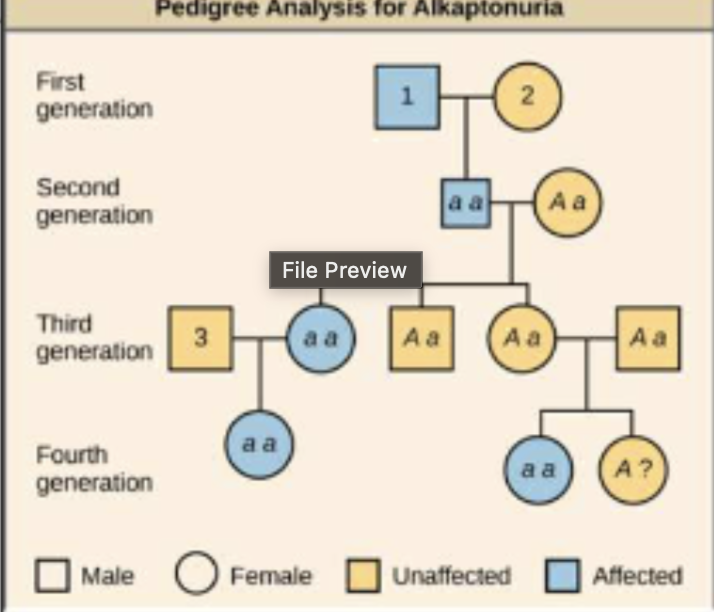
How is it possible to determine a person’s genotype from the genotype of their offspring
If two unaffected parents have an affected child, both parents must be carriers (Aa)
Work Backward from affected individuals to infer possible parental genotype

Dihybrid Cross: Following Two Genes
Follow two characteristics at the same time: Seed color and seed shape
Y = yellow; y = green
R = Round, r = wrinkled
P Generation: YYRR x yyrr.
Y = yellow; y = green
R = Round, r = wrinkled
P Generation: YYRR x yyrr.
What gametes can the F1 generation make? (Punnett square)
YR, Yr. yR, yr
Y = yellow; y = green
R = Round, r = wrinkled
P Generation: YYRR x yyrr.
What can the F2 generation make? ( Given Punnett square) for dihybrid cross image
Image from slideshow

Y = yellow; y = green
R = Round, r = wrinkled
P Generation: YYRR x yyrr.
F1 Generation Phenotype: YyRr
What are the F2 gametes from the heterozygous parent
YR, yR, Yr, yr

Classic statistical ratio of a dihybrid cross (exam)
9:3:3:1

Dihybrid cross:
What are the F2 phenotypes
9 yellow round
3 green round
3 yellow wrinkled
1 green wrinkled
Which is the expected ratio when the genes assort independently and each shows complete dominance
9:3:3:1
Mendel’s Second Law: Independent Assortment (exam)
If you count for each trait individually still get a 3:1 ratio as in monohybrid crosses. Mendel concluded that traits were inherited independently from one another.
Assortment and recombination of alleles for one trait has no effect on assortment and recombination of alleles for other traits.
Incomplete dominance
blended phenotypes (e.g., red × white snapdragons → pink).
Snapdragons:
Cross a true breeding red flower parent with a true breeding white flowered plant
Result: All pink F1 heterozygotes
If you cross pink F1 sibs you get an F2 that has the following ratio of phenotypes
1 red: 2 pink: 1 white
White is probably due to loss of red pigment function
The alleles do NOT blend; they remain discrete
Incomplete Dominace scenario:
Cross a true breeding red flower parent with a true breeding white flowered plant
What is the outcome?
: All pink F1 heterozygotes
Incomplete Dominace scenario:
If you cross pink F1 sibs you get an F2 that has the following ratio of phenotypes
What is the outcome?
1 red: 2 pink: 1 white
White is probably due to loss of red pigment function
Incomplete dominance phenotype ratio F1 punett square
Get picture from iPhone, ALL Pink

Incomplete dominance phenotype ratio F2 punett square
Red, Pink White Varations (get image from iPhone)

Example of incomplete dominance
snapdragons
Multiple Alleles
(e.g., rabbit coat color hierarchy C > cᶜʰ > cʰ > c) or blood type
More than two alleles of a gene exist in the population, although each individual carries only two
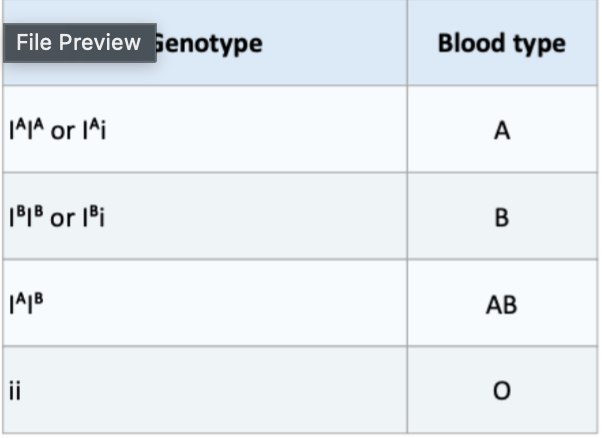
ABO blood type has three alleles:
IA, IB, and i
IA and IB are _______ — both are expressed together
codominant
Both IA and IB are _______ to i
dominant
Type AB (IA IB) demonstrates ________: both A and B ______ are expressed
codominace, antigens

Blood type Genotypes
A - IAIA or IAi
B - IBIB or IBi
AB - IAIB
O - ii

Multiple alleles for a single trait showing an order of dominance
Four different alleles exist for the rabbit coat color (C) gene.
C is dominant to cch
◦ CC, Ccch , Cch , Cc: all brown
cch is dominant to ch
◦ cchcch, cchch , cchc: all black tipped white
ch is dominant to c
chch, cchc: all white fur, black paws

Four different alleles exist for the rabbit coat color (C) gene.
C is dominant to cch
◦ CC, Ccch , Cch , Cc: all brown
cch is dominant to ch
◦ cchcch, cchch , cchc: all black tipped white
ch is dominant to c
chch, chc: all white fur, black paws
Image from slideshow

X linked inheritance (exam)
X linked genes are located on the X chromsomes
e.g., eye color in Drosophila; males more often affected).
XX individuals usually have two copies of an X-linked
gene.
•XY individuals have only one copy of most X-linked
genes; they are hemizygous.
•A recessive X-linked allele is expressed in an XY
individual whenever it is present on the X
chromosome.
•Example: in Drosophila, red eyes are dominant to
white eyes.
X linked inheritance: XX individuals usually have ___ copies of an X-linked
two
X Linked inheritance:
•XY individuals have only one copy of most X-linked
genes; they are _______.
hemizygous
X Linked inheritance:
A ______ X-linked allele is expressed in an XY
individual whenever it is present on the X
chromosome.
recessive

X Linked inheritance example: (exam)
In ________, red eyes are _______ to white eyes
drosophila, dominant
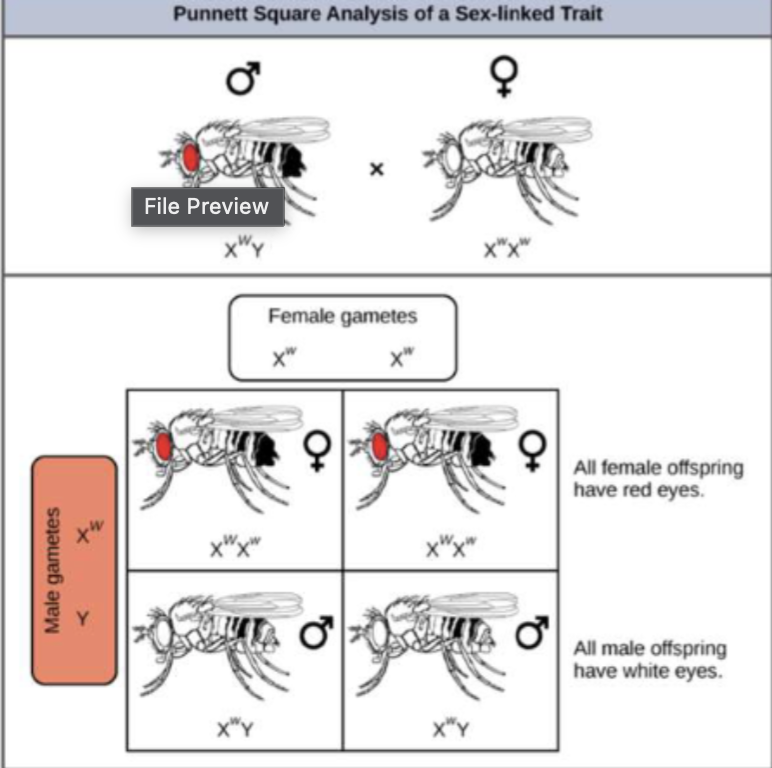
X-Linked Cross: Drosophila Eye Color
•Xᴿ = red-eye allele; Xʳ = white-eye allele.
•Cross: XᴿY × XʳXʳ.
•Daughters receive Xᴿ from father and Xʳ
from mother → XᴿXʳ, red-eyed carriers.
•Sons receive Y from father and Xʳ from
mother → XʳY, white-eyed.
•Fathers give their X chromosome to
daughters and their Y chromosome to son
X Linked Dominant
Image from slideshow
X-Linked Cross: Drosophila Eye Color
Punett Square:
Cross XwY male with XRXr female
Red eye female, Red Eye male
Red Eye female, White eye male
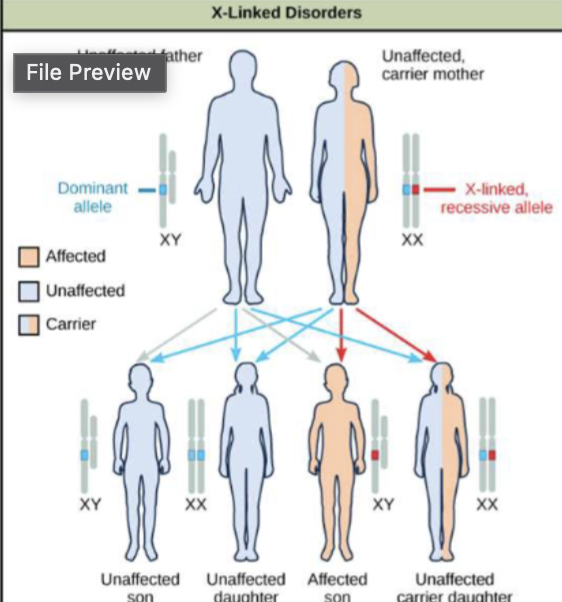
X Linked Recessive: Carrier Mother
Cross: carrier mother XᴺXⁿ × unaffected father
XᴺY.
•Sons: 50% XᴺY unaffected; 50% XⁿY affected.
•Daughters: 50% XᴺXᴺ unaffected non-carriers;
50% XᴺXⁿ unaffected carriers.
•In this cross, no daughters are affected
because the father contributes a normal Xᴺ
allele.
Image from slideshow
Lethal Alleles (exam)
alter expected ratios (e.g., Manx cats → 2:1).
All Manx cat are heterozygotes for the M allele
• mm homozygotes are normal house cats
• Mm heterozygotes are Manx (short/no tail)
• MM homozygotes all die at the embryo stage
• Crossing 2 Manx cats produce an offspring
ratio of 2 Manx : 1 normal. Not 3:1.
• Why? Explain
one of them dies, heterozygous will survive and give phenozytype
Why are short tales lethal
has to do with spinal development
Epistasis (exam)
one gene masks the effect of another (e.g., albino mice C gene masks A gene).