Elasticity
 Call Kai
 Learn
Learn Practice Test
 Spaced Repetition
 Match
Match Flashcards
 Knowt Play
1/40

There's no tags or description
Looks like no tags are added yet.
Name | Mastery | Learn | Test | Matching | Spaced | Call with Kai | Chat |
|---|
No analytics yet
Send a link to your students to track their progress
41 Terms
Elasticity
the property of a body that tends to return the body to its original shape after the force is removed. If the applied force is too large, the body is distorted beyond its elastic limit, and the original shape is not restored.
ex) twisting your ankle can damage ligaments in your ankle because the ligaments elasticity wasn’t strong enough
Elasticity in the skin allows
movement of joints and facilitates tactile sensory organs.
Cardiovascular System
Allows our blood vessels to function properly. Artery walls stretch when pressure pumps blood away from the heart. Elastic fibers in the walls ensure they keep its shape. Elastic recoil keeps blood moving though the capillaries. Veins have to maintain elasticity so the blood can move properly
Elastic properties change with
age and disease
Arteriosclerosis
a disease in which arteries lose elasticity as their walls became stiff and inflexible; often as a result of high blood pressure exerting excess force against arterial walls. Begins with inflammation and causes arteries to become blocked. decreases blood flow and oxygen caused by elasticity.
*Atonia
Loss of elasticity and muscle strength.
Properties of Sound
Travels in motion, elastics, periodic motion
Periodic Motion
Defined as motion which repeats itself at regular time intervals. Time required to complete one full cycle.
ex) vibration, oscillation, cycles
Frequency
The number of vibrations per unit of time (Mhz). The higher the frequency the less time each vibration takes. Frequency of US wave depends on the thickness of crystal.
Amplitude
Maximum distance moved from the equilibrium point. How intense sound wave is
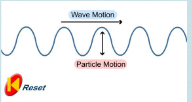
Transverse Wave
a wave in which the particles are oscillating back and forth perpendicular to the direction of propagation of the wave.

Longitudinal Waves
waves in which the periodic motion of the particles is parallel to the propagation direction.
Ultrasound Pressure Wave
They originate from elastic properties vibrating back and forth. The vibration creates pressure changes within the air and sound will be produced. Energy is transmitted by alternating between compression and rarefying of material. The waves increase blood flow which increases healing.
What is US used for
diagnosis (creates images), treatment (localized increase in temperature), pain control, dermal ulcers, surgical incisions, carpal tunnel syndrome, tendon and ligament injuries, absorbs calcium deposits
What is US
A high frequency sound wave that can enter the body and pass through it while attenuating due to absorption of the sound waves into tissue. Consists of frequencies above human hearing. Greater than 20,000 Hz Increases cellular response and making it happen quicker
Thermal Effects of US
Increases tissue temperature
Reduction of pain, extensibility of tissue, increase circulation, reduce muscle spasms, alter nerve conduction, lengthen soft tissue= lets tissue stretch more
Nonthermal Effects of US
Can alter cellular activity
Micro streaming, acoustic streaming, and cavitation cause mechanical changes in biological tissue and processes.
Inflammation phase of healing, wound healing, blood flow (local area), increase skin permeability to topical medication.
Attenuation
Decrease in intensity as sound waves pass through. Greatest in tissue with high collagen content (tendons, ligaments, cartilage, scar tissue)
Reasons for Attenuation
Absorption, refraction, reflection

Refraction
Redirection of US wave as it continues to enter the tissue.
Reflection
Redirection of US wave opposite to angle of incident. Mostly occurs between tissue interfaces (air-skin, soft tissue-bone). Why it is important to keep middle of transducer head level with skin at all times.
What properties does a crystal in US head have
Pizeoelectric
Transducer crystal
Able to respond to electrical current by contracting and expanding as the electrical current alternates. The contracting causes tissue to compress and rarify. When crystal expands, tissue particles get compressed, when crystal contracts, tissue particles rarify
Transducer
Turns elecrtical waves into sound waves
Power
The amount of watts given out of US machine
Intensity
power per unit area of sound head, how much sound waves going into one area, important in temperature. measured in Wcm²
Acoustic Streaming
Steady, circular flow of cell material caused by US wave
Cavitation
Gas bubbles in tissue are made smaller during compression phase of US and expand during rarefaction phase. If they explode, they cause damage to the cells
Microstreaming
Very small flow of material(gas bubbles from cavitation)
Lithotripsy
If these implode can cause tissue damage
Piezoelectric definition
Able to change shape in response to electrical current
Rarefaction
Decrease in density as US waves pass through. Particles are pulled apart (low density, low pressure)
Effective Radiating Area
the area of the transducer from which US energy radiates. Only half the size of transducer head (middle)
1 Mhz used for tissue ___ cm deep
5
deep within muscle joint, knee, quad
3 Mhz used for tissue ___ cm deep
1-2
elbow
Factors that influence temperature change
Absorption coefficient, average intensity, duration of treatment
Frequency
higher freq, higher temp
low Mhz causes higher temp
less intensity for higher frequency
Clinical uses of US
Soft tissue shortening, pain control, dermal ulcers, surgical skin incisions, absorb calcium deposits, phonophoresis
Ways to maintain elasticity
good diet, exercise, no drugs or smoking
low muscle tone
post seizure, hanging limb, low mobility
high muscle tone
cerebral palsy, arms bent and scrunched to body
what is sound used for
to manipulate tissue