Flashcards CHEM 105: Atoms and Isotopes
 Call Kai
 Learn
Learn Practice Test
 Spaced Repetition
 Match
Match Flashcards
 Knowt Play
1/22

There's no tags or description
Looks like no tags are added yet.
Name | Mastery | Learn | Test | Matching | Spaced | Call with Kai | Chat |
|---|
No analytics yet
Send a link to your students to track their progress
23 Terms
What is matter?
Anything that takes up space and has mass
What is an atom?
The smallest identifiable unit of an element
What are the subatomic particles and their charges?
Protons (+), neutrons (0), and electrons (-)
_______ and _______ are found in the nucleus of an atom.
protons, neutrons

Protons and neutrons make up the majority of an atom's _____________ while most of the volume is from the ___________ ___________.
mass, electron cloud
What is an element?
A pure substance that cannot be broke down into simpler substances by chemical transformation
In the periodic table, the rows are referred to as ________ and the columns are referred to as __________ or ____________.
periods, groups, families
Every element has a unique number of __________, which is the same value as the atomic number.
protons
Isotopes have the same number of _________ but a different number of ___________.
protons, neutrons
Isotopes are all the same element, but have a different number of _________.
neutrons
In isotope symbol notation, the mass number goes on the _________ (top/bottom) while the atomic number goes on the __________ (top/bottom).
top, bottom
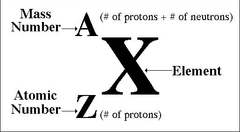
What is the formula to solve for neutrons in an isotope?
Mass number - atomic/proton number = # of neutrons
The number of electrons is (almost) always the same as the number of which subatomic particle?
protons
What is the difference between the average atomic mass and the mass number?
The mass number is always a whole number and is the sum of protons and neutrons, while the average atomic mass is usually a decimal and describes all atoms of the element mixed together
Column 1A refers to which group?
Alkali metals
Column 2A refers to which group?
Alkali Earth metals
Column 7A refers to which group?
Halogens
Column 8A refers to which group?
Noble gases
What is special about the noble gases?
They're inert. Their low reactivity means they are unlikely to form chemical bonds
Which columns make up the main group elements?
1A - 8A
The block in between the main group elements is which group?
Transition metals
Elements in the same _________ (group/period) have similar properties/reactivities.
group
Which three elements are metalloids and are underneath the staircase?
Ge, Sb and Po