Computer Networks (Final)
 Call Kai
 Learn
 Practice Test
 Spaced Repetition
 Match
 Flashcards
 Knowt Play
1/35

Earn XP
Description and Tags
Lecture 12 and beyond (for final; I don't remember if it's cumulative).
36 Terms
Network layer
Highest level layer that is present in hosts and routers
performs addressing, forwarding, and routing, etc.
Autonomous System/Domain
region of a network under a single administrative entity (routers/switches); can make decisions within itself as long as everyone uses IP routing protocol; assigned unique identifier (ASN)
Local forwarding
directing a packet to the correct interface so that it progresses to its destination via reading address from packet header & search forwarding table (in memory)
Global routing
Setting up network-wide forwarding tables to enable end-to-end communication
Forwarding (data plane)
directing one data packet and each router uses local routing state
Routing (control plane)
compute the forwarding tables that guide packets
jointly computed by routers using a distributed system
IP packet header/IP header
present in all devices
IP version number (4 bits), packet length (16 bits)
destination’s IP address (32 bits)
TTL (8 bits)
checksum (16 bits)
fragmentation fields (32 bits)
ToS (8 bits), options (variable length)

IP header checksum
router discards if checksum is invalid; checksum recalculated at every router
ToS (Type of Service)/Differentiated Service
allows packets to be treated differently based on needs (e.g. indicate priority, congestion notification)
IP header option field examples
record route
strict source route
loose source route
timestamp
IP header protocol byte
tells destination what to do with the received packet (transport layer protocol)
IPv4 fragmentation fields
identifier: which fragments belong together
flags: (reserved: ignore, DF: don’t fragment, MF: more fragments coming)
offset: portion of original payload this fragment contains
Router capacity
number of external router ports * speed of a port
What’s inside a router?
linecards & interconnect/switching fabric

Input linecard
Receive incoming packets (physical layer)
update the IP header
lookup the output port for the destination IP address
queue the packet at the switch fabric
Router hardware processing
packet classification: map packets to flows
buffer management: decide when and which packet to drop
scheduler: decide when and which packet to transmit
Max-min fairness
How round-robin routers attempt to service flows in a fair fashion assuming packets are of same size

Fair queuing
How round-robin routers attempt to service flows fairly with packets of varyinig sizes
Explicit Congestion Notification
packet header, set by congested routers (serves as early indicator of congestion to avoid delays)
Valid routing state
produces forwarding decisions that always deliver packets to their destinations
no dead ends & no loops
Flooding
node sends its link-state info (edge + cost to reach) out on all of its links, the next node forwards the info on all of its links (except the one the info originated from)
What causes flooding?
topology change (e.g. link/node failure/recovery)
configuration change (e.g. link cost change)
periodically
Link-state routing protocols
OSPF: open shortest path first (uses IP as opposed to TCP or UDP)
IS-IS: intermediate system to intermediate system
Distance vector routing protocol
each node tells its neighbors about its global view
Link-state routing protocol
each node broadcasts its local information
Border Gateway Protocol
extends distance-vector ideas to accommodate policy (autonomy, policy, privacy)
IP addressing hierarchy
Network: 23 bits prefix (inter-domain routing uses this)
Host: 9 bits suffix

Subnet mask
a group of machines that share the same IP address prefix
BGP route selection
controls whether/how traffic leaves the network

BGP route export
controls whether/how traffic enters the network
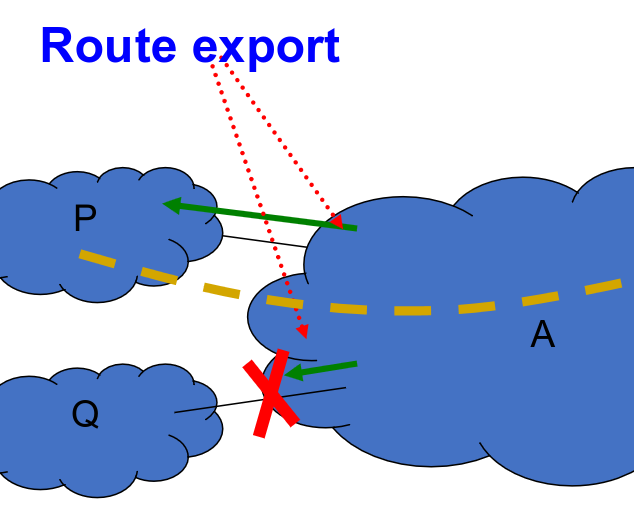
Gao-Rexford
rules for determining how to export routes

eBGP sessions
sessions between border routers in different ASes (learn routes to external destinations)
iBGP session
sessions between border routers and other routers within the same AS (distribute externally leraned routes internally)
IGP (Interior Gateway Protocol)
provide internal reachability
Messages in BGP
open: establishes BGP session (it uses TCP)
notification: report unusual conditions
update: inform neighbor of new routes & old routes that become inactive
keep-alive: inform neighbor that connection is still viable
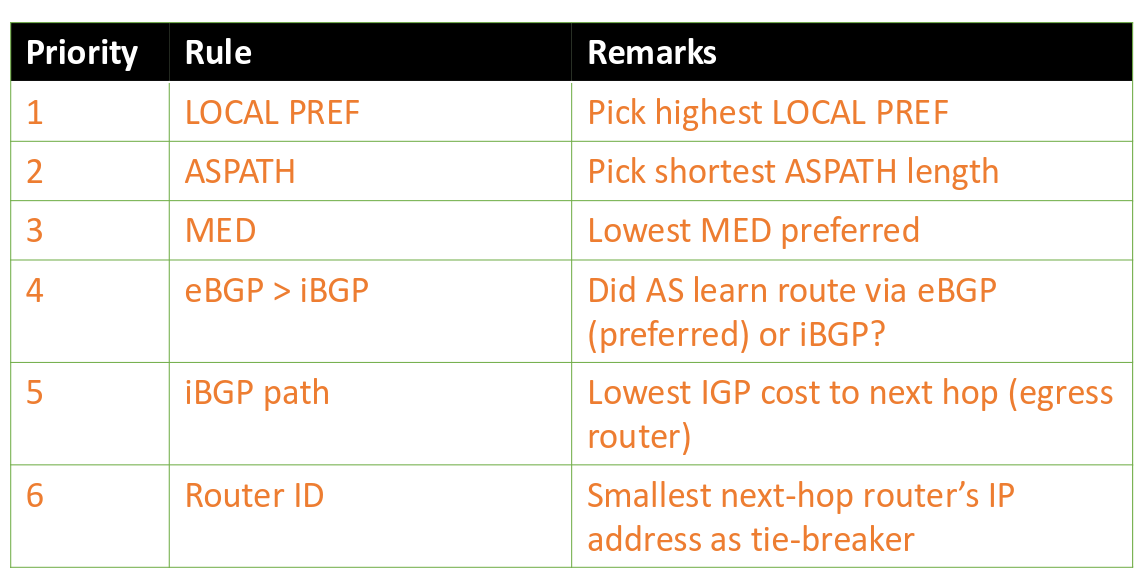
Route selection priority order
based on the attributes provided in BGP, it determines which route is chosen