perception test 2
 Call Kai
 Learn
 Practice Test
 Spaced Repetition
 Match
 Flashcards
 Knowt Play
1/181

There's no tags or description
Looks like no tags are added yet.
182 Terms
What is the pathway from the retina to the brain?
optic nerve
optic chiasm
optic tract and thalamus
lateral geniculate nucleus OR superior colliculus
primary visual cortex (V1)
temporal lobe OR parietal lobe
frontal lobe
What is the optic chiasm?
an x-shaped bundle of fibers on the underside of the brain where nerve fibers activated by stimulation of one side of the visual field cross over to the opposite side of the brain.
What does it mean when we say the brain is contralateral?
that each hemisphere responds to the opposite side of the body
What is the lateral geniculate nucleus (LGN)?
the nucleus in the thalamus that receives inputs from the optic nerve and communicates with the cortical receiving area for vision
where 90% of the signals from the retina go
What is the superior colliculus?
an area in the brain that is involved in controlling eye movements and other visual behaviors
where 10% of signals from the retina go
What is the function of the LGN?
to regulate neural informaiton as it flows from the retina to the cortex
What is feedback?
backward flow of information that the LGN receives from the brain
What is the visual receiving area? aka striate cortex
the area in the occipital lobe where signals from the retina and LGN first reach the cortex
What stimuli do striate neurons prefer?
elongated contours over spots of light
orientation selectivity
direction selectivity
location or phase sensitivity
ocular dominance
end-stopping
What are simple cortical cells?
a neuron in the visual cortex that responds best to bars of a particular orientation
What is the orientation tuning curve?
a function relating the firing rat of a neuron to the orientation of the stimulus
What are complex cells?
a neuron in the visual cortex that responds best to moving bars with a particular orientation
What is an end-stopped cell?
cortical neuron that responds best to lines of specific lengths that are moving in particular direction.
responds to corners, angles, bars of particular length or direction
What are feature detectors?
a neuron that responds selectively to a specific feature of the stimulus like orientation or direction
What is a m ganglion cell?
a ganglion cell that receives input from diffuse bipolar cells
have large dendritic fields (high convergence) good sensitivity, and are used for motion conversion (flicker or motion; how image changes overtime)
work best in low light situations
Make up 8-10% of ganglion cells
connect to the magnocellular pathway
What are magnocellular layers of the LGN best at detecting?
coarse details and motion/flickers
What are k ganglion cells?
ganglion cells that recieve input from both kinds of bipolar cells.
largest dendritic fields (high convergence) used for yellow - blue colour vision
work best in bright situations.
make up 5-8% of ganglion cells
connects to the koniocellular pathway
What are the koniocellular pathways best at detecting?
blue-yellow colour vision
What is a p ganglion cell?
A ganglion cell that receives input from midget (puny) bipolar cells
have tiny dendritic field (low convergence) uses cones for colour vision (red-green) and visual acuity (details) (shape or texture)
work best bright areas
make up 70% of ganglion cells
connect to the paracellular pathway
What are parvocellular layers best at detecting?
detail, texture, colour, and form
What is selective adaptation?
the process where a person or animal is selectively exposed to a stimulus and then the effect of the exposure is assessed by testing a large range of stimuli
the original stimuli’s sensitivity is decreased (neurons fire less and less once a person looks at a stimulus for a long period)
What are the 2 physiological effects off selective adaptation?
the neuron firing rate decreases
the neuron fires less when the stimulus is immediately presented again
What is the Hubel & Wiesel study on cat visual cortexes?
mapped how the mammalian brain processes visual information and proved that early sensory experience shapes brain development
FOUND
every neuron had a receptive field at about the same location on the retina
What is contrast threshold?
the intensity difference between two areas that can just barely be seen
measured using gratings with alternative light and dark bars
How do you measure selective adaptation orientation? (3 steps)
Measure a person’s contrast threshold to gratings with a number of different orientations.
Adapt the person to one orientation by having them view a high contrast adapting stimulus for 1 or 2 mins
Remeasure the contrast threshold of all test stimuli from step 1
What is selective rearing?
a process where animals are reared in special environments
What is neural plasticity (experience-dependent plasticity)?
the capacity of the nervous system to change in response to perceptual experience
ex. if an animal is in an environment with only vertical lines they should have simple cells that only respond to vertical stimuli
What is the use it or lose it effect?
the result of selective rearing experiments
if you do not use certain neurons you will lose ability to process things that neuron specializes in
What is a retinotopic map?
a map on a structure in the visual system that indicates locations on the structure that correspond to locations on the retina.
What is cortical magnification?
Occurs when a disproportionately large area on the cortex is activated by stimulation of a small area on the receptor surface.
What is the cortical magnification factor?
The size of the cortical magnification effect
What is the Dougherty study on cortical magnification in humans?
fMRI scanned patients looked directly at a dot in the center of the screen (so the image fell on the fovea). A stimulus light was either near the center or further from the center.
FOUND
cortical activation magnifies when stimuli fall in the area processed by the fovea

What are location columns?
A column in the visual cortex that contains neurons with the same receptive field locations on the retina.
What are orientation columns?
a column in the visual cortex that contains neurons with the same orientation preference.
What is a hypercolumn?
a unit in the striate cortex that combines location, orientation, and ocular dominance columns that serve a specific area on the retina.
a location column with all its orientation columns
The cortical representation of a stimulus DOES NOT have to ______ the stimulus; it just has to contain information that ________ the stimulus
resemble; represents
What is tiling?
The adjacent (and often overlapping) location columns working together to cover the entire visual field (similar to covering a floor with tiles).

What is the extrastriate cortex?
Collective term for visual areas in the occipital lobe and beyond known as V2, V3, V4, and V5.

What is ablation (aka lesioning)?
Removal of an area of the brain.
the destruction or removal of tissue in the nervous system
What is an object discrimination task?
The behavioral task used in Ungerleider and Mishkin’s experiment in which they provided evidence for the ventral, or what, visual processing stream.
Monkeys were required to respond to an object with a particular shape
ex. target object (rectangle) and other stimulus (triangle) with the hope they pick the target object to get the food

What is a landmark discrimination problem task?
The behavioral task used in Ungerleider and Mishkin’s experiment in which they provided evidence for the dorsal, or where, visual processing stream.
Monkeys were required to respond to a previously indicated location.
ex. monkey removes the cover of the food on the object closest to the large cylinder (landmark)

What is the what pathway? (aka the ventral pathway)
the pathway from the striate cortex to the temporal lobe. (parvocellular and koniocellular layer of LGN)
responsible for determining object identities
What is the where/how/action pathway? (aka dorsal pathway)
the pathway from the striate cortex to the parietal lobe (magnocellular layer of LGN)
responsible for determining object location, taking action with an object (reaching, grasping)
What is neuropsychology?
the study of the behavioral effects of brain damage in humans
What is a double dissociation?
In brain damage, when function A is present and function B is absent in one person, and function A is absent and function B is present in another.
one person has damage to A and cant do y but can do x.
one person has damage to B and cant do x but can do y.
Presence of a double dissociation means that the two functions involve different mechanisms and operate independently of one another.
What is the story of patient DF?
a woman who had carbon monoxide. She passed out from severe hypoxia (oxygen deprivation). she was in coma. She developed visual form agnosia.
What is visual form agnosia?
a person cannot perceive the shape, form, or orientation of an object, making it impossible to visually recognize or draw it, despite having normal basic visual acuity and color vision
What is optic ataxia?
a neurological movement disorder characterized by an inability to accurately reach for or grasp an object under visual guidance, despite having clear vision and normal muscle strength
What is the rod and frame illusion?
a task where an observer performs 2 tasks (one matching task - what pathway; one grasping task - where/how pathway)
participant needs to orient a line vertically (match 2 lines as the same; make the lines vertical)
FOUND:
the frame orientation affects the matching task but NOT the grasping task
What is the inferotemporal (IT) cortex?
An area of the brain in the ventral cortex that is involved in object perception and facial recognition.
What is the hippocampus?
Subcortical structure in the brain that is associated with forming and storing memories.
What is a neuron’s receptive field?
the area of retina that when stimulated influences the neuron’s firing
What is contextual modulation?
Change in response to a stimulus presented within a neuron’s receptive field caused by stimulation outside of the receptive field.
What is object recogntion?
The ability to identify objects.
What is prosopagnosia?
a cognitive and neurological disorder that impairs a person's ability to recognize faces, including family members, friends, or even their own reflection
what is object agnosia?
when you can see details of the word but can’t identify what objects are
there is an inability for visual input to make contact with the knowledge we have
What is an inverse projection problem?
The idea that a particular image on the retina could have been caused by an infinite number of different objects. This means that the retinal image does not unambiguously specify a stimulus.
What are the tasks involved in perceiving objects?
Determining the boundaries of an object
Determining the true shape of an object by removing image clutter
Recognize an incredibly large number of objects
we need to be able to convert the ambiguity of one angle with a known angle
What are occludes?
when one object obscures part of another object
What is viewpoint invariance?
The condition in which object properties don’t change when viewed from different angles.
Responsible for our ability to recognize objects when viewed from different angles.
What is perceptual organization?
The process by which small elements become perceptually grouped into larger objects.
What is grouping?
In perceptual organization, the process by which visual events are “put together” into units or objects.
What is segregation?
The process of separating one area or object from another.
What is gestalt psychology?
An approach to psychology that developed as a reaction to structuralism.
he Gestalt approach proposes principles of perceptual organization and figure–ground segregation and states that “the whole is different than the sum of its parts.”
What is structuralism?
The approach to psychology, prominent in the late 19th and early 20th centuries, that postulated that perceptions result from the summation of many elementary sensations.
What is apparent movement?
An illusion of movement that occurs when two objects separated in space are presented rapidly, one after another, separated by a brief time interval.

What are illusory contours?
Contour that is perceived even though it is not present in the physical stimulus.
What are principles of perceptual organization?
Principles that describe how elements in a scene become grouped together.
What is the principle of good continuation?
the ideas that:
points (when connected) result in a straight or smoothly curving lines are seen as belonging together and the lines tend to be seen in such a way as to follow the smoothest path.
objects that are partially covered by other objects are seen as continuing behind the covering object

What is the principle of similarity?
the principle that states that similar things appear to be grouped together

What is the principle of proximity/nearness?
the principle that states that things that are near each other appear to be grouped together
What is the principle of common fate?
the principle that states things that are moving in the same direction appear to be grouped together
What is the principle of common region?
the principle that states elements that are within the same region of space appear to be grouped together
What is the principle of uniform connectedness?
the principle that states that a connected region of the same visual properties such as lightness, colour, texture, or motion is perceived as a single unit
What is figure-ground segregtation?
The perceptual separation of an object from its background
What is the figure?
When an object is seen as separate from the background (the “ground”)
What is the ground?
In object perception, the background
What is reversible figure-ground?
A figure–ground pattern that perceptually reverses as it is viewed, so that the figure becomes the ground and the ground becomes the figure.
ex. Rubin’s vase-face illusion

What is border ownership?
the idea that when two areas share a border, as occurs in figure–ground displays, the border is usually perceived as belonging to the figure.
What are figural cues?
Visual cue that determines how an image is segregated into figure and ground.
What are the Gestalt figure-ground assignment cues? SCS PRM
surroundedness (surrounding region = ground)
convexity (bulge = figure)
size (smaller = figure)
symmetry (symmetrical = figure)
parallelism (parallel = figure)
relative motion (moving in front of and closer = figure)
meaningfulness
What is Biderman’s recognition by components theory?
Theory that states that objects are comprised of individual geometric components called geons, and we recognize objects based on the arrangement of those geons.
What is a geon?
According to recognition by components (RBC) theory, the individual geometric components that comprise objects.
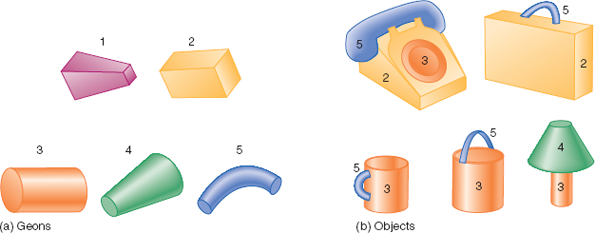
What does Recognition by components theory NOT explain?
grouping or organizations (some objects can’t be represented by assemblies of geons ex. clouds in the sky)
distinguishment between two categories (how can we tell 2 different mugs are different if they use the same geons?)
What is a scene?
A view of a real-world environment that contains:
background elements
multiple objects that are organized in a meaningful way relative to each other and the background
What is the gist of a scene?
General description of a scene that allows people to identify the scene after viewing them for only a fraction of a second
What is the Potter study on how long it takes to perceive the gist of a scene?
Participants were shown a target picture and then were asked to indicate if they saw that picture as or not as they flashed rapidly
FOUND
her observers could do this with almost 100% accuracy
What is persistence of vision?
A phenomenon in which perception of any stimulus persists for about 250 ms (1/4 second) after the stimulus is physically terminated.
What is a visual masking stimulus?
A visual pattern that, when presented immediately after a visual stimulus, decreases a person’s ability to perceive the stimulus.
What are structural description theories?
the viewpoints that there is invariant representation
we have one representation and argue our behaviors are invariant (we fast at recognizing objects from all directions for example)
What is template matching?
the viewpoint that we have dependent representation where we
a classical theory of pattern recognition. It proposes that the brain identifies objects, letters, or sounds by comparing incoming sensory input directly to a vast storehouse of exact, whole-form mental images or patterns (called templates) stored in memory.
What is Olivia & Torralba’s global image features?
Information that may enable observers to rapidly perceive the gist of a scene.
Features associated with specific types of scenes include degree of naturalness, degree of openness, degree of roughness, degree of expansion, and color.
What is the degree of naturalness?
natural scenes have more textured areas and undulating (wavy) contours while manmade scenes are dominated by straight lines and horizontals and verticals
What is the degree of openness?
the idea that open scenes often have a visible horizon line and contain few objects (ex. the ocean)
What is the degree of roughness?
low roughness in a scene (fewer elements. ex. ocean) vs high roughness of a scene (lots of elements. ex. forest)
What is the degree of expansion?
the convergence of parallel lines that indicates the degree of expansion
What are physical regularities?
Characteristics of the environment that occur regularly and in many different situations.
What is the light from above assumption?
The assumption that light usually comes from above, which influences our perception of form in some situations.
What are semantic regularities?
Characteristics associated with the functions associated with different types of scenes. These characteristics are learned from experience.
the things that belong in a given scene
What is a scene schma?
An observer’s knowledge about what is contained in typical scenes.
knowledge of what a scene typically contains