Compass Study Plan A: Physio Adaptation Quiz 1
 Call Kai
 Learn
 Practice Test
 Spaced Repetition
 Match
 Flashcards
 Knowt Play
1/12

There's no tags or description
Looks like no tags are added yet.
13 Terms
Which clinical findings would the nurse expect when assessing a client with hyperthyroidism? Select all that apply. One, some, or all responses may be correct.
Diarrhea
Listlessness
Weight loss
Bradycardia
Decreased appetite
Diarrhea
Weight loss
Excessive thyroid hormones increase the metabolic rate, causing an increase in intestinal peristalsis. Excessive thyroid hormones increase the metabolic rate, causing weight loss. Listlessness occurs with hypothyroidism because of a decreased metabolic rate. A slow pulse rate (bradycardia) accompanies hypothyroidism, not hyperthyroidism, because of a decreased metabolic rate. Appetite increases (polyphagia) with hyperthyroidism in an effort to meet metabolic needs.
During the infusion of dialysate during peritoneal dialysis, the client exhibits symptoms of severe respiratory difficulty. Which action would the nurse take?
Slow the rate of the client's infusion.
Place the client in a low-Fowler position.
Auscultate the client's lungs for breath sounds.
Drain the fluid from the client's peritoneal cavity.
Drain the fluid from the client's peritoneal cavity.
Pressure from the dialysate may cause upward displacement of the diaphragm; the dialysate should be drained from the peritoneal cavity. Additional fluid, even at a decreased rate of infusion, will aggravate the respiratory difficulty. The client should already be in the semi-Fowler position. Auscultation is important, but it does not alleviate the respiratory difficulty.
While walking in a hallway, a client with a chest tube becomes confused and pulls the chest tube out. Which action would the nurse take?
Place the client in the supine position.
Spread a clamp in the insertion site to hold the site open.
Obtain a sterile Vaseline gauze to cover the opening.
Cover the opening with the cleanest material available.
Cover the opening with the cleanest material available.
This emergency situation requires covering the opening with the cleanest material available to prevent atmospheric air from entering the thoracic cavity; the client's respiratory status takes priority over the potential for infection. Placing the client in the supine position is useless and will impair further the client's breathing. Using a clamp to hold the insertion site open is unsafe because it allows atmospheric air to enter the thoracic cavity. Although an occlusive dressing is desirable, atmospheric air will enter the thoracic cavity while time is taken to obtain the occlusive dressing.
For which complication would the nurse assess an infant with gastroesophageal reflux?
Bowel obstruction
Abdominal distention
Increased hematocrit
Respiratory problems
Respiratory problems
Reflux of gastric contents to the pharynx predisposes the infant to aspiration and the development of respiratory problems. There is no risk for a bowel obstruction; the problem is an incompetent esophageal sphincter. An increased hematocrit is not expected unless there is severe dehydration. Abdominal distention does not occur, because gastric contents are forcefully vomited.
Which clinical findings would the nurse anticipate for a client who has an exacerbation of multiple sclerosis? Select all that apply. One, some, or all responses may be correct.
Double vision
Resting tremors
Flaccid paralysis
Scanning speech
Intellectual disability
Double vision
Scanning speech
Diplopia (double vision) and nystagmus (involuntary, rapid, rhythmic eye movements) are experienced by clients with multiple sclerosis as a result of demyelination. Scanning (clipped) speech occurs with multiple sclerosis as a result of demyelination. These clients exhibit the Charcot triad: intention tremor, nystagmus, and scanning speech. Clients experience intention, not resting, tremors. Clients experience spastic paralysis because upper motor neurons are involved. Although emotional affect and speech are affected, intelligence remains intact.
The client reports excessive bleeding during menstruation. Which herbal therapies are unlikely to be prescribed by the primary health care provider? Select all that apply. One, some, or all responses may be correct.
Raspberry
Chamomile
Lady’s mantle
Chaste tree fruit
Shepherd’s purse
Chamomile
Chaste tree fruit
Chamomile is an antispasmodic agent that helps reduce breast pain. Chaste tree fruit is used to reduce breast pain by reducing the prolactin levels. Raspberry, lady’s mantle, and shepherd’s purse are uterotonic agents used to treat menorrhea.
While assessing the skin of a client, the appearance of which skin change supports the diagnosis of allergic contact dermatitis?
Red papules and plaques
Raised or irregularly shaped wheals
Red, macular, papular rash with abrupt onset
Bright erythema, oozing vesicles with extreme pruritus
Red papules and plaques
While examining a client’s skin, the primary health care provider finds red papules and plaques and concludes it is allergic contact dermatitis. Raised or irregularly shaped wheals are due to urticaria. A red, macular, papular rash with abrupt onset is due to medication reactions. Bright erythema, oozing vesicles with extreme pruritus is due to atopic dermatitis.
Which skin conditions would the nurse expect when performing a physical assessment on a client with a new diagnosis of hyperthyroidism? Select all that apply. One, some, or all responses may be correct.
Warm
Moist
Pale
Smooth
Coarse
Dry
Warm
Moist
Smooth
Hyperfunction of the thyroid gland causes diaphoresis, which makes the skin moist. Hyperthyroidism also causes smooth and warm skin. Pale, coarse, and dry skin is found with hypothyroidism.
Which statements are true regarding ectopic pregnancy? Select all that apply. One, some, or all responses may be correct.
Smoking is one of the risk factors for ectopic pregnancy.
Ectopic pregnancy is directly related to fetopelvic incompatibility.
Ectopic pregnancy occurs when the fertilized egg implants in the fallopian tubes.
When a young woman exhibits abdominal pain, ectopic pregnancy is suspected.
If the adolescent exhibits abdominal pain and hypotension, the ectopic pregnancy may have ruptured.
Smoking is one of the risk factors for ectopic pregnancy.
Ectopic pregnancy occurs when the fertilized egg implants in the fallopian tubes.
When a young woman exhibits abdominal pain, ectopic pregnancy is suspected.
If the adolescent exhibits abdominal pain and hypotension, the ectopic pregnancy may have ruptured.
Smoking is a risk factor for ectopic pregnancy. Ectopic pregnancy occurs when the fertilized egg implants outside the uterus, usually in the fallopian tubes. An adolescent exhibiting severe abdominal pain with hypotension is indicative of rupture of ectopic pregnancy and may need immediate surgery. Fetopelvic incompatibility is related to prolonged labor in younger teenagers of 12 to 16 years of age. However, it is not associated with ectopic pregnancy. Abdominal pain associated with or without bleeding, may indicate possible ectopic pregnancy. A pregnancy test and further assessment is needed.
When a client is newly diagnosed with chronic obstructive pulmonary disease (COPD), which action by the nurse has the highest priority?
Teach the client how to use the prescribed inhalers.
Discuss the normal progression of the disease process.
Ask whether the client is interested in quitting smoking.
Explain the purpose of a pulmonary rehabilitation program.
Ask whether the client is interested in quitting smoking.
Smoking cessation slows the progression of COPD and is the most important action that the client can take to help maintain lung function. Although many clients may not be ready to stop smoking, the nurse will assess the client’s interest in smoking cessation at every encounter. Teaching correct inhaler use is important, but inhaled medications only treat the symptoms of COPD and do not slow disease progression. The client will be educated on the progression of COPD, but education alone does not change the progression of the disease. Pulmonary rehabilitation programs are helpful in improving ability to do activities of daily living and also will assist the client with tobacco cessation, but assessment of readiness to quit smoking is done before developing a plan to quit.
The registered nurse is teaching a nursing student about ways to minimize heat radiation. Which statements made by the nursing student indicate effective learning? Select all that apply. One, some, or all responses may be correct.
"I will increase the distance between the client and cold surfaces."
"I will cover the client with dark clothes."
"I will instruct the client to remove extra clothes."
"I will instruct the client to lie in the fetal position."
"I will advise the client to wear sparsely woven clothes."
"I will increase the distance between the client and cold surfaces."
"I will cover the client with dark clothes."
"I will instruct the client to lie in the fetal position."
Increasing the distance between the client and cooler surfaces helps minimize heat radiation by reducing the temperature gradient between the client and nearby objects. Wearing dark clothes and lying in the fetal position will minimize heat radiation. Removing extra clothes will increase heat radiation. Wearing sparsely woven clothes will enhance heat radiation.
Upon assessment of a client, the nurse observed the condition depicted in the photo. Which is the likely cause of the clinical manifestations?
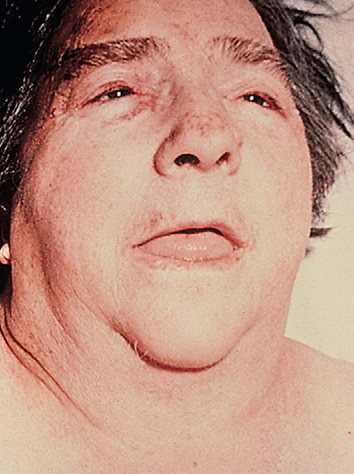
Decreased cardiac output
Decreased erythropoietin levels
Accumulation of mucopolysaccharides in blood vessel wall
Accumulation of hydrophilic mucopolysaccharides in tissues
Accumulation of hydrophilic mucopolysaccharides in tissues
The accumulation of hydrophilic mucopolysaccharides in tissues and dermis results in a condition called myxedema, which is seen in the image. Decreased cardiac output leads to decreased perfusion to the brain and other body systems. Decreased erythropoietin levels cause anemia in clients with hypothyroidism. Accumulation of mucopolysaccharides in blood vessel wall results in coronary atherosclerosis.
Which are manifestations of hypoestrogenism? Select all that apply. One, some, or all responses may be correct.
Hot flashes
Amenorrhea
Gynecomastia
Hypermenorrhea
Reduced bone density
Hot flashes
Amenorrhea
Reduced bone density
Low levels of estrogen may cause hot flashes, amenorrhea, and reduced bone density. Gynecomastia and hypermenorrhea are manifestations of excess estrogen production.