Chapter 10 Biological Rhythms and Sleep
 Call Kai
 Learn
 Practice Test
 Spaced Repetition
 Match
 Flashcards
 Knowt Play
1/85

There's no tags or description
Looks like no tags are added yet.
86 Terms
Biological rhythm that is about 24 hours long
Circadian
Biological rhythm that is less than 24 hours (can repeat many times during the day)
Ultradian
Biological rhythm that is longer than 24 hours
Infradian
Sleep/wake cycle is an example of what rhythm?
Circadian
Eating and hormone release are examples of what rhythm?
Ultradian
Menstrual cycle is an example of what rhythm?
Infradian
free-running rhythm
No external cues, maintaining own endogenous cycle
time between two similar points of successive cycles (like sunset to sunset)
Period
suprachiasmatic nucleus (SCN)
Master internal clock
Where is the SCN located?
hypothalamus
Entrainment
Shifting rhythm with external cues
Jet lag is the result of what?
Mismatch between internal and external time
zeitgeber (cue)
stimulus that entrains circadian rhythm
Special ganglion cells have a unique photopigment (melanopsin) that is sensitive to light and sends input to SCN
How light entrains rhythm
if someone lacks melanopsin, their circadian rhythms ___ __ _________
can be entrained
Rhythm is maintained _______ the body
outside
If lesion in SCN is present, what happens?
Internal clock is gone but external cues still present
Males are more likely to be _____ ____
night owls
___-_______ changes to circadian rhythm are present
age related
Synchrony
neurons firing together (low frequency, high amplitude)
Asynchrony
Neurons start in synchrony and then not (high frequency, low amplitude)
How many stages of sleep are there?
four
Stage 1 sleep
Asynchronous firing with little synchrony (low frequency, high amplitude)
What wave features are present in stage 1 sleep?
Alpha rhythms and vertex spikes
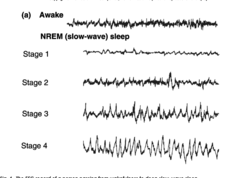
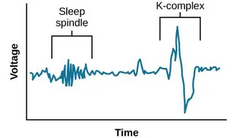
Stage 2 sleep
More synchrony with sleep spindles and K complexes
Stage 3 Sleep
Slow wave sleep (SWS)
SWS is said to be what type of sleep?
deep
Describe the neuronal firing during stage 3 sleep
Synchronous, high amplitude
What wave features are present in stage 3 sleep?
delta waves

REM sleep
Asynchrony, looks like someone who is awake/relaxed
Cerebral blood flow, neural firing rates, and temperature all increase (higher in REM than non-REM sleep)
What happens to brain during sleep
Heart rate and respiration are ______ in REM sleep compared to non-REM
Higher
While in REM sleep, postural tension and knee-jerk reflexes are __________
suppressed
While in REM sleep, there is an increase in ________ and _____ ___ _________
twitches, rapid eye movements
Hormone secretion during REM sleep is ___ while high in ___
low, SWS
Dreams are _____ during REM sleep and _____ during non-REM
vivid, vague
In the first 2 weeks of life, REM sleep accounts for how much of the infant's total sleep?
Half
Most people sleep ____ as they age, especially stage 3 sleep
Less stage 3 sleep can affect what?
physiology and cognition
Sleep deprivation behavioral effects vary by what?
age and personality
Irritability, difficulty in concentrating, and episodes of disorientation
most common behavioral changes from sleep deprivation
You never _______ all the sleep time you lost, but you may make up for the loss by having more intense sleep for a few nights
recover
the ______ you get to sleep, the ______ you recover
sooner
4 main functions of sleep
Energy conservation, niche adaptation, body and brain restoration, memory consolidation
Energy conservation
Use less energy when asleep
ecological niche
The unique assortment of environmental opportunities and
challenges to which each organism is adapted.
Niche adaptation
Fits each species' ecological niche, increasing chances of survival by avoiding predators and gathering food at better times
Body and brain restoration
deprivation increases risk factor for bad health outcomes - glymphatic system takes toxins out of brain
memory consolidation
SWS and REM sleep help memory formation, learning and recall
How many neural systems aid in the mechanism of sleep?
four
1st neural system
Forebrain system generates SWS
What can induce SWS activity in the basal forebrain?
Electrical stimulation
If the basal forebrain has lesions, what does it suppress?
sleep
Sleep active neurons in basal forebrain
become active at sleep onset
What is the main function of the forebrain system during sleep?
Gateway that helps turn the cortex up during waking and REM sleep, turns it down during deep sleep
2nd neural system
Brainstem system activates sleeping forebrain into wakefulness
Electrical stimulation of the brainstem does what?
activates forebrain, takes it out of SWS
Reticular formation
the activating system in brainstem
If the reticular formation is lesioned, what occurs?
persistent sleep (constant SWS)
3rd neural system
pontine system triggers REM sleep
the pontine system is called what?
REM sleep center, where some neurons are only active during REM
Function of pontine system
triggers REM sleep and prevents motor neurons from firing
Why is it important to prevent motor neurons from firing during sleep?
Muslces have no muscle tone (not just relaxed), cannot move during sleep
4th neural system
hypothalamic system coordinates the other three neural systems
Why does the hypothalamic system coordinate the other neural systems during sleep?
To know what stage we are in
What is the neuropeptide that is almost exclusively found in hypothalamus that is responsible for coordination and switching brain between the stages of sleep?
orexin/hypocretin
If orexin functions normally, what happens?
keeps sleep at bay and prevents direct transition from wakefulness into REM sleep
Narcolepsy
uncontrollable sleep attacks
Cataplexy
sudden loss of muscle control
trigger for cataplexy with narcolepsy
sudden, intense emotional stimuli
Cataplexy is the result of a loss of what?
orexin neurons
Insomnia
Problem of sleep quantity or continuity
Parasomnia
Abnormal behaviors or experiences that occur during sleep
Sleep state misperception
Sleeping without knowing
sleep apnea
unreliable respiration during sleep
How many non-REM related parasomnias were used as examples?
3
Night terrors
sudden arousals from SWS marked by intense fear and autonomic nervous system activation
Sleep enuresis
Bed wetting - associated with SWS, more common in children
What is a common treatment for Sleep enuresis?
nasal vasopressin (ADH)
Nasal vasopressin is given to those struggling with sleep enuresis because it does what?
increases water retention in kidneys
Somnambulism
Sleepwalking typically during SWS
How many REM related parasomnia examples were used?
two
Sleep paralysis
a temporary inability to move or talk just before falling asleep or just after waking
REM behavior disorder (RBD)
a sleep disorder in which a person physically acts out a dream
RBD occurs because of what?
muscle atonia of REM sleep is absent
Onset of RBD is followed by symptoms of what?
Parkinson's disease and dementia