BIO1050
 Call Kai
 Learn
 Practice Test
 Spaced Repetition
 Match
 Flashcards
 Knowt Play
 Podcast
1/475

Earn XP
Description and Tags
476 Terms
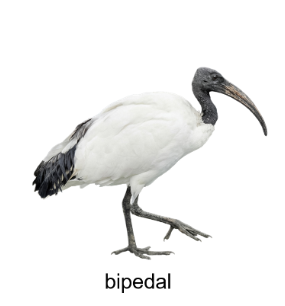
bipedal
animal that has two legs, upright body posture, as seen in humans and some birds.

quadrupedal
4 limbs typically used, Horizontal body posture, Example of cats and dogs
Bipedalism and quadrupedalism are…
locomotory strategies (moving your whole body from place to place, such as walking, swimming or flying.)
flexibility allows animals to…
optimise stability, speed, energy efficiency, or access to resources under different circumstances.

Locomotor classification should be viewed as a description of..
predominant mode of movement rather than an absolute state
(It can switch)
Superior
toward the head, upper part of the body, or above another structure

Inferior
toward the feet, lower part of the body, or below another structure

Anterior
toward the front of the body, toward the head

Posterior
toward the back of the body, toward the tail

Dorsal
toward the back or upper surface of the body

Ventral
toward the belly or lower surface

Superficial
closer to the body surface

Deep
farther from the body surface

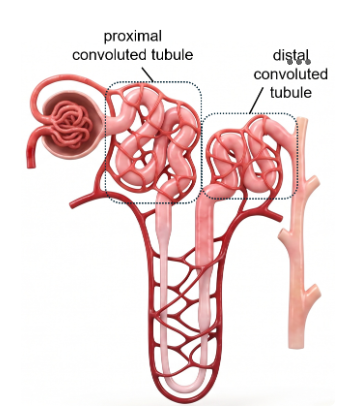
Proximal
closer to the point of attachment

Distal
farther from the point of attachment
Medial
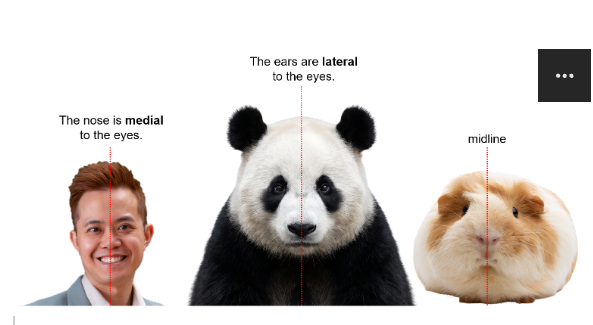
closer to the midline of the body
Lateral
farther from the midline of the body

What does skeleton do?
Fight against gravity
Moving
hold the body up
Hydrostatic skeleton
Closed pocket, Muscle squeeze the shape and make it move
Example of Hydrostatic skeleton
Jellyfish (cnidarians)
Roundworms (nematodes), flatworms and earthworms (annelids)
Advantageous for Hydrostatic skeleton
Flexible
fit into tight space
Cost less energy
no mineral
Disadvantageous for Hydrostatic skeleton
Almost no protection
wet place to live
keeps the animal small
Exoskeleton
A hard shell on the outside
Made of calcium carbonate or chitin
Example of Exoskeleton
Mollucus (calcium carbonate)
arthropods (chitins)
Advantageous for Exoskeleton
Protects from predators
Stops the body drying out (Desiccation)
Disadvantageous of Exoskeleton
Limit size must be shed to grow
needs lots of minerals from food
Endoskeleton
A hard skeleton inside the body
made of bone and/or cartilage
Examples of Endoskeleton
Vertebrates + few others like starfish
Advantageous for endoskeleton
Supports big bodies
grows without shedding
allows lots of movement
Disadvantageous of endoskeleton
Soft parts are left exposed
needs lots of minerals from food
Skeleton and growths
Animals with exoskeleton grow by moulting, called ecdysis.
They shed the old shell, grow a bigger soft one and then hardens.
Hydrostatic skeleton of body size
The bigger you get, the harder it is to hold your shape with fluid so they stay fairly small.
Biggest animal: giant squid
Exoskeleton of body size
As the animal grows, the shell must get much thicker and heavier, so it becomes too heavy to carry. This keeps animals with an exoskeleton fairly small.
Endoskselton of body size
Grows from the inside and can keep being rebuilt. It can hold huge bodies
Calcium carbonate
a hard mineral found in shells and corals
Calcium phosphate
makes bones and teeth hard
Cartilage
Bendy tissue in joints
Chitin
A tough sugar based material in insect shells and in the walls of fungus cells
Collagen
A stretchy, strong protein in bone and skin.
stops tissue from tearing when pulled
Keratin
a tough protein in hair, nails, claws, horns, feather, scales
Bone structure
How bone is built, hard, solid compact bone on the outside and light, holey spongy bone on the inside where the marrow is
Flying Birds
light
hollow
air-filled bones (pneumatic)
they are light enough to fly
Diving birds
Heavier bones
sink more easily
Dugongs
Very thick
Heavy bones (osteosclerosis)
A weight to keep them on the seafloor while they eat seagrass
Dolphins
Light bones
Swim fast and turn easily
Plants (no skeleton)
Cellulose (strong fibers that resist being pulled apart)
Lignin (the walls stiff and hard to crush, and helps them resist rotting)
Trees can grow over…
100 m tall
Termites can’t break down cellulose and ligin by themselves, they rely on…
Tiny Microbes
What is it called if both sides help each other?
Symbiotic Relationship
Skeletal muscle
Muscle joined to your bones
Striated (looks striped under a microscope)
Voluntary (you choose when to move it)
It moves you, hold posture, and makes heat
Structure of muscle built
Muscle → muscle fibre → myofibril → sarcomere → actin and myosin filaments
Muscle Fibre
One muscle cell
Huge (Up to 30 cm long)
Myofibril
Long strands inside the fibre
Sarcomere
tiny unit that actually shortens when you contract
Thin Filaments
Made of actin
Attached to the end of the sarcomere (Z lines)
Thick filaments
Made of myosin
Attached to the middle
when a muscle contracts
The filaments don’t get shorter, they slide over each other, so the sarcomere gets shorter.
Myosin grabs actin and pulls it toward the middle (The M line)
Myosin
Has two heads
Each head has a spot to grab actin and a spot to hold ATP
Three protein for thin Filament
Actin: The backbone, with spots where myosin can grab on
Tropomyosin: A rope like a protein that covers those spots when the muscle is resting
Troponin: The switch, when calcium (Ca2+) sticks to it, it moves tropomyosin out of the way and uncovers the spots
Cross bridge cycling
ATP sits on the myosin head
ATP is broken into ADP and phosphate
The Head grabs actin. This link is called a cross-bridge
ADP and phosphate are released, and the head snaps back, pulling actin (Power stroke)
A new ATP sticks to the head, which makes it let go
Neuromuscular junction
Where a nerve meets a muscle
Excitation-contraction coupling
An electrical signal in the muscle leads to it contracting
Nerve to muscle
Nerve signal (An action potential) and the nerve releases acetylcholine (ACh, a chemical Messager)
ACh sticks to the muscle cell and lets sodium rush in, causing depolarises meaning it changes its electrical charge
The siginal travels deep into the muscle through tunnels called T tubules
Calcium released from sarcoplasmic reticulum, the muscle’s calcium storage tank
Calcium sticks to troponin, which uncovers the spots on actin
Cross-bridges form and the power stroke happens
Calcium is pumped back into storage. ATP required.
Rigor mortis
“Stiffness of death”. After death, no more ATP is made:
Calcium leaks out and can’t be pumped back, spots stay uncovers
Myosin grabs actin but can’t let go because needs ATP
Muscle locked and stiff until proteins break down later
A single fibre works in…
An all or nothing way
One contraction = ?
Twitch
Motor unit size
one nerve cell plus all the muscle fibres it controls
Small units
Control just a few fibres and are good for fine control, like your fingers and eyes
Large units
Many fibres and are good for strong jobs, like calves
Henneman’s size principle
Small units are switched on first and large ones are added as you need more force
Switching on more units gives
more force
How often the signals comes
One signal gives a twitch
Fast signal = the muscle can’t relax between twitches, so the force builds up (Summation)
Very fast signal = Give one smooth, constant contraction (Tetanus)
Too squashed = ?
There’s no room left to shorten so it’s weak
Too stretched = ?
The filaments barely overlap and can’t grab each other
It’s weak
Just Right: The most force. Muscles are arranged in your body to sit near this best length
Locomotion
Moving from one place to another for food, escape predators, find mates, and spread into new areas (dispersing).
Different ways moving (Walking, swimming, flying, burrowing) have shaped how bodies evolved
Hydrostatic, simple muscles (nematode)
Fluid acts as the skeleton
Only Longitudinal muscles (Running along the body)
no joints or tendons
What movement does Hydrostatic, simple muscles (nematode) gives?
Just side to side wiggling (Sinusoidal meaning S-shaped waves)
Simple and not precise
Hydrostatic, Complex muscles (earthworm)
Has bot circular muscles (rings around the body)
longitudinal muscles
Each body segment works like it’s own little fluid unit
What movement does Hydrostatic, Complex muscle (earthworm) gives?
Can stretch
Shorten and anchor segments
Makes it good at burrowing (digging)
Exoskeleton (movement)
Muscle attach to the inside of the shell
Movement happens at articulated joints (bendy joints between hard parts)
No tendons needed
What movement does Exoskeleton gives?
Fast
Precise
Powerful
moves like walking, jumping and flying
But It has to moult to grow
Endoskeleton (movement)
Muscles attach to bones by tendons
Bones act the levers that make the muscle’s force bigger
What movement does Endoskeleton gives?
The widest range of strong, well-controlled movement.
3 types of human joints
Fibrous
Cartilaginous
Synovial
What is held together by for Fibrous, Cartilaginous and Synovial
Fibrous: Tough collagen tissue
Cartilaginous: Cartilage
Synovial: A joint capsule around a fluid-filled space
What movement does fibrous, Cartilaginous and synovial has?
Fibrous: little to none
Cartilaginous: A little
Synovial: the most
Example for Fibrous, Cartilaginous, Synovial
Fibrous: Skull sutures
cartilaginous: Growth plate
Synovial: Knee, hip, shoulder
Case study Flea
Fleas have an exoskeleton with joints that act like pivots (Turning points)
They also have resilin, a stretchy protein that works like a spring
Muscles slowly load energy into it, then it releases the energy all at once
This lets fleas jump many times their own body length. Dragonflies use resilin in their flight muscles too
Fast twitch
Speed: fast
Force: higher
Get tired: Quickly
Energy: Anaerobic (no oxygen)
Myoglobin (A protein that stores oxygen): Little, so the muscle looks white
Mitochondria: Fewer
Good for: Short burst of power
Animals: Cheetah, sprinting fish
Slow Twitch
Speed: Slow
Force: Lower
Get tired: Hardly
Energy: Aerobic(Uses oxygen)
Myoglobin (A protein that stores oxygen): Lots, so the muscle looks red
Mitochondria: Many
Good for: Endurance
Animals: Wolves, tuna
Cheetah (case study: Human vs Cheetah)
Cheetahs have lots of fast twitch fibres
A bend spine
Stretchy tendons
Makes them super fast but only for a short time
Cheetah can’t chase prey over long distance
Human (case study: Human vs Cheetah)
More slow twitch fibres
Keep going for much longer
Case study: Tuna
Red muscle (Slow-twitch) used for steady
non-stop cruising
Full of myoglobin
mitochondria and blood vessels
White muscle (Fast-twitch used for quick bursts like chasing prey or escaping
Salmon is orange because of pigments (Colour chemicals) from it’s food
When you touch something hot:
sensory neuron → interneuron → motor neuron → muscle pulls away
Sensory neuron
carries the message to the spinal cord.
Interneuron
A middle part nerve cell in the spinal cord that links the other two
Motor neuron
carries the message out to the muscle.
Knee-Jerk reflex
Stretch reflex: it’s set off when a muscle is stretched
Postural support: Keeping you steady and balanced while moving
This check for nervous system
4 steps for reflexs
Stretch: A tap on the patellar tendon, quickly stretches the quadriceps
Detect: Muscle spindles notice the muscle got longer They send a signal along the sensory neuron to the spinal chord
Integrate in the spinal cord:
Connects straight to the motor neuron for the quadriceps
Connects through an interneuron that inhibits (switches off)
Response: The quadricep contracts and the hamstring relax so your lower leg kicks foward
Hamstrings need to relax because…
Muscle spindles sense a stretch and the spinal cord tells the quadriceps to contract and the hamstring to relax so it kicks out