SENSORY SYSTEM: SPECIAL SENSES: HEARING & EQUILIBRIUM
 Call Kai
 Learn
 Practice Test
 Spaced Repetition
 Match
 Flashcards
 Knowt Play
1/25

There's no tags or description
Looks like no tags are added yet.
26 Terms
Outer Ear
Portion of the ear that collects and channels sound; includes the auricle, external auditory canal, and tympanic membrane.

Pinna (auricle)
Visible external part of the ear that collects sound waves and funnels them into the auditory canal.

external acoustic meatus (auditory canal)
Passage that carries sound waves from the auricle to the tympanic membrane

middle ear
Air-filled cavity containing the auditory ossicles; transmits vibrations from the tympanic membrane toward the inner ear.

tympanic membrane
Eardrum; vibrates when struck by sound waves.

auditory ossicles
Three small middle-ear bones that amplify and transmit vibrations to the oval window. From lateral to medial.
malleus
"Hammer"; ossicle attached to the tympanic membrane that passes vibrations to the incus.

incus
"Anvil"; ossicle that passes vibrations from the malleus to the stapes.

stapes
"Stirrup"; ossicle whose footplate transmits vibrations to the oval window.

inner ear
Region containing the cochlea for hearing and the vestibule and semicircular canals for equilibrium.

oval window
Membrane-covered opening between the middle ear and vestibule; receives vibrations from the stapes and transmits them into inner-ear fluid

round window
Membrane-covered opening that allows pressure relief as fluid moves within the cochlea.

Cochlea
Spiral-shaped inner-ear structure containing the receptors for hearing.
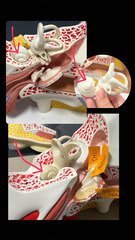
scala tympani
Perilymph-filled chamber below the cochlear duct; ends at the round window.

scala vestibuli
Perilymph-filled chamber above the cochlear duct; receives pressure waves entering through the oval window.

basilar membrane
Membrane forming the floor of the cochlear duct and supporting the organ of Corti; vibrates in response to sound.

tectorial membrane
Gel-like membrane overlying the hair cells of the organ of Corti; relative movement between it and the hair cells helps bend their sensory projections.

cochlear duct
Endolymph-filled middle compartment of the cochlea that contains the organ of Corti.
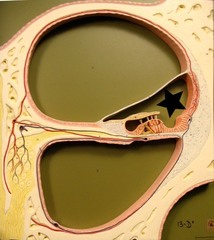
Organ of Corti
Sensory organ for hearing, located on the basilar membrane within the cochlear duct; contains hair cells.

hair cells
Sensory receptor cells that detect mechanical movement. In the cochlea, bending their sensory projections produces electrical signals that stimulate the cochlear nerve fibers.

vestibule
Central region of the inner ear involved in equilibrium; contains the utricle and saccule.

Utricle
Membranous sac in the vestibule that detects head tilt and mainly horizontal linear acceleration, such as moving forward in a car.
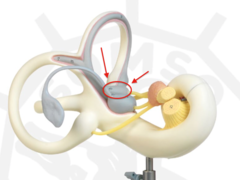
Saccule
Membranous sac in the vestibule that detects head position relative to gravity and mainly vertical linear acceleration, such as riding an elevator.

semicircular canals
Three bony canals of the inner ear that house the semicircular ducts; associated with detecting rotational head movements.

semicircular ducts
Endolymph-filled tubes inside the semicircular canals; receptors in their enlarged ends detect rotational acceleration of the head.

Eustachian tube (pharyngotympanic tube)
Tube connecting the middle ear to the nasopharynx; equalizes air pressure across the tympanic membrane.
