Anatomy final exam upper limb slide deck 1 (pictures used for labelling included)
 Call Kai
 Learn
 Practice Test
 Spaced Repetition
 Match
 Flashcards
 Knowt Play
1/247

There's no tags or description
Looks like no tags are added yet.
248 Terms

what is the origin of latissimus dorsi?
from spinous processes of inferior thoracic vertebrae, thoracolumbar fascia, iliac crest, and inferior ribs


what is the insertion of latissimus dorsi?
intertubercular sulcus of humerus
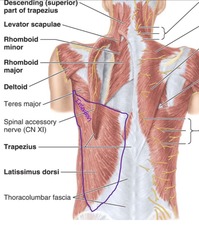
what is the innervation of latissimus dorsi?
thoracodorsal nerve
what are the actions of latissimus dorsi?
extends, adducts, and medially rotates humerus
What is the muscle classification of the latissimus dorsi, location and depth?
-posterior axio-appendicular muscle
- superficial
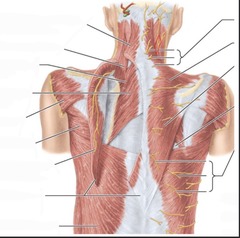
label the latissimus dorsi

what muscle is involved in folding ones arms behind the back or scratching the skin over the opposite scapula?
latissimus dorsi
what muscle in combination with pectoralis major, is a powerful adductor of the humerus?
latissimus dorsi
what plays a major (indirect) role (via its humeral attachment) in downward rotation of the scapula?
latissimus dorsi
what raises the trunk to the arm and is thus important in climbing, doing chin-ups, swimming, and paddling a canoe (for these actions the origin and insertion are switched)
latissimus dorsi
What is the muscle classification of the levator scapulae, location and depth?
-posterior axio-appendicular muscles
-deep


what is the origin of the levator scapulae?
from transverse process of upper cervical vertebrae


what is the insertion of the levator scapulae?
superior part of medial (vertebral) border of scapula (I)
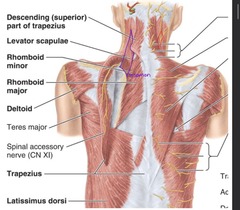
What is the innervation of the levator scapulae?
C3, C4, and dorsal scapular nerve
What is the action of the levator scapulae?
elevates scapula, rotates glenoid inferiorly
What is the muscle classification of the rhomboid major, location and depth?
-posterior axio-appendicular muscles
-deep


label the levator scapulae


What is the origin of the rhomboid major?
spinous processes of upper thoracic vertebrae


What is the insertion of the rhomboid major?
medial border of scapula

What is the innervation of the rhomboid major?
dorsal scapular nerve
What is the action of the rhomboid major?
retract scapula and rotate glenoid cavity inferiorly
what is the muscle classification of the rhomboid major?
posterior axio-appendicular deep muscle

label the rhomboid major
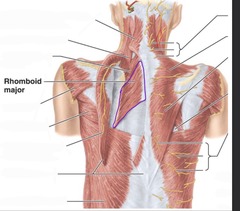

What is the origin of the rhomboid minor?
spinous process of C7 and T1 vertebrae


What is the insertion of the rhomboid minor?
medial border of scapula

What is the innervation of the rhomboid minor?
dorsal scapular nerve
What is the action of the rhomboid minor?
retract scapula and rotate glenoid cavity inferiorly
What is the muscle classification of the rhomboid minor, location and depth?
-posterior axio-appendicular muscles
-deep


label the rhomboid minor

The axio-appendicular muscles serve to position the base from which the ___________ limb will function relative to the ________.
The axio-appendicular muscles serve to position the base from which the (upper) limb will function relative to the (trunk).
Some of axio-appendicular muscles work _____________ to elevate-depress and protract-retract the entire __________.
Some of axio-appendicular muscles work (antagonistically) to elevate-depress and protract-retract the entire (scapula).
other muscles rotate the __________ to elevate or depress the ________ cavity/ shoulder joint.
other muscles rotate the (scapula) to elevate or depress the (glenoid) cavity/ shoulder joint.
The clavicle (the only limb attachment to the axial skeleton) ________ all movements of scapula.
The clavicle (the only limb attachment to the axial skeleton) (limits) all movements of scapula.
most scapular movements involve the cooperation of 2 or more muscles with different innervations; therefore, single nerve injuries typically weaken, but do not ________ the movements.
most scapular movements involve the cooperation of 2 or more muscles with different innervations; therefore, single nerve injuries typically weaken, but do not (eliminate) the movements.
Pectoralis major and latissimus dorsi additionally move the ______ and subclavius moves the ___________.
Pectoralis major and latissimus dorsi additionally move the (humerus) and subclavius moves the (clavicle).
what muscles make up the posterior axio-appendicular muscles?
-latissimus dorsi
-levator scapulae
-rhomboid major
-rhomboid minor

what is the origin of the deltoid?
clavicle and acromion and spine of scapula
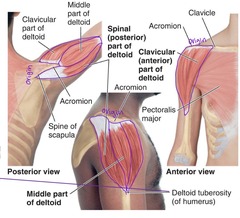

What is the insertion of the deltoid?
deltoid tuberosity of humerus

What is the innervation of the deltoid?
axillary nerve
What is the action of the deltoid?
flex and medially rotate arm (clavicular part); abduct arm (middle part or all 3 parts); extend and laterally rotate arm (spinal part)
what the muscle classification of Deltoid?
-scapulohumeral muscles
what are the three parts of the deltoid called?
-clavicular
-middle
-spinal

Label the three parts of the deltoid


What is the origin of the teres major?
inferior angle of scapula


What is the insertion of the teres major?
near intertubercular sulcus of humerus
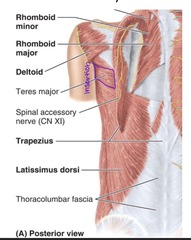
What is the innervation of the teres major?
lower subscapular nerve
What is the action of the teres major?
adducts and medially rotates arm
what is the muscle classification of the teres major?
-scapulohumeral mucles

label the teres major


What is the origin of the supraspinatus?
supraspinous fossa of scapula


What is the insertion of the supraspinatus?
greater tubercle of humerus

What is the innervation of the supraspinatus?
suprascapular nerve
what is the action of the supraspinatus?
Aids deltoid in arm abduction.
what is the muscles classification of the supraspinatus?
-scapulohumeral muscles

label the supraspinatus

What 4 muscles compose the rotator cuff?
supraspinatus, infraspinatus, teres minor, subscapularis
SITS muscles
Each rotator cuff muscle, in addition to the function listed on its slide, performs the function of ______________ and pulling the humeral head medially into and against the scapula's glenoid cavity during ___________ movements.
Each rotator cuff muscle, in addition to the function listed on its slide, performs the function of (grasping) and pulling the humeral head medially into and against the scapula's glenoid cavity during (shoulder) movements.
The SITS muscles' tendons blend with the ________ layer of the capsule of the shoulder joint to form a ___________________, which reinforces the joint capsule.
The SITS muscles' tendons blend with the (fibrous) layer of the capsule of the shoulder joint to form a (musculotendinous rotator cuff) , which reinforces the joint capsule.

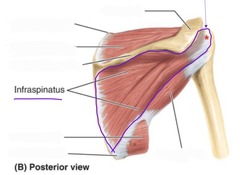
what is the origin of the infraspinatus?
infraspinatus fossa of scapula


What is the insertion of the infraspinatus?
greater tubercle of humerus

What is the innervation of the infraspinatus?
suprascapular nerve
what is the action of the infraspinatues?
laterally rotates arm
what is the muscle classification of the infraspinatus?
-scapulohumeral muscles

label the infraspinatus

What is the origin of the teres minor?
lateral border of scapula


What is the insertion of the teres minor?
greater tubercle of humerus

What is the innervation of the teres minor?
axillary nerve
what is the action of the teres minor?
laterally rotates arm
what is the muscle classification of the teres minor?
-scapulohumeral muscles

label the teres minor


What is the origin of the subscapularis?
subscapular fossa of scapula


What is the insertion of the subscapularis?
lesser tubercle of humerus

What is the innervation of the subscapularis?
subscapular nerve
What is the action of the subscapularis?
medially rotates arm
what is the muscle classification of the subscapularis?
-scapulohumeral

label the subscapularis

the scapulohumeral muscles act in __________ groups to abduct/adduct, flex/extend, medially rotate/laterally rotate, and circumduct the humerus.
the scapulohumeral muscles act in (opposing) groups to abduct/adduct, flex/extend, medially rotate/laterally rotate, and circumduct the humerus.
the scapulohumeral muscles established the height and distance from the trunk of the humerus, and thus establishes the spot and direction from which the _________ and the _________ will operate.
the scapulohumeral muscles established the height and distance from the trunk of the humerus, and thus establishes the spot and direction from which the (forearm) and the (hand) will operate.
All movements produced by the scapulohumeral musecles at the glenohumeral joint are essentially accompanied by movements produced by the ___________________ muscles at the sternoclavicular and scapulothoracic joints.
All movements produced by the scapulohumeral musecles at the glenohumeral joint are essentially accompanied by movements produced by the (axio-appendicular) muscles at the sternoclavicular and scapulothoracic joints.
what muscles make up the scapulohumeral muscles?
-deltoid
-teres major
-SITS muscles
what is the name of the fat-filled compartment most inferior to the glenohumeral joint at the junction of the arm and thorax?
axilla
What provides housing and a passageway for lymph nodes and for neurovascular structures to and from the neck/thorax and the entire upper limb (including the pectoral, scapular, and subscapular regions as well as the free limb)
axilla
axillary structures are normally protected by the arm but are vulnerable when the arm is ________.
axillary structures are normally protected by the arm but are vulnerable when the arm is (abducted)
Nerves and vessels traversing the axilla are ensheathed in a protective wrapping that is an extension of the cervical fascia, what is it called?
axillary sheath
Nerves and vessels traversing the axilla are ensheathed in a protective wrapping that is an extension of the cervical fascia, embedded in a cushioning matrix that allows flexibility. what is the cushioning matrix called?
axillary fat
Nerves and vessels traversing the axilla are ensheathed in a protective wrapping that is an extension of the cervical fascia, embedded in a cushioning matrix that allows flexibility, and are surrounded by ______________ walls.
Nerves and vessels traversing the axilla are ensheathed in a protective wrapping that is an extension of the cervical fascia, embedded in a cushioning matrix that allows flexibility, and are surrounded by (musculoskeletal) walls.
Where does the axillary artery begin? what artery is it a continuation of?
begins at the first rib; continuation of the subclavian artery
The subclavian artery is a branch from either of what two arteries?
branch of the aortic arch (left side) or the brachiocephalic trunk (right side)
when the axillary artery enters the inferior border of teres major, it enters the arm and is renamed what artery?
brachial artery
The axillary artery is divided into how many parts?
3 parts
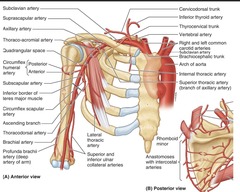

Where is the axillary artery located?


where is the subclavian artery located?
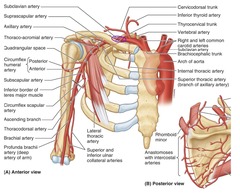

where is the brachial artery located?

Regarding the 3 parts of the axillary artery, the first part of the artery gives rises to how many major branch(es)?
1 major branch
Regarding the 3 parts of the axillary artery, the second part of the artery gives rises to how many major branch(es)?
2 major branches
Regarding the 3 parts of the axillary artery, the third part of the artery gives rises to how many major branch(es)?
3 major branches
all of the branches of the axillary artery (6 total branches) supply blood to all or part of what muscles? and what other structures?
-subclavius
-pectoralis major and minor
-serratus anterior
-latissimus dorsi
-deltoid
-teres mjajor
-SITS muscles
-shoudler joint
-axillaray lymph nodes
-mammary glands
What does the axillary artery indirectly supply?
the entire upper limb by continuing as the brachial artery
The axillary vein is formed by the union of what two veins?
-brachial vein
-basilic vein
Where does the axillary vein lie in relation to the axillary artery?
lies mostly slightly anterior and slightly inferior to the axillary artery