EXAM 3 MS
 Call Kai
 Learn
 Practice Test
 Spaced Repetition
 Match
 Flashcards
 Knowt Play
1/63

There's no tags or description
Looks like no tags are added yet.
64 Terms
What are antioxidants?
Prevent oxidation
What are natural antioxidants?
Rosemary
Vitamin E
What are synthetic antioxidants/
BHA
BHT
Why are LED lights preferred over Fluorescent
They produce less heat
Overwrap PVC
Short self life
Oxidize quickly
More oxygen
Modified Atmosphere Packaging
High oxygen
80% oxygen
20% Co2
Longer shelf life
Vacuum packaging
Removes O2
Deoxy myoglobin

Detect gasses
Monitors pH
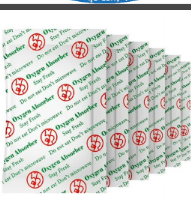
Absorbs oxygen

Nanocoating
Antimicrobial
Blocks oxygen
Slows oxidation
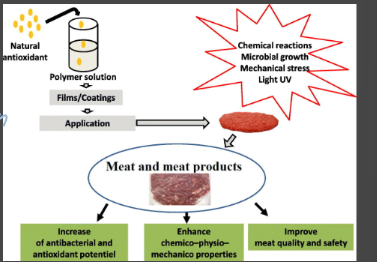
Edible film
Slows oxidation

Biodegradble

Time freshness tracking
Reading pH
What are short term refrigeration temps
32-40*F
What is immersion in ice water used for?
Poultry
Standard freezing
-18*C
6-12 hrs
3-6 months
Blast freezer
-30* to -40*C
-10*F
3-6 hrs
Up to 18 months
Longterm packaging
Vacuum packaging
Freezer burn
Not a food safety concern
Food palatability issue
Cold storage and curing chambers
pH below 5
What does salting do
Dry’s out meat
Curing agent
Sodium nitrates
Cured meat color
Cured meat flavor
Prevents clostridium botulin
Hot smoking
165-200*F
Quicker, fewer hours
Cold smoking
Temps below 90*F
Allows product to absorb flavor
Fish & Cheese
What is fermentation
Beneficial bacteria
Produces lactic acid
Lowers pH
What is canning
Air tight
Pre-cooked
What is meat processing
Altering something from its original form
Ground beef
30% fat
Cannot have added fat
Hamburger meat
30% fat
Can have added fat
What is dry aging
Stored in controlled environment (controlling temp & humidity)
Calpains (natural enzymes)
Loses 15-30% moisture
What are calpains responsible for?
Breaks down the structural parts of a sarcomere
Makes the product tender
What is wet aging?
Vacuum sealed
Aging in its own juices
Refrigerate for 7-28 days
Less texture changes
Cheaper and can do at home
What does a mechanical tenderizer do
Breaks down meat (makes tender)
Pineapple
Bromalin
Figs
Ficin
Papaya
Papain
Rib
9%
2nd most valuable part of beef carcass
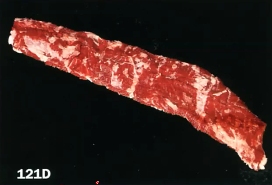
Inside skirt
Bigger
Shall be dropped to prevent cutting in half when ribbing the carcass
Fajita meat
Rib plate separation
3 inches from LD on the rib end
4 inches from LD on the chuck end
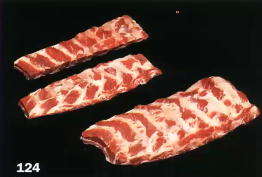
Back rib
To make boneless ribeye steaks, take this part off
Remove chine bones

Ribeye roll
Remove from cap and wedge meat at natural seam
The lip measures 2×2 in from the LD on both ends
Remove backstrap
Surface should be practically free of fat
Prepare as 2×2
Neck strap should be removed

Untrimmed Short ribs
Can be derived from the primal rib or the primal plate (ribs 6-10)
Trimmed short ribs
Can be derived from the primal rib or the primal plate
Made up of ribs 6, 7, and 8 only
External surface shall be practically free of fat
What are Flanken style ribs referred to as?
Korean ribs
Loin
17% most valuable
Short loin (9%)
Sirloin (8%)
What are minor cuts of the hindquarter?
Flank
Tri tip
Sirloin flap (bavette)
Picanha

Flank
Removed at the natural seam from the fat
The membrane is removed from it and trimmed free of fat
Fajita
Round-full separation
A saw cut is made between the 4th and 5th sacral vertebrae, and through a point 1 inch from the most anterior portion of the aitch bone
The cut should shave a silver dollar-sized piece of bone from the head of the femur (butcher’s dollar)
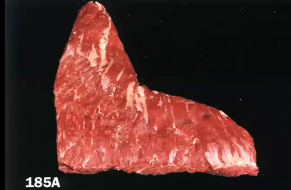
Bavette
Sirloin flat
Kidney fat is removed
Fajita

Tenderloin
Most tender muscle (psoas major)
Most expensive
Short loin—Sirloin seperation

Make a cut through the middle of the last lumbar vertebra

Strip loin
Picanha
Sirloin Cap

Tri tip
T bone vs Porterhouse
Porter house has gluteus Medius muscle
Hind Quarter
48% of carcass
Round 24%
Loin from round
1 in anterior of the aitch bone
Rib from Loin
Between 12 & 13 rib
Chuck from rib
Between 5 & 6 rib

Sirloin tip
The knuckle
Removed by a cut that starts above the patella
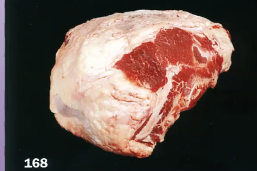
Aitch bone and trimmed to ¼ inch
Inside round
What is the goose neck round?
Heel
Eye of round
bottom round flat

Heel/ Pikes peak roast
Removed from the bottom round flat at the natural seam

Eye of round
½ thick steak
Tenderize round steak'
Chicken fried steak