Depression pathophysiology
 Call Kai
 Learn
Learn Practice Test
 Spaced Repetition
 Match
Match Flashcards
 Knowt Play
1/32

There's no tags or description
Looks like no tags are added yet.
Name | Mastery | Learn | Test | Matching | Spaced | Call with Kai | Chat |
|---|
No analytics yet
Send a link to your students to track their progress
33 Terms
Describe the monoamine theory of depression.
- Depression is caused by a deficit in monoamine neurotransmitters (serotonin and noreadrenaline).
- Theory developed as drugs that reduced activity of these neurotransmitters caused symptoms of depression.
What drugs can affect monoamine nuerotransmitters?
- Tricyclic antidepressants
- MAO inhibitors
- Tryptophan
- Reserpine
- a-methyltyrosine
- Methyldopa

Which drugs that affect monoamine neurotransmitters enhance mood?
- Tricyclic antidepressants
- MAO inhibitors
- Tryptophan

Which drugs that affect monoamine neurotransmitters reduce mood?
- Reserpine
- a-methyltyrosine
- Methyldopa

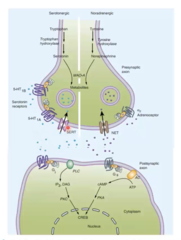
What is the MOA of drugs that affect monoamine neurotransmitters?

How effective is the inhibition of NA vs 5-HT reuptake in treating depression?
Both are equally effective in alleviating depressive symptoms.
What is the time gap between neurochemical changes and clinical antidepressant effects?
While neurochemical actions are rapid, clinical antidepressant effects take weeks to develop.
Secondary adaptive changes
What secondary adaptive changes occur after long-term antidepressant usage?
- Serotonin autoreceptor desensitisation.
- Increased BDNF expression.
How does serotonin autoreceptor desensitisation treat depression (secondary adaptive)?
- When serotonin levels rise, 5-HT₁A autoreceptors detect it and inhibit further serotonin release.
- SSRIs block serotonin reuptake, leading to increased serotonin in the synaptic cleft.
- This initially overstimulates 5-HT₁A autoreceptors, limiting additional serotonin release.
- With chronic SSRI exposure, these autoreceptors desensitise causing the inhibitory brake to be lifted
- This allows serotonergic neurons to fire more and release more serotonin.
- This enhances serotonin signalling in brain treating depression.
- Explains delayed therapeutic effect.
How does increased BDNF expression lead to treatment of depression (secondary adaptive)?
- BDNF increases neurotrophic factor that supports brain health.
- Depression lowers BDNF causing damage to the hippocampus.
- Antidepressants increase BDNF which promotes neuronal growth and synaptic plasticity.
- This contributes to long-term recovery in depression.
Describe the SLC6 transporters
- e.g., SERT, NET
- They reuptake serotonin and noreadrenaline.
- They are symporters with Na+ across plasma membrane.
- Dependent on extracellular Cl-
- Some can transport K+

Describe the structure of the SERT transporter.
- 12 transmembrane domains
- Intracellular N and C terminus
- Large glycosylated EC loop between TM3 and 4.
- Alternating access model
- Substrate binding site.

Describe reuptake inhibitors.
- Prevent the reuptake of serotonin or NA into neurons.
- Increases levels of serotonin and/or noreadrenaline in synapse.
- SSRIs = selective serotonin reuptake inhibitors.
- SNRIs = serotonin & noreadrenaline reuptake inhibitors.
What are examples of SSRIs?
- Fluoxetine
- Paroxetine
- Sertraline
- Sitalopram
- Escitalopram, fluvoxamine
What are examples of NDRI (only noreadrenaline)?
- Buproprion
- Reboxetine
- Atomoxetine
What are examples of mixed drugs which work on serotonin and noreadrenaline?
- Venlafaxine
- Duloxetine
What are examples of tricyclic antidepressants (non-selective)?
- Amitryptiline
- Imipramine
- Desipramine
What are the consequences of increased 5-HT3 and NA activity?
- Increased signalling through 5-HT3 and NA receptors.
- Gene expression changes, neurogenesis and chronic adaptive changes.
How can noreadrenaline control 5-HT release?
- Can act on excitatory a2 receptors to enhance 5-HT release.
- a2 receptors are downregulated by antidepressants.
- a2 receptor antagonsist could further enhance serotonin release e.g., Mirtazapine or mianserin.
What is the function of Monoamine Oxidase (MAO)?
MAO breaks down monoamine neurotransmitters.
What are the two forms of Monoamine Oxidase (MAO)?
- MAO-A: Found in the CNS. Breaks down serotonin and NA.
- MAO-B: Found in the CNS and platelets. breaks down dopamine.
What happens when MAO is inhibited?
- Inhibitors of MAO increase levels of monoamines (5-HT, NA, dopamine) in tissues.
- Used to treat depression and Parkinson's disease.
What are examples of MAO inhibitors (MAOIs)?
- Moclobemide (reversible MAO-A inhibitor, used as an antidepressant).
What are examples of irreversible non-competitive MAO inhibitors?
- Phenelzine, iproniazid.
- Most are non-selective for different forms of MAO.
What are examples of reversible non-competitive inhibitors?
- Moclobemide
- Can be increased in spontaneous release of neurotransmitter and increase in release by sympathomimetic amines.
What are side effects of MAO inhibitors?
- Hypotension
- Tremors, excitement, insomnia
- Increased appetite causing weight gain.
- Drug and food interaction.
Why do MAO inhibitors cause food interactions?
- Tyramine, found in aged cheese and more is normally broken down by MAO in the gut.
- MAOIs block this breakdown, allowing tyramine to enter the bloodstream.
- Excess tyramine increases noreadrenaline release, causing hypertensive crisis (severe headache, high blood pressure).
- Patients on MAOIs should follow a low-tyramine diet to prevent this.
Describe the neuroendocrine mechanism for depression.
- Depression is linked to dysregulation of the hypothalamic-pituitary-adrenal (HPA) axis.
- This leads to elevated plasma cortisol levels and impaired negative feedback of glucocorticoids.
- This leads to depressive symptoms.
Describe evidence for the neuroendocrine mechanism for depression.
- Injection of CRH into brain can mimic depression.
- Cushing's syndrome often causes depression.
Describe inflammatory mechanisms for depression.
- Increased IL2 and IFNγ can induced depression in humans.
- Behavioural changes experienced with infection mimic depressive symptoms.
- There is also post-mortem evidence of microglial activation in patients with depression.
Describe structural changes in the brain for depression.
- Neuronal cell loss disrupts neurotransmitter balance, contributing to depression.
- Imaging shows reduced gray matter in the prefrontal cortex and hippocampus.
- Post-mortem studies confirm loss of GABAergic neurons, astrocytes, and oligodendrocytes in the prefrontal cortex.
Describe neuroplasticity and neurogenesis as an explanation for depression.
- People with depression have reduced BDNF which controls neurogenesis therefore reduced neurogenesis causes depression.
- Antidepressants can raise BDNF levels.
Describe ketamine (esketamine) as an antidepressant.
- Blocks NMDA receptors on GABA internueurons prevenitng activity.
- This causes a glutamate surge which increases BDNF signalling and neurogenesis treating depression.
- Nasal spray form which has no delay compared to SSRIs.