6. factor analysis
 Call Kai
 Learn
 Practice Test
 Spaced Repetition
 Match
 Flashcards
 Knowt Play
1/19

Earn XP
Description and Tags
6. factor analysis
20 Terms
Factor Analysis
Multivariate statistical technique
Seeks to explain the covariance relationships amongst observed variables in terms of a few underlying but unobservable quantities that we call factors.
multivariate statistical technique → we analyze
several variables simultaneously
Psychometrics → factor analysis the
responses to the items of the test
Factor analysis was developed mainly by psychologists seeking to
investigate the correspondence between scores:
on observed variables (indicators) &
latent variables (psychological constructs).
Authors of factor analysis
Karl Pearson
Charles Spearman
attempted to define & study intelligence
through factor analysis we are trying to
make sense of the pattern of correlation in our data
Observable quantities
observed variables
indicators
test scores
Unobservable quantities
latent variables
factors
dimensions
in factor analysis we try to explain the correlation
between item scores, in terms of some unobservable quantities called factors
The main challenge of factor analysis is that it has many decision points
Extraction method
Number of factors
Rotation method
Interpretation of the factor solution: does the factor model make sense?
A series of bad choices can compromise the results.
Default options in many statistical software programs are not the best choices.
Remember that: Observed score
True score + Error So we can also say that:
σ2 = σ2 + σ2
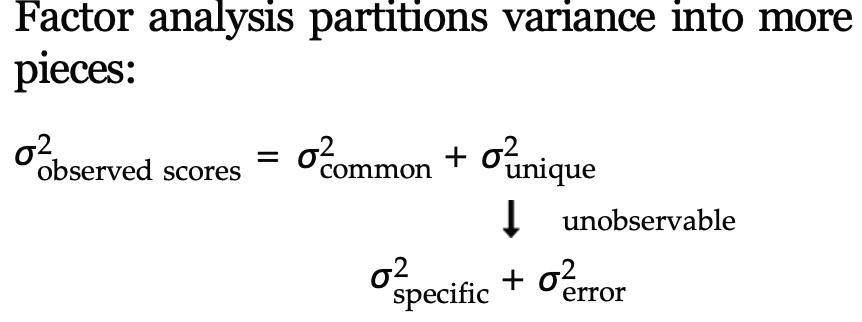
Common & unique variance dataset

Common variance
Variance that is shared among a set of observed variables.
It is the reason why observed variables correlate.
We assume that this common variance manifests because there is a common underlying factor (or factors) that cause this variability.
Unique variance
variance that is unique to the observed variable.
Specific variance
systematic variance that is not explained by a common factor;
it is due to specific/particular characteristics of the observed variable.
Error variance
random measurement error
total amount of variance has to be equal to one

Example → Employee Engagement

Exploratory model
Procedure aims to explore the structure of the test.
We estimate all possible factor loadings & factor correlations.
We may try different factor solutions & see which one is a better fit to the data.
Confirmatory model
Procedure aims to confirm a structure that we expect to be present in the test.
We specify the number of factors & what factors loadings & factor correlations to estimate & which ones to fix to 0.
We check model fit*