The rumen and non-glandular stomachs SDL
 Call Kai
 Learn
 Practice Test
 Spaced Repetition
 Match
 Flashcards
 Knowt Play
1/49

There's no tags or description
Looks like no tags are added yet.
50 Terms
What are the components dealing with fermentatioon in the ruminant GI tract..
Herbivores with 2 claws/ foot
reticulum, rumen omasum
How mcuh space does the rumen, reticulum stomach and omasum ocupy in the digestive tract…
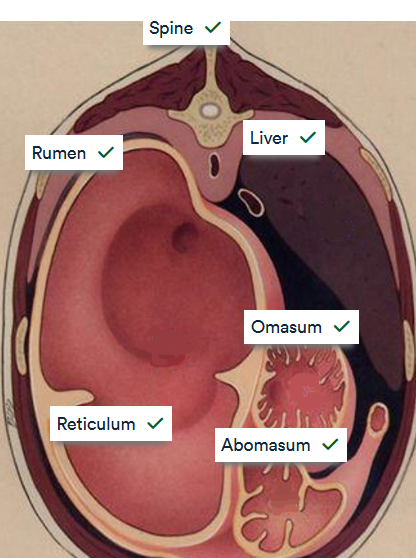
84% of the digestive system.. The rumen and reticulum comprise around 84% of the volume of the total stomach, the omasum 12%, and the abomasum 4%. The rumen is the largest stomach compartment, holding up to 120 litres in a mature cow.The reticulum holds approximately 19 litres in the mature cow. The rumen and reticulum have similar functions and are separated only by a small muscular fold of tissue. They can be collectively referred to as the reticulorumen. The omasum and abomasum hold up to 55 and 25 litres, respectively, in the mature cow.
What do ruminants have instead on inscisors
dental pad
Lower insicors = looser too prevent dental pad damage
What does saliva contain which helps its fimctopm
produces bicarbonate and potassium - neutralises the saliva
buffer in the rumen
How much saliva does a cow produce/ day and what is it produced by
100 litresSaliva is produced by the parotid, mandibular, sublingual and many minor salivary glands.
what does the tongue contain on it?
The tongue contains different types of papillae: harsh, caudally directed filiform papillae are on the tip of the tongue, and conical and flat lenticular papillae are found towards the pharynx. The papillae aid in moving the food towards the rumen. Fungiform and vallate papillae have taste receptors. About two-thirds of the way down the tongue, there is a lingual fossa where food can collect.
what area of the tongue is most suseptivel too
linguinal fossa.. between the thirds
By what movement does food pass down the oesophagus
Peristalisis
what are the 3 sections of the oesophagus
Cervical, thoracic and abdominal
What percentage of dog and cow oesphagus’es are striated
100%
How is the oesophagus epithelium adapted
Muscosal lining of the epithelium
Longitudinal folds which allows widening
(ruminants = highly kertinised epithelium..)
What is reverse peristalisis of the oesophagus
This is in ruminants when they regurgitate thier food in order too ‘re chew it’ this is known as chewing the cud for up too 8 hours/ day..

What are these 4 layers of the oesophagus (labelled)

What is the reticulum
muscular pouch on cranial epithelium
contains reticulated epithelium
What is the Omasum..
The omasum is lined with a deeply folded mucous membrane. Ensures food only passes through the abomasum..

What are the 5 sacs of the rumen
Dorsal Sac
caudo dorsal blind sac
caudoventral blind sac
vental sac
cranial sac


label this..

What does teh rumen do?
ferments cellulose… produces volatile fatty aids
How i s the rumen surface addapted?
Rume papillae - absorbs volatile fatty acids
many finger-like projections - increase the surface area
absorptive surface + microflora can then attatch
no muscularis mucosa

What atype of epithelium in in the rumen
keratinised stratified sqaumous epithelium
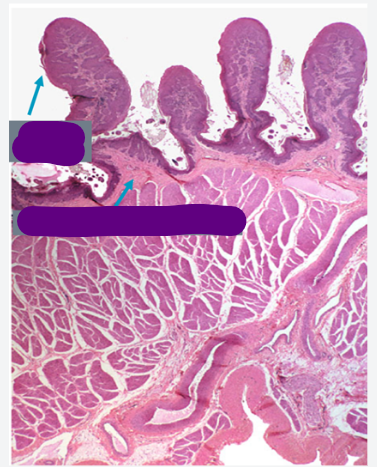

How does nutrition affect ruminant papillae
HIgh conc VFA —→ GROWTH longer papillae
Low conc VFa + poor nutiriton —→ Few shorter blunter papillae

Why are Calves fed short cropped staw
It improves papillae development by 'cleaning' the papillae with its sharp edges and thinning the keratin layer allowing better nutrient absorption.
What are the 2 key problems with rumen digestion?
Plant material is poorly masticate d— chewing the cud - hig saliva demand
cow does not possess cellulase — has many micfrolosa
How else do cows break up LARGE pieces of material
rumen muscle contractions..
reticulated membrane.. for a large microbiome..
What is the primary nutrients in the rumen that are absorbed
These are the primary nutrient absorbed in the rumen, although some other nutrients may also be absorbed here. The constant absorption of VFA creates a gradient allowing the microbiota to produce more VFA making it a highly efficient system for VFA (and as a result energy) production.
What is the caecum
large blind pouch, is located at the beginning of the large intestine, approximately 1 metre long with a 2-gallon capacity in the mature cow. The caecum serves little function in a ruminant, unlike its role in horses. The colon is the site of most of the water absorption in the large intestine.
What is the structure of ruminal papillae
Leaf shaped keratinised stratified sqaumoous mucosal epithelium.. RUminal papillae are found within the rumen, reticulum and omasum
What are the 2 issues with rumen digestion and ow are these addressed
Plant material is large, poorly masticated —> chewing the cud
No cellulase enzymes —> these are produced by bacteria
What product is absorbed in the ruen
Volatile fatty acids from microbial fermentation
What do rumen bacteria feed on…
Cellulose, lignin, starch, oil and protein
What 3 VFAs are produced from fermentation
ACetate Propionate and butyrate
What do protazoa primariily digest
Fibre
What is the primary function of rumen archaea
MEthanogenesis
this removes hydrogen so that ruminal digestion via microbes can still occur
IS lactobacilli found in the rumen?
No - found in the small intestine
What does reticula tissue look like and where is it?
Cranial absomen adjacent to hte diaphragm, first pouch of the reticulum..
appears in a honey comb structures

Why is keratinised epithelilium needed in the ruminnant stomach lining?
To protect the tissue from mechanical abrasion and chemical damage
Why do solid objects emd up in the reticulum..
becausae the reticulo- omasal orifice is more dorsal than the floor of the compartments- reticulum will trap foriegn bodies
What is Traumatic reticuloperitonitis
Anial injests a metal object
this proliferates the wall of the reticulum + causes an infection
What is the cause of frothy bloat
Cow injests high conc legumes, stable foam foams in rumen and traps gas.. gas cannot be passed out
What is the function of the fluid in the reticulum
helps too separat ethe particles
each biphasic contraction contents are sorted. particles can be trapped in the honey comb structures

What is this the lining of?
The reticulum

How is the keratin which lines the ruminant GI tract replaced?
continuously replaced through proliferation and differentiation
What nerve fibres control the rate and strength of rumen contraction
Vagal efferent nerves
What is the difference between primary vs secondary contractions in the rumen
PRimary = weak initial mixing contraction
secondary - Dorsal - caudal sac wave of contractonis
What is eruction
BUrping
What are teh 3 possibilities of rumen contraction
Primary contractions - wave of contraction, then wave of relaction
secondary contractions - usuually eruction
regurgitation - opposite too primary contrations, relaxtion of distal oesophageal sphyncter
What doe sthe omasum contain within it..
many lammellae, final digestive segment, true perpose unknwon
Camelids do not have an omasum

What is the abomasum split into and what makes its surface absorptive*
fundus, corpus and pylorus
12 large folds over an absorptive surface, columnar epithelial cells. glands produce pepsin and HCL- digests protein from feed and microbes
fore refereace