CSA- NECK
 Call Kai
 Learn
 Practice Test
 Spaced Repetition
 Match
 Flashcards
 Knowt Play
1/198

There's no tags or description
Looks like no tags are added yet.
199 Terms
smallest vertebrae in size
cervical
c spine all have bifid spinous process except___
C1
lateral mass has
articular processes (SAP & IAP)
transverse foramina for the vertebral arteries & veins
c1=
atlas (supports the head & receives the dens of C2)
c2=
axis
C1 does not have a
spinous process or body
anterior & posterior arches are known as what in cspine
tubercle
what forms pivot for rotation of the atlas & head
c2 (axis)
what part of the cspine has a long body, extending upward forming the dens & has a thick bifid spinous process
C2
what cspine have a body & vertebral arch which surrounds the spinal cord, vertebral foramina, and bifid spinous process
C3-C6
what c vertebrae is known as the vertebral prominens & has a longer, single spinous process
C7
what bone is located below the mandible at C3 (U-shaped)
hyoid
what are the ligaments that attach to the larynx & is housed near the hyoid
voice box
what has the function of tongue movement & swallowing
hyoid bone
the voice box (larynx) is from what c vertebrae
C3-C6
what is part of the airway is in the anterior neck, acts as an air passageway, and contains laryngeal cartilages interconnected by ligaments in muscles aiding in voice production
larynx
thyroid cartilage is ___ to the hyoid bone
inferior
what is the largest of the cartilage structures in the larynx
thyroid cartilage
the anterior surface of the thyroid cartilage forms the ___
adams apple
laryngeal prominence is located at what C level
C4
what is a spoon shaped cartilage, posterior to the hyoid bone, and closes the opening to the larynx when food is ingested
epiglottis
what is the single cartilage inferior to the thyroid cartilage, wraps around the airway
cricoid cartilage
cricoid cartilage is wider ___
posteriorly
what rest on the posterior cricoid processes and has the function of vocal cord attachment
arytenoid cartilage
what are the 3 cartilages of the larynx
thyroid
cricoid
arytenoid
what cartilage of the larynx is u-shaped
thyroid
what cartilage of the larynx is circular shaped
cricoid
what cartilage of the larynx is 2 pyramid shaped cartilages
arytenoid
what are the vestibular folds also known as?
false vocal cords
what are the mucous membranes structures just superior to the glottic space with the function of protecting the airway & has NO ROLE IN VOICE PRODUCTION
vestibular folds (false vocal cords)
what are the ligaments that extend between arytenoid & thyroid cartilages, covered by mucous membranes, and are muscles that move the cartilage changing tension on the ligaments, AIDS IN VOICE PRODUCTION
vocal cords (folds)
what is the space within the larynx (between vocal & vestibular folds)
glottic space (ventricle)
tubular structure that extends from base of skull to C6 & becomes continuous with the esophagus (SERVES BOTH RESPIRATORY & DIGESTIVE)
pharynx
3 parts of the pharynx
nasopharynx
oropharynx
laryngeal pharynx
what is posterior to the larynx, below the epiglottis, ending at esophagus
laryngeal pharynx
main airway that extends from larynx to the main bronchi (level of C6-T4) & anterior to the esophagus & vertebral bodies
trachea
what starts at the level of C6 (end of pharynx) & extends to stomach
esophagus
esophagus is __ & __ to bodies of the vertebra
medial & anterior
what is a u-shaped gland, inferior to larynx, & has 2 lobes on either side of the trachea, that contributes to hormone production (influences metabolism, growth, development, & temperature)
thyroid gland
what are the thyroid glands connected by
isthmus
what are the salivary glands
submandibular
parotid
sublingual
function of salivary glands
produce & empty saliva into oral cavity by ways of ducts to aid in digestion
what salivary gland is the second largest salivary gland (walnut size)
submandibular
what salivary gland is in front of the auricle & is the largest salivary gland
parotid
what is the smallest salivary gland
sublingual
what muscle extends from superior-posterior aspect of the mentum to the posterior aspect of the mandible & forms most of the musculature of the tongue
genioglossus muscle
what muscle extends from inferior-posterior aspect of mentum to the hyoid bone & raises up the hyoid bone & depresses the mandible
geniohyoid muscle
what muscle attaches to the mastoid process of the temporal bone & aids in bending & rotating the head
sternocleidomastoid muscle
what arteries are through the neck (beside the trachea) & bifurcate into internal & external arteries?
common carotid arteries
the __ common carotid artery originates from the brachiocephalic artery
right
the __common carotid artery is the second major branch off the arotic arch
left
common carotid arteries bifurcate into external & internal carotids around what
C3/C4
what arteries originate from common carotids, ascend next to the internal jugular vein, & supply blood from anterior & middle cerebrum?
internal carotids
what artery arise from common carotid, supplies blood to the external head
external carotids
are the internal or external carotid arteries more superficially located in the anterior neck?
external
what arteries ascend superiorly through transverse foramina beginning at C6 & enter the skull through the foramen magnum & supply blood to the posterior brain/cerebrum
vertebral arteries
vertebral arteries start at the subclavian arteries & become___
basilar arteries
slide 43!!
what veins are on either side of the neck, next to the common carotid & join with subclavian veins to form the brachiocephalic veins & DRAIN BLOOD FROM THE BRAIN, FACE, AND NECK
internal jugular veins
what vein extends from subclavian vein through the neck & drain blood from the cranium & deep structure within the facial area
external jugular veins
external jugular veins will begin to visualize just below the ___
parotid gland
what are the 2 small veins behind the mandible that have the function of draining smaller veins from the temporal & maxillary regions
retromandibular veins

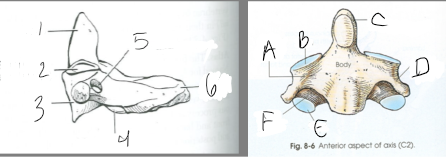
what is 1?
anterior arch

what is 2?
anterior tubercle
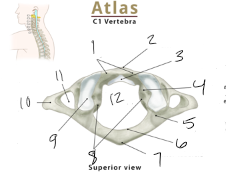
what is 3?
articular surface for dens of axis

what is 4?
transverse ligament tubercle
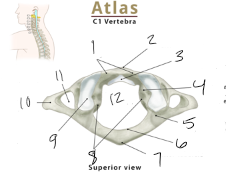
what is 5?
groove for the vertebral artery

what is 6?
posterior arch

what is 7?
posterior tubercle
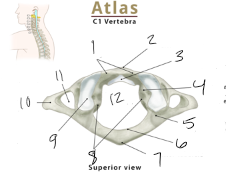
what is 8?
lateral mass

what is 9?
superior articular facet

what is 10?
transverse process

what is 11?
transverse foramen

what is 12?
vertebral foramen
axis (C2)
forms pivot for rotation of the atlas and head
long body extending upward forming dens (odontoid)
thick, bifid, spinous process
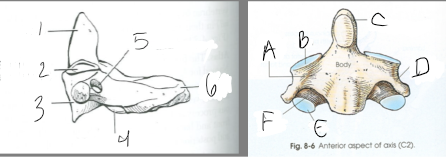
what is 1?
dens

what is 2?
superior articular facet

what is 3?
body

what is 4?
inferior articular facet

what is 5?
transverse foramen

what is 6?
spinous process

what is A?
superior articular process
what is B?
facet (superior)

what is C?
dens (odontoid process)

what is D?
transverse process
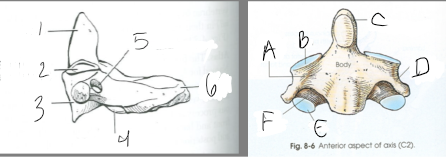
what is E?
facet

what is F?
inferior articular process

what is A?
dens

what is B?
transverse process of C1

what is C?
lateral mass of C1

what is D?
inferior articular surface of C1

what is E?
left Z joint

what is F?
body of C2

what is G?
right superior articular surface of C2

what is H?
anterior arch

what is A?
dens

what is B?
body of C3
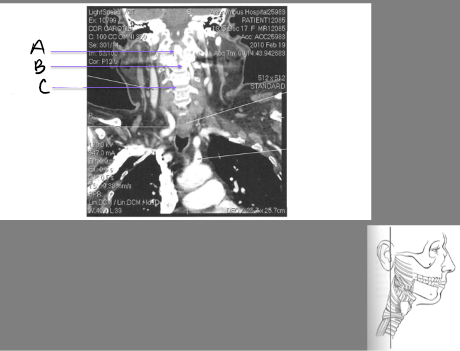
what is C?
intervertebral disc space
which is more superficial & anterior the internal or external carotid
external carotid
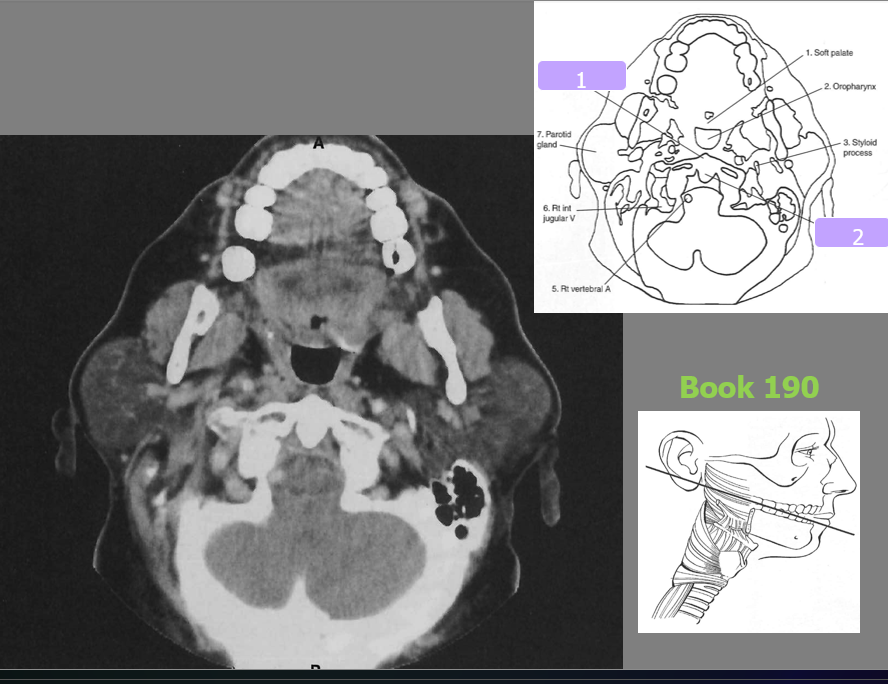
what is 1
anterior tubercle of C1