Market structure
 Call Kai
 Learn
 Practice Test
 Spaced Repetition
 Match
 Flashcards
 Knowt Play
1/177

There's no tags or description
Looks like no tags are added yet.
178 Terms
Define market structure
they are defined by the number of firms in the market and the ways in which they behave
What is the spectrum of competition in market structures?
A range from perfect competition (most competitive) → pure monopoly (least competitive). Includes monopolistic competition and oligopoly in between.
What are the main factors used to distinguish between market structures?
number of buyers
the number and size of firms
the type of product (homogenous or differentiated)
the types of barriers to entry and exit
the degree of information
Why does ease of entry affect competitiveness?
If entry is easy, new firms enter → compete away profits → prices fall → more competitive market
What is product differentiation?
The extent to which products are seen as similar or unique; includes branding, quality differences, style
How does differentiation affect market power?
More differentiation → more brand loyalty → firms gain pricing power → less competition
What type of knowledge exists in perfect competition versus other structures?
Perfect competition → perfect knowledge.
Other structures → imperfect knowledge.
Give an example of a structural entry barrier.
Economies of scale making it hard for small firms to compete
Give an example of a legal entry barrier.
Patents, licenses, government regulation
Give an example of a strategic entry barrier.
Predatory pricing or limit pricing by existing firms
Why do economists care about market structure?
It determines prices, profits, competition intensity, efficiency and consumer welfare
What is the N-firm ratio?
how much market share the N biggest firms (any number e.g 4) in the market have - it is used to measure market dominance
What does traditional theory assume about the objective of firms?
Firms aim to profit maximise.
What is the profit maximisation rule?
MC = MR
Other than profit maximisation what are the other objectives of firms?
revenue maximisation
sales maximisation
satisficing
growth
survival
market share maximisation
What is revenue maximisation?
where a firm aims to generate the highest possible total revenue, rather than focusing on profit
At what point is revenue maximised?
MR=0
What is sales maximisation?
where a firm aims to sell as much output as possible, subject to the condition that it still makes normal profit (i.e., covers all its costs)
At what point are sales maximised?
price = AC
What is growth?
a long-term objective to expand market share or diversification. Firms want economies of scale, prestige and bargaining power
What is satisficing?
Choosing an outcome that is “good enough” rather than maximising anything. Managers aim for enough profit to keep shareholders happy and for adequate pay and environment
Why might firms satisfice?
Limited information, time constraints, conflicting stakeholders, risk avoidance.
When do firms aim for just survival?
during a recession or when firms are new
What is market share maximisation?
Market share maximisation is when a firm sets price and output to gain the largest possible share of the market, often by lowering prices and expanding output.
What is divorce of ownership and control?
when the people who own a firm (shareholders) are different from the people who control and run the firm (managers)
How can divorce of ownership and control change a firm's performance?
It can reduce efficiency, shift objectives, and lead to satisficing instead of MC = MR output
What does divorce of ownership and control lead to?
the principal-agent problem
What is the principal-agent problem?
when the principal (the owner or person who delegates authority) and the agent (the person who makes decisions on their behalf) have different objectives, and the principal cannot perfectly monitor the agent’s behaviour due to asymmetric information
Do all firms profit maximise in the short run?
Not necessarily — many satisfice due to managerial objectives or lack of perfect information
Why is profit maximisation still important long-term?
Provides funds for investment and innovation, and attracts shareholders
What are public sector firms?
firms owned by the government e.g NHS, BBC
What are private sector firms?
firms owned by individuals e.g apple
What are for-profit firms?
firms looking to make profit
What are not-for-profit firms?
firms that are not looking for profit and wish to achieve social objectives e.g oxfam
What are the main assumptions of perfect competition?
many small buyers and sellers
no entry/exit barriers
homogenous products
perfect information
price takers
Why are firms in perfect competition price takers?
Because products are identical and no firm is large enough to influence market price
What does the firm’s demand curve look like in perfect competition?
Perfectly elastic (horizontal) at the market price as there are many firms, if the price of a product in one where to change consumers would just move to another
What are some examples of perfect competition?
agricultural markets e.g rice, commodity markets e.g gold
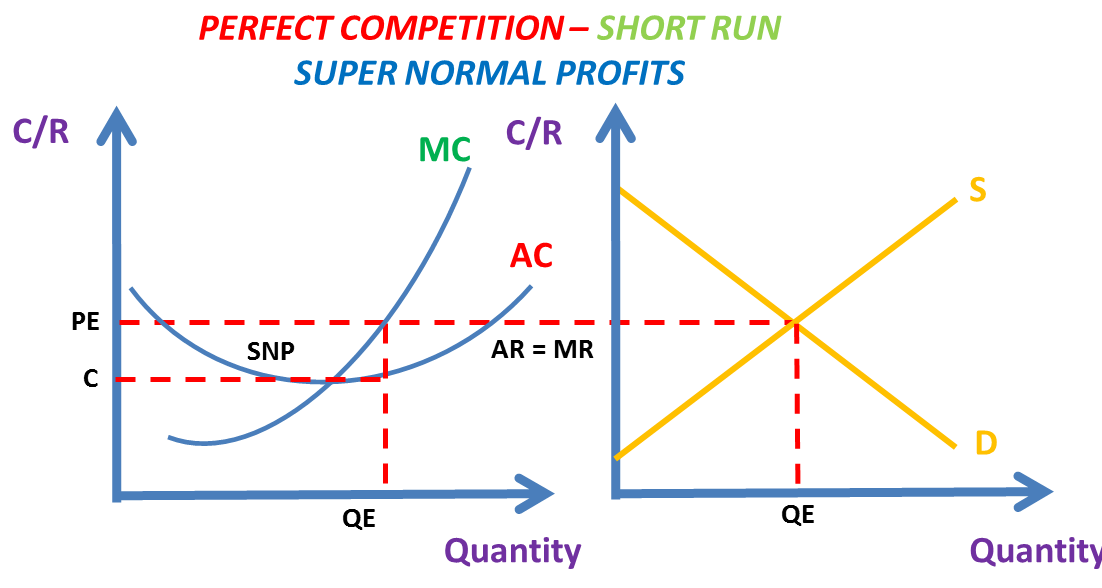
What does the short-run perfect competition diagram look like for a market and for a firm?
supernormal profit is being made
Why can perfect competition firms make supernormal profit in the short run?
The number of firms is fixed (no entry yet)
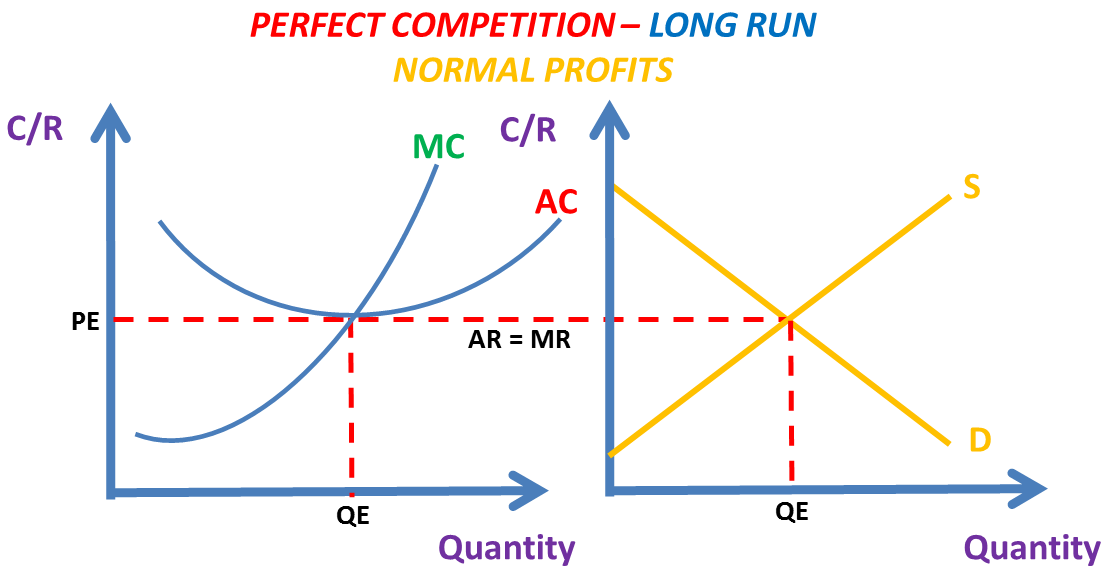
What does the long-run perfect competition diagram look like?
normal profit is being made as AR=AC
Why can firms only earn normal profit in the long run?
Free entry/exit → new firms enter when supernormal profits exist → supply increases → price falls to AC
What condition shows long-run equilibrium in perfect competition?
the point where firms make normal profit and there is no incentive for firms to enter or exit the market - AR = AC and MC = MR
What is productive efficiency?
Occurs when firm produces at lowest point of AC curve (MES)
What is allocative efficiency?
when welfare is maximised - P = MC (/AR/demand = MC)
What is allocative and productive efficiency known as?
static efficiency - efficiency at a given point in time
What is X-efficiency?
when a firm is producing at or below the AC curve for a given output. X-inefficiency is when a firm is producing above AC at a given output
What is dynamic efficiency?
how changing technology improves a firm’s output potential overtime - make supernormal profit where AR>AC to invest in research and development
Why is perfect competition allocatively efficient in the long run?
Because P = AR = MR
Why is perfect competition productively efficient in the long run?
Entry/exit pushes firms to minimum AC.
Why is dynamic efficiency likely to be low in perfect competition?
No long-run supernormal profit → few funds for innovation
Why is X-efficiency likely to be high?
Strong competition forces cost minimisation
What is the role of perfect competition as a “yardstick”?
It provides a benchmark to compare the efficiency of real-world markets
Why might perfect competition NOT lead to efficiency in reality?
Assumptions (perfect knowledge, no barriers, identical products) rarely hold.
What are the main characteristics of monopolistic competition?
many firms
low entry/exit barriers
differentiated products
imperfect information
Why do firms in monopolistic competition have some pricing power?
Because products are differentiated (branding, quality, design)
What are some examples of monopolistic competition?
hairdressers and barbers, restaurants
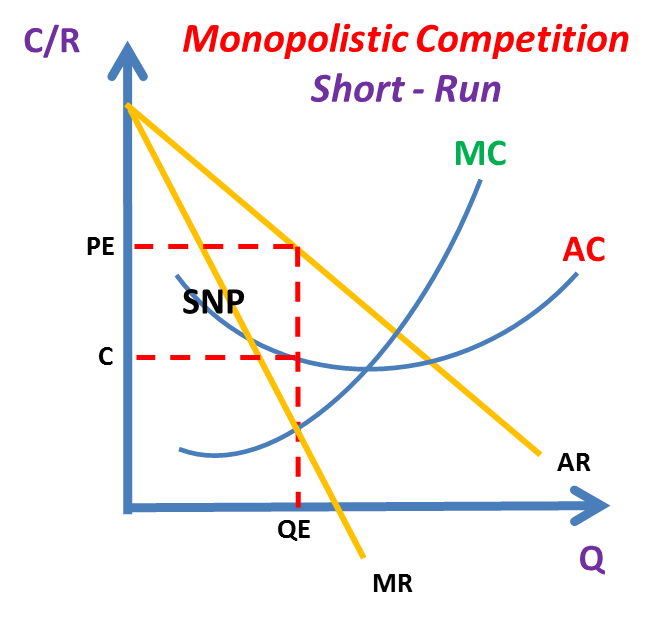
What does the short-run monopolistic competition curve look like?
same as monopoly
firms are making supernormal profit
Why does entry occur when firms earn supernormal profit?
Low barriers → new firms enter to capture customers
What happens to the demand curve of existing firms when new firms enter?
It shifts left and becomes more elastic (flatter)
What does the monopolistic competition diagram look like in the long-run?
AR is tangential to the AC
normal profit is being made
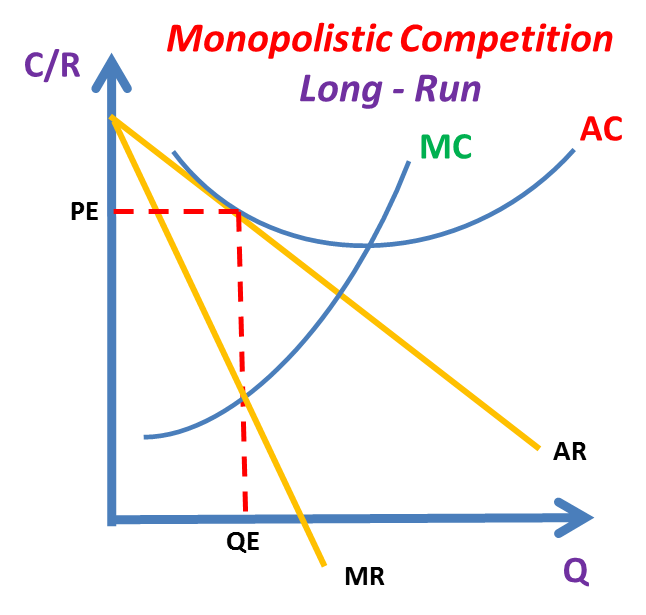
Why do monopolistically competitive firms make only normal profit in the long run?
Entry reduces demand until AR = AC. Now that normal profit is being made, the long-run equilibrium has been reached and no new firms will see the need to enter the market
Are monopolistically competitive firms productively efficient in the long run? Why/why not?
No — they do not produce at minimum AC
Are monopolistically competitive firms allocatively efficient?
No — because P > MC
What type of competition is common in monopolistic competition?
Non-price competition
Why is non-price competition important in monopolistic competition?
Raising prices is risky when many substitutes exist, so firms use differentiation instead
What are advantages of monopolistic competition for consumers?
Product variety, quality improvements, innovation, reasonably competitive prices
What are disadvantages of monopolistic competition?
Not allocatively efficient, not productively efficient, resources wasted on advertising
What are the key characteristics of oligopoly?
few large sellers
high barriers to entry and exit
differentiated products
interdependence
uncertainty
What is interdependence?
firms must consider rivals’ reactions when making decisions
What are some of the barriers in an oligopoly?
brand loyalty
huge sunk costs e.g advertising and research and development
economies of scale
high fixed costs
What are price wars?
when firms repeatedly reduce their prices below that of their competitors with the aim of lowering the lowest price - this benefits consumers
Give a real-world example of price wars
in 1990s, supermarkets such as tesco and asda had a price war with baked beans
What is collusion?
when 2 or more firms agree to limit competition (to avoid price wars)
What are the 2 types of collusion?
overt collusion and tacit collusion
What is overt collusion?
A formal agreement between firms to set price/output e.g could have signed a contract
What are cartels?
a group of firms in an oligopoly that engage in overt (explicit) collusion to fix prices, limit output, or share markets in order to increase joint profits.
basically, the firms that engage in the overt collusion
Why have the MA made overt collusion illegal?
because it avoids competition, price rises - bad for consumers. It is now done in secret
Give a key example of overt collusion
in 2004-2006, Virgin Atlantic and British airways overtly colluded.
The two airlines illegally coordinated fuel surcharges on long-haul flights
This involved direct communication between senior managers about pricing
Who whistle-blew?
Virgin Atlantic reported the cartel to the UK Office of Fair Trading (OFT)
Virgin received immunity from fines under the cartel leniency programme
British Airways did not report it first, so they were fined
What does collusion allow firms to behave like?
A monopolist - maximising joint profit
Give an example of a public cartel that is allowed
OPEC is overt collusion between 30 countries. They keep oil at high prices and attempt to restrict supply. This ensures continued supply and reduces overconsumption
What are some of the problems with cartels?
Incentive to cheat by secretly lowering prices
Difficult to enforce agreements
May attract new entrants
Often broken up by competition authorities
What is tacit collusion?
an unspoken agreement between firms - Firms follow a price leader without explicit agreement
What is price leadership?
when one firm changes their prices and the other firms follow e.g British gas
What triggers price competition?
A breakdown in tacit collusion, when firms can’t make an agreement or aggressive attempts to gain market share
What are the 3 types of price competition?
price wars
predatory pricing
limit pricing
What is limit pricing?
Setting a low price (often below short-run profit-maximising level but above cost) to deter potential entrants from entering the market. This can be long term and economies of scale is used to reduce AC. Usually legal
What is predatory pricing?
when a firm aggressively cuts prices below AVC to force competitors from the market (below short run shut down point AVC = AR). In the long-run, it gets rids of competition and price increases taking over the market. It is illegal
What is non-price competition?
when firms compete without changing price
What are some examples of non-price competition?
advertising, loyalty cards (e.g nandos - collect more points to get free chicken), branding, quality, differentiated products, customer service
Why does uncertainty exist in oligopoly?
Firms cannot predict rivals’ reactions with certainty. Decisions by 1 firm in the industry impacts all of the other firms. This is why collusion happens
What is a key consequence of interdependence?
Firms avoid risky price changes
What is the difference between a collusive and non-collusive oligopoly?
collusive oligopolies fix the same price whereas non-collusive oligopolies compete to undercut each other and gain market share
What is co-operation?
when firms work together to develop something which benefits them all e.g ford and volkswagen cooperated to make ford galaxy
Why do oligopolists invest heavily in advertising and R&D?
To differentiate, build loyalty, deter entry, and reduce uncertainty
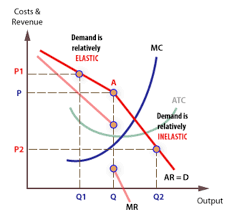
What type of oligopoly does the kinked demand curve model apply to?
Non-collusive oligopoly
What key assumption underlies the kinked demand curve?
Firms believe rivals will react differently to price rises than to price cuts
Draw and explain the kinked demand curve
demand is elastic above the kink (equilibrium) as if price rises, consumers will switch to cheaper substitutes
demand is inelastic below the kink as rivals match price cuts - competition so the firms only gains a little extra market share
when it is in equilibrium, there is no incentive for firms to change their prices and so prices remain fixed - price rigidity