F2M2 - Accounting Changes and Error Corrections
 Call Kai
 Learn
Learn Practice Test
 Spaced Repetition
 Match
Match Flashcards
 Knowt Play
1/4

There's no tags or description
Looks like no tags are added yet.
Name | Mastery | Learn | Test | Matching | Spaced | Call with Kai | Chat |
|---|
No analytics yet
Send a link to your students to track their progress
5 Terms
For Year 1, Pac Co. estimated its two-year equipment warranty costs based on $100 per unit sold in Year 1. Experience during Year 2 indicated that the estimate should have been based on $110 per unit. The effect of this $10 difference from the estimate is reported:
A. As a correction of an error requiring Year 1 financial statements to be restated.
B. As an accounting change, net of tax, below Year 2 income from continuing operations.
C. As an accounting change requiring Year 1 financial statements to be restated.
D. In Year 2, as income from continuing operations.
The correct answer is D. In Year 2, as income from continuing operations. ✅
This question tests a change in accounting estimate.
CPA exam rule to remember
Change in estimate → Prospective
Per U.S. GAAP, which of the following statements is correct regarding accounting changes that result in financial statements that are, in effect, the statements of a different reporting entity?
A. No restatements or adjustments are required if the changes involve consolidated methods of accounting for subsidiaries.
B. No restatements or adjustments are required if the changes involve the cost or equity methods of accounting for investments.
C. Cumulative-effect adjustments should be reported as separate items on the income statement in the year of change.
D. The financial statements of all prior periods presented should be restated.
Choice "D" is correct. Financial statements of all prior periods presented should be restated when there is a "change in entity" such as resulting from:
Changing companies in consolidated financial statements.
Consolidated financial statements versus previous individual financial statements.

How should the effect of a change in accounting principle that is inseparable from the effect of a change in accounting estimate be reported?
A. As a correction of an error.
B. By footnote disclosure only.
C. As a component of income from continuing operations.
D. By restating the financial statements of all prior periods presented.
The correct answer is C. As a component of income from continuing operations. ✅
The key phrase is:
“A change in accounting principle that is inseparable from a change in accounting estimate.”
Under U.S. GAAP, when a change in accounting principle cannot be separated from a change in estimate, the entire change is treated as a change in accounting estimate.
A change in estimate is accounted for prospectively, meaning:
❌ Do not restate prior years.
❌ Do not adjust beginning retained earnings.
✅ Recognize the effect in the current and/or future periods affected.
✅ The current-period effect is included in income from continuing operations.

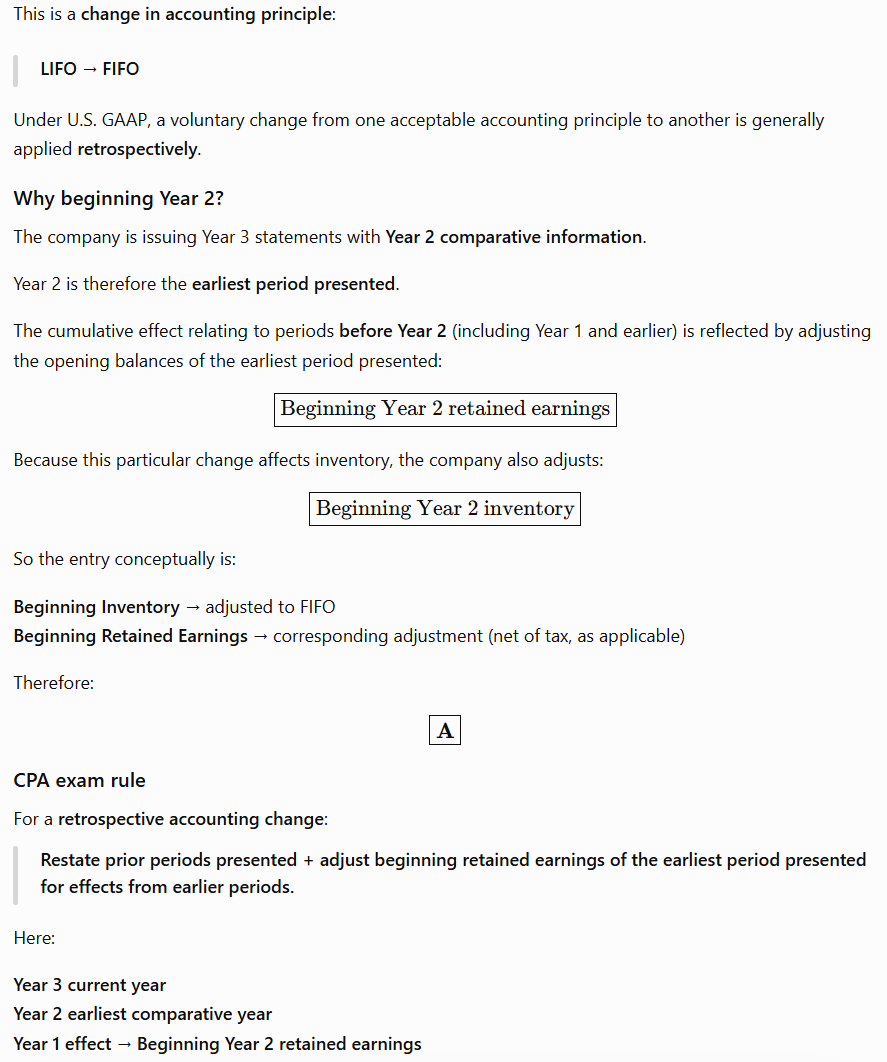
On January 1, Year 3, a company changed its inventory costing method from LIFO to FIFO. The company's Year 3 financial statements contain comparative information for Year 2. How should the company present the Year 1 effect of the change in accounting principle in its Year 3 comparative financial statements?
A. As an adjustment to the beginning Year 2 inventory balance with an offsetting adjustment to beginning Year 2 retained earnings.
B. As part of income from continuing operations in the Year 2 income statement.
C. As an extraordinary item in the Year 2 income statement.
D. As a note disclosure only.
Choice “A” is correct. If comparative financial statements are presented, the cumulative effect of a change in accounting principle is presented net of tax as an adjustment to beginning retained earnings in the statement of stockholders' equity.
Under U.S. GAAP, if a company is not presenting comparative financial statements, the correction of an error in the financial statements of a prior period should be reported, net of applicable income taxes, in the current:
A. Retained earnings statement as an adjustment of the opening balance.
B. Income statement after income from continuing operations and after discontinued operations.
C. Retained earnings statement after net income but before dividends.
D. Income statement after income from continuing operations and before discontinued operations.
The correct answer is A. Retained earnings statement as an adjustment of the opening balance. ✅
This question tests the treatment of a prior-period error when comparative financial statements are NOT presented.
A material error from a prior period is corrected as a prior-period adjustment, net of applicable income taxes.
Because the error belongs to a previous period, it should not affect current-year net income. Instead, it adjusts:
