NPB 101: Muscle Physiology 2: Mediators of Force
 Call Kai
 Learn
 Practice Test
 Spaced Repetition
 Match
 Flashcards
 Knowt Play
1/18

There's no tags or description
Looks like no tags are added yet.
19 Terms
Muscle Cramps
Involuntary tetanic contraction of skeletal muscle
Causes unknown
Related to ion imbalances
Hypocalcemic Tetany
Low extracellular Ca2+
How does low extracellular Ca2+ cause contraction?
Hypocalcemic Tetany → Low Ca2+
Membrane potential moves closer to the threshold needed to fire an AP, nerves and motor axons begin firing spontaneous, repetitive AP’s.
Length Tension Curve
Active tension depends on filament overlap
T = thick filament - 1.6 μm
t = thin filament - 1.0 μm
1.0 + 1.6 + 1.0 = 3.6 μm
Based on filament lengths what is the maximum sarcomere length a human muscle can produce active force?
A human skeletal muscle sarcomere can productive active force up to a max length of approx. 3.6 μm, where all physical overlap bw actin and myosin filaments ceases
T = thick filament - 1.6 μm
t = thin filament - 1.0 μm
1.0 + 1.6 + 1.0 = approx. 3.6 μm

What is total force when stimulated at 140% of Lo?
Active force = Force you get in response to stimulus
Approx. 50 on ex
Passive Tension = Relaxed fiber
Approx. 22 on ex
Total Force = Active Force + Passive Tension
50 + 22 = approx. 72
Twitch Contraction
Twitch is the result of a single impulse for muscle contraction
Isometric twitch → Generates muscle tension w/o changing length of the muscle
Isotonic twitch → Moves a load with a constant muscle tension while the muscle length changes
Isotonic Contractions
Longer latency periods
Slower shortening velocity
Heavier load, longer we have before we move it and slower to move
Isotonic Contractions- Types of Contraction
Concentric → Muscle gets shorter, positive velocity
Isometric → Length doesn’t change, velocity is 0
Eccentric → Forces are higher
Concentric Contraction
Muscle generates tension and shortens, positive velocity

Isometric Contraction
Muscle generates force/builds tension without changing its length, velocity is 0

Eccentric Contraction
Muscle lengthens while under tension bc external resistance or load is greater than the force the muscle generates

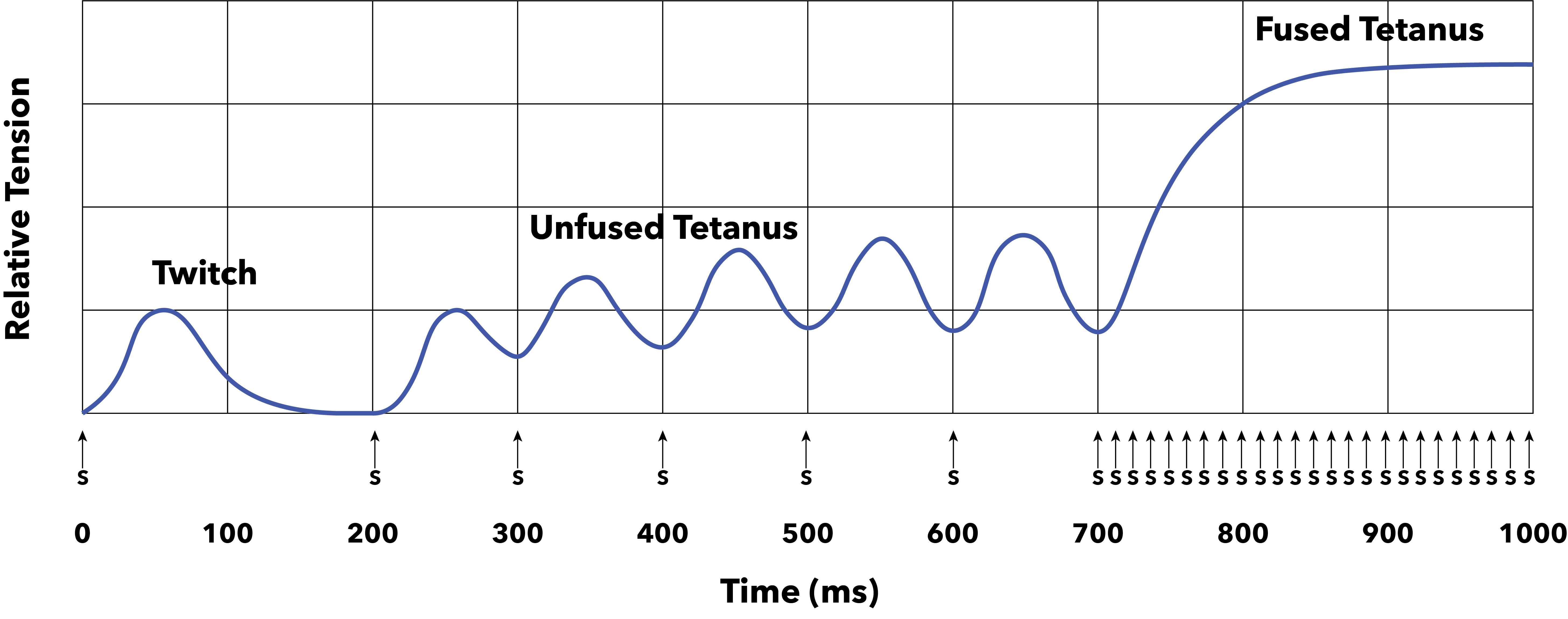
Muscle Twitch and Tetanus
Twitch
Force generated from single stimulation (temporal summation)
Tetanus
Twitch series when next stimulus occur after full relaxation
Unfused tetanus when next stimulus occurs during relaxation
Fused tetanus when next stimulus occurs before any relaxation
Unfused Tetanus
Moderate stimulation rate
Muscle has a brief, partial relaxation period bw stimuli
Force output shows fluctuating waves or oscillations rather than a flat line

Fused Tetanus
High stimulation rate
NO relaxation phase bw individual stimuli
Individual twitches merge completely into a smooth, steady, and continuous extraction
Maximal possible muscle tension
Which muscle is stronger? Able to produce more active tension?
More compact = more tension, in parallel, summing up all sarcomeres
Which muscle is faster? Able to contract at higher velocity?
More in series, only pulls against neighboring, ability to work over a long range of lengths will be organized in series
Physiological Cross-Sectional Area (PCSA)
Number of sarcomeres in parallel
Relates to maximum tension
Larger PCSA = Doubled muscle force, twice the maximum force with more sarcomeres in parallel
Normalized Fiber Length
Number of sarcomeres in series
Relates to maximum velocity
Relates to muscle excursion
Long Fibers have a larger muscle length (mm) as it’s spread out.
Do ankle plantarflexors or dorsiflexors generate more maximum tension?
Plantarflexors → More fibers in parallel , makes it generate more tension