Intro Cognition UVA Midterm 2 readings
 Call Kai
 Learn
 Practice Test
 Spaced Repetition
 Match
 Flashcards
 Knowt Play
1/244

Earn XP
Description and Tags
focused on readings, key terms, a concepts
245 Terms
UNIT 5
Sensory and working memory
sensory memory
this is a general term referring to sensory buffers that can hold so much information at one time, but only for a second or two — how much information can someone take in instantly.
comes before short term memory.
always gets replaced.
sensory memory always gets replaced?
true
what is an example of sensory memory being helpful?
watching tv or a movie
what is sensory memory?
early span of apprehension studies
characteristics of iconic memory
echoic memory

early span of apprehension studies (sensory memory)
introspection people were interested in how much information could get into the conscious process
they used “span of apprehension studies” — this paved the way for the study of sensory memory.
basic approach was 150 years ago by Stanley Jevon — created a fundamental experiment showing sensory memory.
** people continued to do experiments like Stanley’s but the caveat was that people always felt like something was missing. — idea that i saw something but i just cannot remember.
What experiment did Stanley Jevon create? what does it show?
tossed beans form a bowl to try and get them in a small white box. the white box was surrounded by a black tray. Some beans would go in the white box and some on the black tray. — His goal was to briefly glance at the white box and try to recall how many beans where in the box. — he did this 1,027 times
he found if there were 3-4 beans in the white box he was predominately correct. — when there was 5 beans he was very good at predicting it but not perfect. — as his number of beans increased his accuracy dropped. ———— people thought at the time that the capacity of sensory memory was 9 beans.
how correct was Stanely Jevon when he threw 4 beans on the white tray? how about when he threw 8?
100% correct with 4, and about 50% with 8
what was created to combat the lack of precision in Stanley Jevon’s experiment?
the tachistoscope — allowed for participants to see the visual stimuli for a precise amount instead of “momentary glances.” — after researchers used this for a while they found that the span of apprehension is about 8.4
still wasn’t the best way to measure apprehension
what was the best way of measuring apprehension?
George Sperling created a experiment that flashed numbers and letters to participants. they would see 4-12 items 1/20th of a sec. then they were asked to remember the display. — the participants could only remember 4 if there were 12 items, they also noted that they felt like they could of seen/remembered more items but forgot them quickly.
then he made an adjustment and added a sound to the items that were flashing. — this is called partial-report procedure. — they were only reporting a row

what did George Sperling do in his experiment/ what did he call it? What did he find?
Was called partial report procedure:
used rows and columns to test sensory memory.
originally he was asking participants to remember all the numbers and letters in each column and row. — very few individuals could do so.
so then he added cues /stimulus to try and improve memory and it worked!

By how much did memory improve due to the addition of cues/stimulus in George Sperling’s experiment?
went from 33% — 75%

what is the modal model?
a model that is composed of the most common features of models in the early 1970s — turned out to kind of incorrect.
the image is shows what it is.
how long does short term memory lasts before it is forgotten?
30 secs
how long does long term memory last before it is forgotten?
tends to last a long time.
how long does sensory memory last before it is forgotten?
1 - 2 secs
Since modal model did not work, what model came after?
working memory model
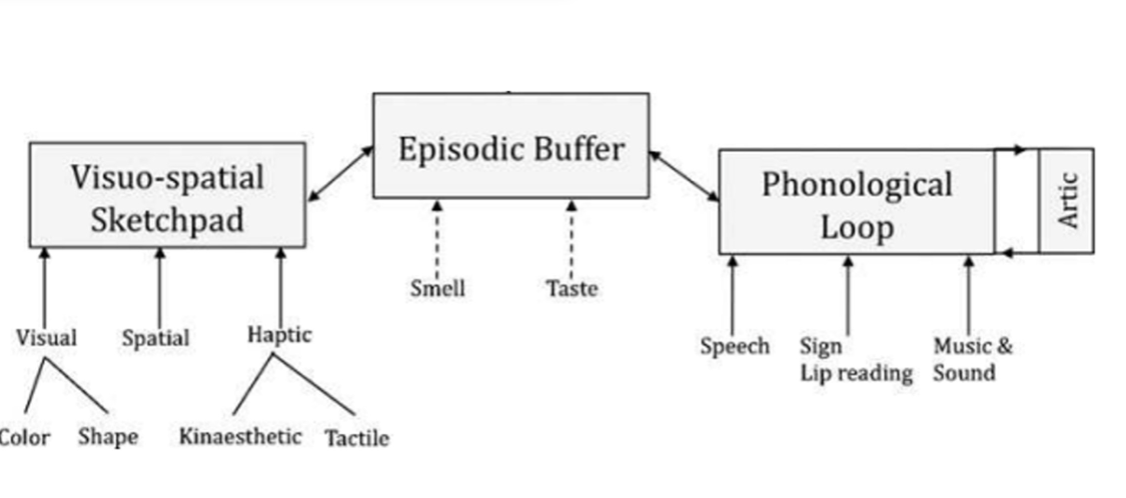
what is working memory?
this model implies where thought happens — also provided more ways to code information like sound, sight, and meaning
has 3 boxes
visuo-spatial sketch pad
episodic buffer
phonological loop
what does phonological loop consist of regarding working memory?
SOUNDS
speech
sign/ lip reading
music/ sound
BUT has 2 componets
phonological store — stores about 2 sec worth of auditory information ****can come from your environment****
articulatory control process — process of talking to yourself.
what are some predictions regarding phonological loops?
since sensory memory storage only last 2 secs, a person who talks fast has larger capacities for retaining info
since sensory memory storage only last 2 secs, anyone who has smaller capacity for long words
words that sound the same should confuse you and your memory. —- ex: cap, cat, can
if you are busy you cannot put anything into phonological store so you must code words some other way.
what does episodic buffer consist of regarding working memory?
smell
taste
stores combined information of (phono and visuo) information that interacts with long term memory. — something you have already learned before often.
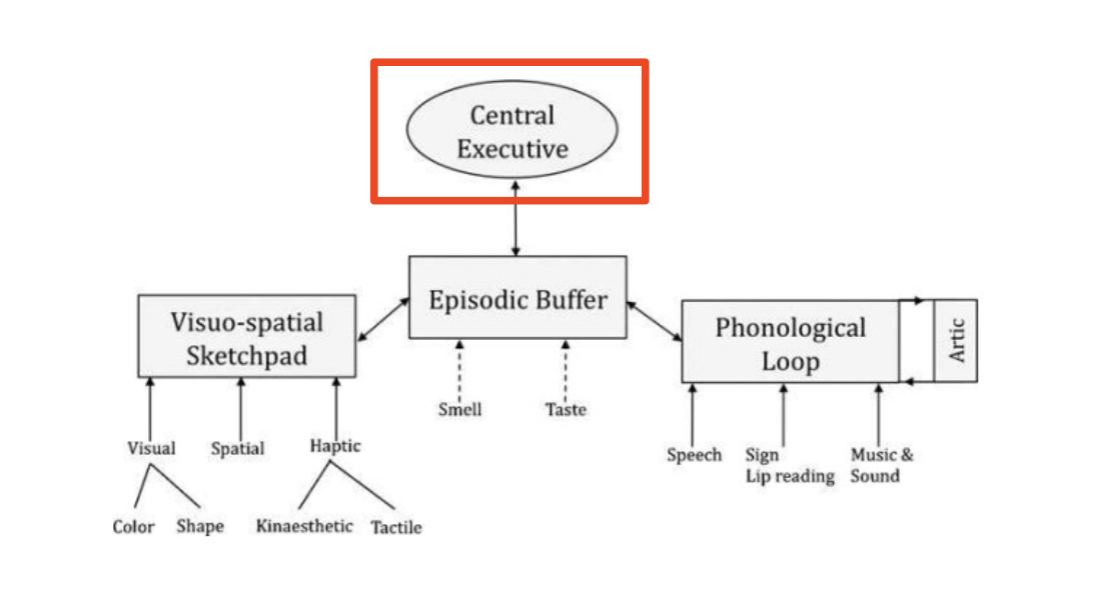
what does central executive consist of regarding working memory?
regulates our attention to information. — decides on what strategies to use.
also helps maintain info in working memory
kind of like a supervisor.
what does visuo-spatial sketchpad consist of regarding working memory?
visual — like color or shapes
spatial
haptic — tactile (physical touch) and kinesthetic (ability to sense own movement)
claims that their is semantic representation in working memory.
remember this as like mental imagery
what does proactive interference mean?
old info affects how we learn / remember new information
what does semantic mean?
meaning

what process goes into short term memory?
working memory model

characteristics of iconic memory
large capacity
forgetting
representation
1st characteristic of iconic memory is?
large capacity
maintains most of the perceptual encounters
vary with conditions of stimulus (ex: brightness)
depends on what comes before and after
allows more than one stimulus at one time
2nd characteristic of iconic memory is?
forgetting
memory is short lived (500 mill seconds or no longer than 1 sec)
doesn’t just disappear — decay appears very soon after object/stimulus appears — decay happens suddenly
the icon/ iconic contents can be easily replaced/erased by another visual stimuli — this is known as “mask”
3rd characteristic of iconic memory is?
representation
stores physical characteristics of object but not what it means.
ex: size, location
what is echoic memory?
auditory version of iconic memory
consist of same characteristics - “capacity, forgetting, representation”
1st characteristic of echoic memory?
capacity
records every sound at once
hard to mask tone — brain evaluates this first before it evaluates meaning.
2nd characteristic of echoic memory is?
forgetting
occurs from both decay and masking
maybe white noise? — studies have been inclusive.
3rd characteristic of echoic memory is?
representation —e
what are the characteristics of working memory?
early studies of a short-term information buffer
capacity
forgetting
representation
early studies of a short-term information buffer
information can enter from sensory and long-term memory.
use digit span task to measure the capacity of working memory. (task involves participants repeating back digits in the correct order, the experimenter gave) — as number of digits increased the less likely they were to repeat the correct digits back
measurements of syllables and words vary a lot.
chunks of information makes variation less
the amount of information found in chunk matters.
capacity
working memory is limited — but defining the limit is not easy because changes as we change units.
auditory limited factor is time.
complexity doesn’t necessarily matter regarding visual stimuli
doesn’t have a fixed capacity.
forgetting
working memory fades quickly but can also be replaced by masks
we lose information when new and old information compete against each other, one of them is lost and forgotten. — “this is known as interference (2 types)” — proactive interference occurs when older information interferes with new. — retroactive interference
information is forgotten if we are distracted
representation
how it gets info working memory is based on how it is organized
3 ways to be encoded into memory: 1. visuosparially (visually), acoustically (sound), and semantically (meaning/terms).
how does working memory work
early models
working memory model
working memory as a workspace
early models
began with the modal model — idea that sensory memory feeds into working memory, then into long-term memory. — incomplete/ inaccurate because it proposed that short-term memory only used acoustic code and long term only used semantic code
short-term information decays if it is not rehearsed. — if information is processed longer then it is more likely to enter long term memory
information can enter short term memory (conscious) from long term (unconscious)
working memory model
3 storage buffers are — phonological loop (has 2 componets: 1. phonological store and the articulate control process — “talking to yourself”), visuospatial sketch, episodic buffer (stores all code like visual, auditory, and semantic)
central executive doesn’t store anything but it does direct activities of other components.
3.working memory as a workspace
to learn new vocab — phonological is important for working memory
working memory is important for reading comprehension, verbal tasks
span of apprehension
means the amount of information that can enter the subconscious at once.
tachistoscope
means a device that allows for precise exposure of stimuli
used for span of apprehension studies.
.
partial-report procedure
Developed by Sperling to examine iconic memory, a procedure whereby participants are shown an array of stimuli (usually letters or numbers) very briefly and then are given a cue telling them which subset of the stimuli to report. This method showed that participants perceive most of the stimuli in a complex array.
iconic memory
a snapshot of a moment that is briefly held in a visual variety of sensory memory.
mask
An array of tiny, random black-and-white squares or a stimulus of randomly oriented squiggles and lines. A mask is used to knock another stimulus out of iconic memory. Mask can also be used as a verb (e.g., “The second stimulus masked the first”).
digit span task
Participants hear a list of digits read to them, one digit per second, and must immediately recite the list in the correct order. This task has been used to measure primary memory capacity since the turn of the twentieth century.
word length effect
The finding that participants can remember more words if the words can be said quickly.
inference
A conclusion or step in the reasoning process that is reached on the basis of evidence; an educated guess.
proactive interference
Earlier learning interferes with new learning.
retroactive interference
Later learning interferes with earlier learning.
acoustic confusion effect
Errors in primary memory based on sound (e.g., thinking one heard g instead of d). The presence of such errors indicates that participants use an acoustic code in primary memory on the task.
release from proactive interference
Refers to the effect in which proactive interference dissipates if one changes the stimulus materials.
working memory
Specific theory of primary memory proposed by Baddeley and Hitch (1974), it has three parts: a phonological loop, a visuospatial sketch pad, and a central executive. Working memory is proposed to be a workspace for cognitive processes, not simply a short-term storage device.
modal model
A model composed of the most common features of models of short-term memory in the early 1970s. The modal model turned out to be incorrect in many details.
rehearse
To practice material in an effort to memorize it.
short-term memory
A particular theory of primary memory. Short-term memory is usually accorded a duration of thirty seconds (if the material is not rehearsed) and a capacity of about five chunks of information.
phonological loop
The part of the working memory model in which auditory information is stored.
visuospatial sketch pad
A buffer on which visual or spatial information can be manipulated and briefly stored. It is believed to be similar to and perhaps synonymous with visual imagery.
episodic buffer
A component of the working memory model of primary memory. It stores information in a multimodal code; that is, the code can represent visual, auditory, or semantic information.
central executive
The cognitive supervisor and scheduler, which integrates information from different sources and decides on strategies to be used in tasks and allocates attention.
phonological store
The part of the phonological loop that can store about two seconds of auditory information.
articulatory suppression
Refers to demanding that participants keep the articulatory system busy with nonsense during encoding (usually by saying “thethethethe” or something similar), thereby ensuring that they will not code stimuli in the phonological store.
obligatory access
Refers to the fact that verbal information (but not all sounds) appears to be entered into the phonological loop by its mere presence, even if the participant does not want it to enter.
short term memory is about persistence?
true
UNIT 6
Long Term Memory Structure
what is antreograde amnesia
old memories are mostly intact but cannot process new memories
ex: HM
what can antreograde amnesia patients learn?
motor skills
repetition priming
what activities prove that antreograde amnesia can learn motor skills?
mirror tracing
pursuit rotor
CAUTION:
this might make us think that long term memory consists of 2 categories like — (motor skills, and words/etc) but we already believe that though.
what is a pursuit rotor?
device that spins circles. — our goal is to try and keep the wand on the target
what activities prove that antreograde amnesia can learn repetition priming?
Gollin figures
tachistopic presentation
stem completion
CAUTION:
might make us think that memory is just memory without processing but this is not accurate
problems occur with encoding, retrieval, and storage.
what are Gollin figures?
deconstructed pictures that are given to us to identify.
they keep showing you better pics of the picture until you get it.
What is tachistopic presentation?
a list of words given to you before doing a different task. — not told to remember
later on you are asked to identify words
what is stem completion?
a list of words given to you at the being and then you being asked to unscramble words after an hour of doing something else. they do not require you/ tell you to use the words from earlier.
what do anterograde amnesic patients not learn?
words
stories
faces
rythyms
etc
what is retrograde amnesia?
old memories are lost after brain injury but can create new memories normally.
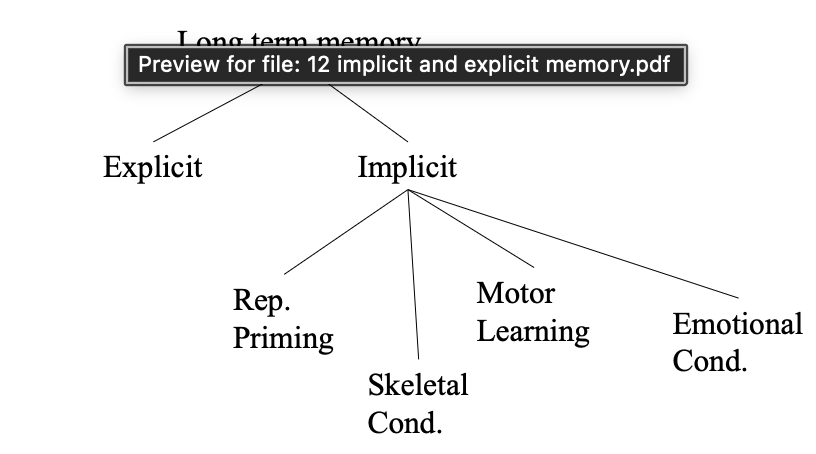
what does long term memory consist of?
4 memory systems. — explicit memory ( hippocampus)
repetition priming — visual cortex
motor skills — basal ganglia
skeletal conditioning— cerebellum
emotional conditioning. — amygdala
****NOTE***
repetition priming, motor skills, and classical conditioning are part of implicit memory.
what is skeletal conditioning?
classical conditioning with motor response
what is emotional conditioning?
classical conditioning with an emotional response.

what is explicit memory?
tries to localize memory in the brain — tested directly
associated with hippocampus
based on anatomy
cares about facts
conscious memory — based on awareness that you are remembering something
consist 2 parts — episodic and semantic
what is episodic?
idea of — “i remember”
learned through a single exposure
has spatial and temporal context
can turn into semantic memories
what is semantic?
idea of —”i know”
has no context involved
possible to learn in a single exposure but not likely.
strengthen with repetition
has 4 properties that theories must account for
4 properties that theories must account for (semantic)
quantity and speed —- long term memory is huge and you must be able to quickly retrieve and store things fast
near miss — even when you make a mistake in retrieving or storing memory you are almost right —idea i know it but i just cant remember
relevant info —- here is what i know from my experience/the past and now let me apply it/ make a inference
resistant to faulty input — “i know what you are talking about but the cue you gave was just wrong”
what organizational system that will not work?
addressing system — number each memory to access info. works great for computers not humans. ex: library
what is a node
representation of a concept

what about collins and quillian — hierarchical theory?
organized by hierarchy
node becomes active because of input
good at providing lots of storage and relevant information
problems = properties are not stored only once

what about collins and lofus?— spreading activation theory
not organized by hierarchy
has a set of units — characteristics
each unit has a state of activation. — key phrases or concepts trigger us to remember concept
weighted links — some things reflect concept better than others.
output function
learning rule to change the weights
tends to create defaults/ automatic characteristics everyone thinks of.
what experiments support spreading activation theory?
repetition priming
semantic priming
the fan effect — ability to observe something quickly and identify specific characteristic. if you have multiple observation = slower time identifying. — only in laboratory
links below what are inhibitory?
0.0
what is implicit memory?
revealed by indirect testing
memory is shown by performance.
learning objects
what are the different types of long term memory?
how is explicit memory organized?
what are the different types of long term memory?
explicit memory
implicit memory
how does explicit memory affect long term memory?
anterograde amnesia — people who cannot learn new information. BUT —- they can learn motor skills, classically conditioned responses, perceptual knowledge (reading mirror reversed words.
stores common knowledge, personal events/experiences
supported by the hippocampus and the thalamus
must have some form of retrograde amnesia.
uses MRI to measure brain activity — neuro-imaging
2 subsystems: episodic memories and semantic memories
how does implicit memory affect long term memory?
memory is outside of awareness
several subtypes — consists of motor skills, priming, conditioning
impacts cerebellum
how is explicit memory organized?
addressing systems — each item has a unique address. helps find what we want.
content addressable storage — memory are in storage houses but con is as we learn more it takes more time
hierarchical theory —memories are stored by nodes and links — kind of like placing things into categories.
spreading activation theories — linking associations of objects to one another
anatomic dissociation
Evidence that two different tasks are supported by different parts of the brain.
explicit memory
A type of memory retrieval that is conscious, usually measured by verbal report. Explicit retrieval would typically be supported by declarative memory; declarative refers to the memory system, and explicit refers to the type of memory test.