13.1 - Common Names for Equations and Graphs

0.0(0)
Studied by 1 person
call kaiCall Kai
learnLearn
examPractice Test
spaced repetitionSpaced Repetition
heart puzzleMatch
flashcardsFlashcards
GameKnowt Play
Card Sorting

1/12

encourage image

There's no tags or description

Looks like no tags are added yet.

13 Terms

1
New cards

Ellipsoid

x²/a² + y²/b² + z²/c² = 1

  • if a=b=c, then the equation is x² + y² +z² = a², and the surface is a sphere


<p>x²/a² + y²/b² + z²/c² = 1</p><ul><li><p>if a=b=c, then the equation is x² + y² +z² = a², and the surface is a sphere</p></li></ul><p></p>
2
New cards

Elliptic cylinder

x²/a² + y²/b² = 1

  • if a=b, the surface is a circular cylinder


<p>x²/a² + y²/b² = 1</p><ul><li><p>if a=b, the surface is a circular cylinder</p></li></ul><p></p>
3
New cards

Elliptic double cone

x²/a² + y²/b² = z²/c²

  • if a=b, the surface is called a circular double cone


<p>x²/a² + y²/b² = z²/c²</p><ul><li><p>if a=b, the surface is called a circular double cone</p></li></ul><p></p>
4
New cards

Elliptic paraboloid

x²/a² + y²/b² = z/c

  • if a=b, the surface is called a circular paraboloid


<p>x²/a² + y²/b² = z/c</p><ul><li><p>if a=b, the surface is called a circular paraboloid</p></li></ul><p></p>
5
New cards

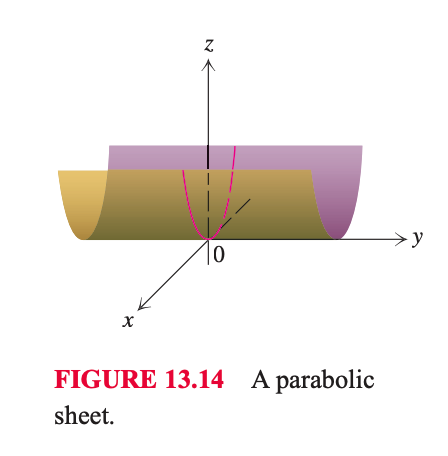
Parabolic sheet (or parabolic cylinder)

z = ax²

  • could replace z w/ x,y or x w/ z,y respectively (as long as the variables aren’t the same on both sides of the equation)

<p>z = ax²</p><ul><li><p>could replace z w/ x,y or x w/ z,y respectively (as long as the variables aren’t the same on both sides of the equation) </p></li></ul><p></p>
6
New cards

Hyperbolic paraboloid / Saddle function

y²/b² - x²/a² = z/c

<p>y²/b² - x²/a² = z/c</p>
7
New cards

Two hyperbolic sheets (or hyperbolic cylinder)

y²/b² - x²/a² = 1

<p>y²/b² - x²/a² = 1</p>
8
New cards

Hyperboloid of one sheet

x²/a² + y²/b² - z²/c² = 1

  • a circle if a=b


<p>x²/a² + y²/b² - z²/c² = 1</p><ul><li><p>a circle if a=b</p></li></ul><p></p>
9
New cards

Hyperboloid of two sheets

z²/c² - x²/a² - y²/b² = 1

  • a circle if a=b


<p>z²/c² - x²/a² - y²/b²  = 1</p><ul><li><p>a circle if a=b</p></li></ul><p></p>
10
New cards

Plane

a(x - x₀) + b(y - y₀) + c(z - z₀) = 0

  • (a,b,c) is the normal vector N

  • (x₀,y₀,z₀) is a point on the plane

  • also has the form ax + by + cz = d


<p>a(x - x₀) + b(y - y₀)  + c(z - z₀) = 0</p><ul><li><p>(a,b,c) is the normal vector <strong>N</strong></p></li><li><p>(x₀,y₀,z₀) is a point on the plane</p></li><li><p>also has the form ax + by + cz = d </p></li></ul><p></p>
11
New cards

Line

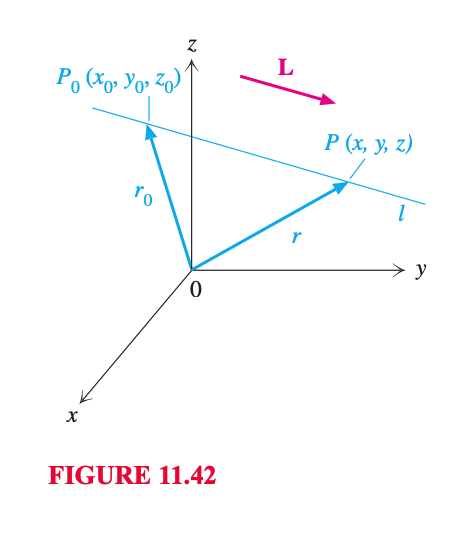
r = r₀ + t(L)

  • (x₀,y₀,z₀) is the initial point vector r₀

  • (a,b,c) is L is the arbitrary direction vector of r scaled by t (some constant)

  • P₀P = tL


<p><strong>r</strong> = <strong>r₀</strong> + t(<strong>L</strong>)</p><ul><li><p>(x₀,y₀,z₀) is the initial point vector <strong>r₀</strong></p></li><li><p>(a,b,c) is <strong>L</strong> is the arbitrary direction vector of <strong>r</strong> scaled by t (some constant)</p></li><li><p><strong>P₀P</strong> = t<strong>L</strong></p></li></ul><p></p>
12
New cards

Line (Parametric)

x = x₀ + at
y = y₀ + bt

z = z₀ + ct

  • (x₀,y₀,z₀) is the initial point vector r₀

  • (a,b,c) is L is the arbitrary direction vector of r scaled by t (some constant)

  • P₀P = tL


<p>x = x₀ + at<br>y = y₀ + bt</p><p>z = z₀ + ct</p><ul><li><p>(x₀,y₀,z₀) is the initial point vector <strong>r₀</strong></p></li><li><p>(a,b,c) is <strong>L</strong> is the arbitrary direction vector of <strong>r</strong> scaled by t (some constant)</p></li><li><p><strong>P₀P</strong> = t<strong>L</strong></p></li></ul><p></p>
13
New cards

Line (Symmetric)

(x - x₀)/a = (y - y₀)/b = (z - z₀)/c

  • (x₀,y₀,z₀) is the initial point vector r₀

  • (a,b,c) is L is the arbitrary direction vector of r scaled by t (some constant)

  • symmetric equations eliminate t as a variable

  • if a, b, or c = 0, write the equation separately

  • P₀P = tL


<p>(x - x₀)/a = (y - y₀)/b = (z - z₀)/c</p><ul><li><p>(x₀,y₀,z₀) is the initial point vector <strong>r₀</strong></p></li></ul><ul><li><p>(a,b,c) is <strong>L</strong> is the arbitrary direction vector of <strong>r</strong> scaled by t (some constant)</p></li><li><p>symmetric equations eliminate t as a variable</p></li><li><p>if a, b, or c = 0, write the equation separately</p></li><li><p><strong>P₀P</strong> = t<strong>L</strong></p></li></ul><p></p>