bio 300 lab 7 quiz
 Call Kai
 Learn
 Practice Test
 Spaced Repetition
 Match
 Flashcards
 Knowt Play
1/39

There's no tags or description
Looks like no tags are added yet.
40 Terms
What are fungi cell walls made of
chitin
fungi are considered absorbptive __________
heterotrophs
what does absorptive heterotrph mean?
Excrete digestive enzymes, absorbs digestive food
What are the 3 modes of nutrition and what do each mean
Saprobes – feeds on nonliving decaying organic
matter
• Parasites – gets nutrients from a host
• Mutualists – both individuals benefit (lichens)
are fungi multi or single celled
can be both
how does unicellular fungi reproduce
budding
what are multicellular fungi bodies made up of
hyphae (bodies composed of cellular strands (filaments))
hyphae can form an interwoven mass it is called a ________
mycelium
what is it called when mycelium is organized v. unorganized
mushrooms, mold
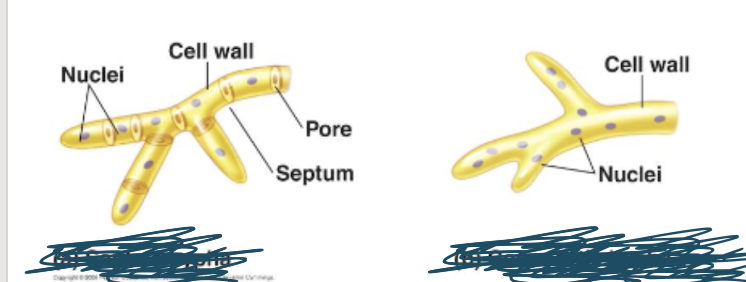
which hyphae is septate and which is coenytic?
a) septate
b) coenytic
what is the diff between septate and coenytic hyphae
Septate have septum dividing the cells: slower:
Coenocytic do not have septum: faster
what are the 5 groups of fungi?
Chytridiomycota (pronounced "my" -
"kota")
2. Zygomycota – breadmolds
3. Glomeromycota
4. Asomycota
5. Basidiomycota – club fungi or mushrooms
Chytridiomycota: Chytridiomycota is the only group with what and what
flagellated cells (sex cells)
true alternation of generation
Chytridiomycota: what environment do Chytridiomycota have to stay in
moist
Chytridiomycota: how does asexual reproduction work
uses Zoospores found in thin-walled sporangia with diploid cells that germinate into another sporophyte (clonal
Chytridiomycota: how does sexual reproduction work?
with sporangia (thick-walled) with haploid spores. Haploid spores germinate into multicellular gametangia.

Chytridiomycota
finish later

Chytridiomycota: whcih is gametophyte and which is sporophyte
top: gametophyte (n)
bottom: sporophyte (n)
breadmold is associate with which fungi group
Zygomycota
Zygomycota: what are the p rimary characteristics of zygomycota? zygospore and sporangiosphores
Zygospore- diploid spore from fusion of two haploid mating strains; held within zygosporangium
Sporangiophores- stalked sporangia; elevate spores above substrate
Zygomycota: what are general characteristics of zygomycota?
Nonmotile
Primarily terrestrial, some aquatic
Coenocytic (aseptic) hyphae
Reproduction:
Sexual-zygotic meisosis
Asexual

Zygomycota: explain
come back to later
Glomeromycota: what is Glomeromycota also known as?
arbuscular endomycorrhizae
Glomeromycota: Mycorrhizae interact with plant roots as ___________
mutalists
Glomeromycota what is mutualism in the context of fungi?
Fungi receive photosynthates and/or protection
• Plants receive mineral nutrients, increased access to water in soil
& protection from pathogenic fungi or bacteria
what is the difference between Endomycorrhizae and Ectomycorrhizae
Endomycorrhizae– fungi that reach within plant roots
(Glomeromycota)
• Arbuscules--highly branched structures around plasma membrane
• Ectomycorrhizae— fungi envelop exterior of plant roots
(Ascomycota & Basidiomycota)
Ascomycota: What are macrofungi in Ascomycota, and what are some examples?
produce large fruiting bodies that disperse haploid spores. e.g: truffles, morels, yeast, and Penicillium.
Ascomycota: What is an ascus, and what does it contain?
A sac-like sporangium containing haploid ascospores (n), produced by meiosis followed by mitosis.
Ascomycota: What are some beneficial/ harmful Ascomycota?
Beneficial: Penicillium produces penicillin; yeast i
Harmful: plant pathogens and human/animal pathogens like Aspergillus.
Ascomycota:What are Woronin bodies, and what do they do?
Plug septal pores when hyphae are damaged, preventing cytoplasm loss
Ascomycota: What is the defining feature of sexual reproduction in Ascomycota
Produce 8 haploid ascospores inside a sac-like ascus (n)
Ascomycota: How does Saccharomyces (baker’s yeast) reproduce
Asexually by budding and sexually by ascospores (parent cells)
Ascomycota: What is dimorphism in yeasts?
Ability to exist in both yeast-forming and filamentous phases
Ascomycota: Does Penicillium reproduce asexually, and what does it do?
Reproduces asexually by conidia, formed at the tips of hyphae, produces penicillin which kills Gram-positive bacteria
Basidiomycota: What are basidia, and what do they produce
Club shaped cells that produce sexual haploid basidiospores on the outside
each holds 4 spore
Basidiomycota: What are a basidiocarp and gills?
Basidiocarp = larger fruiting body (mushroom) formed by mycelium. Gills or pores increase surface area and hold basidia.
Basidiocarp: What are the two organisms in a lichen, and what does each receive?
Fungus (mycobiont) receives photosynthates photosynthetic organism (photobiont) receives protection and liberated nutrients.
Basidiocarp:What are the three lichen growth forms?
Crustose = encrusts flat bodies
foliose = leaf-like
fruticose = highly branched.
Basidiocarp: How do lichens reproduce asexually, and where can they grow?
through soredia in inhospitable environments like polar regions, rocks, and high elevations.
Basidocarp:
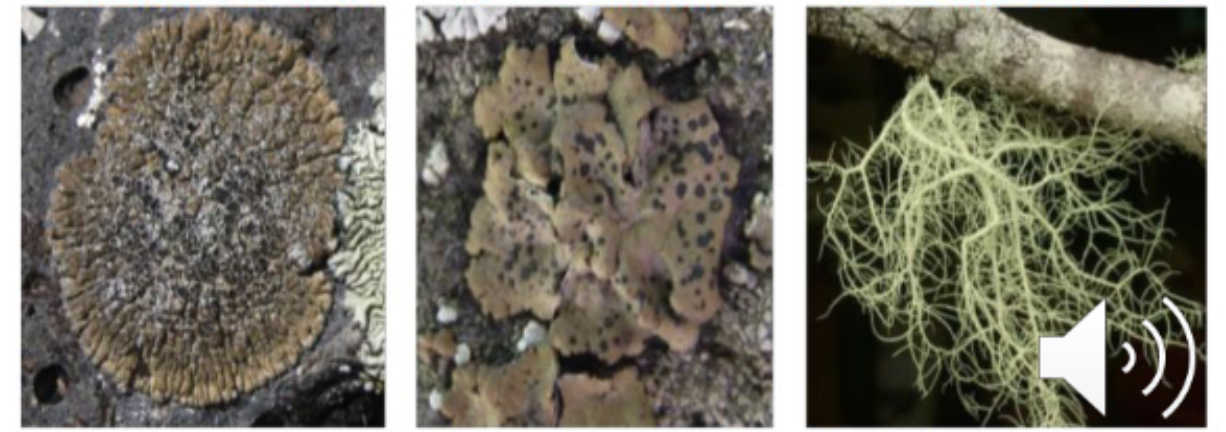
left to right which is which lichen
crustose, foliose, fructose.