AHS3263: Minimum Database
 Call Kai
 Learn
 Practice Test
 Spaced Repetition
 Match
 Flashcards
 Knowt Play
1/38

There's no tags or description
Looks like no tags are added yet.
39 Terms
History is:
General & surgery focused
PE (Physical Exam) includes:
Cardiovascular
Respiratory
GI
UG (urognetinal - Pertaining to both the urinary & reproductive organs)
MSI (musculoskeletal)
PLN (peripheral lymph nodes)
NEURO
Documentation:
Describe what you FIND & DON’T FIND
Ex. of what you find:
Clear lung sounds
Sinus Arrhythmia
Ex. of what you don’t find:
No crackling or wheezing
No murmurs
NSF = No significant findings
WNL = Within normal limits
MUST have a LIMIT
Ex: Temperature,HR, Neurologic exam
Ink ONLY - SINGLE LINE to CROSS OUT
SOAP
S - Subjective = What the pet owner reports
O - Objective = Measurable data(ex: TPR)
A - Assessment = Clinical diagnosis (ex: Bradycardia, pyrexic - fever)
P - Plan = The next step for the patent(ex: CBC/Chem)’
USE appropriate medical terminology
Weight:
Is it 10.8 pounds or 10 pounds 8 ounces?
10.8 pounds = 10 pounds 12 ounces
16 oz = 1 lb —→ (16)(0.8) = 12.8
Preanesthetic Screening:
Dependent on:
ANIMAL’S CONDITION
REASON for SURGERY
Pre-Surgery Diagnostics:
Blood work
Blood gas analysis
ECG
Imaging
Fine-needle mass aspiration
Fecal analysis and/or urinalysis
Bloodwork:
PCV/TS (Packed cell volume - measures the % of RBCs in the blood)
BUN (Blood Urea Nitrogen - measures the amount of urea nitrogen in the blood) - Determines RENAL function
BG (Blood Glucose - measures the amount of glucose in the blood)
Minimum Database:
Depends on animal
CBC (Complete Blood Count - blood test that evaluates RBCS, WBCS, & platelets)
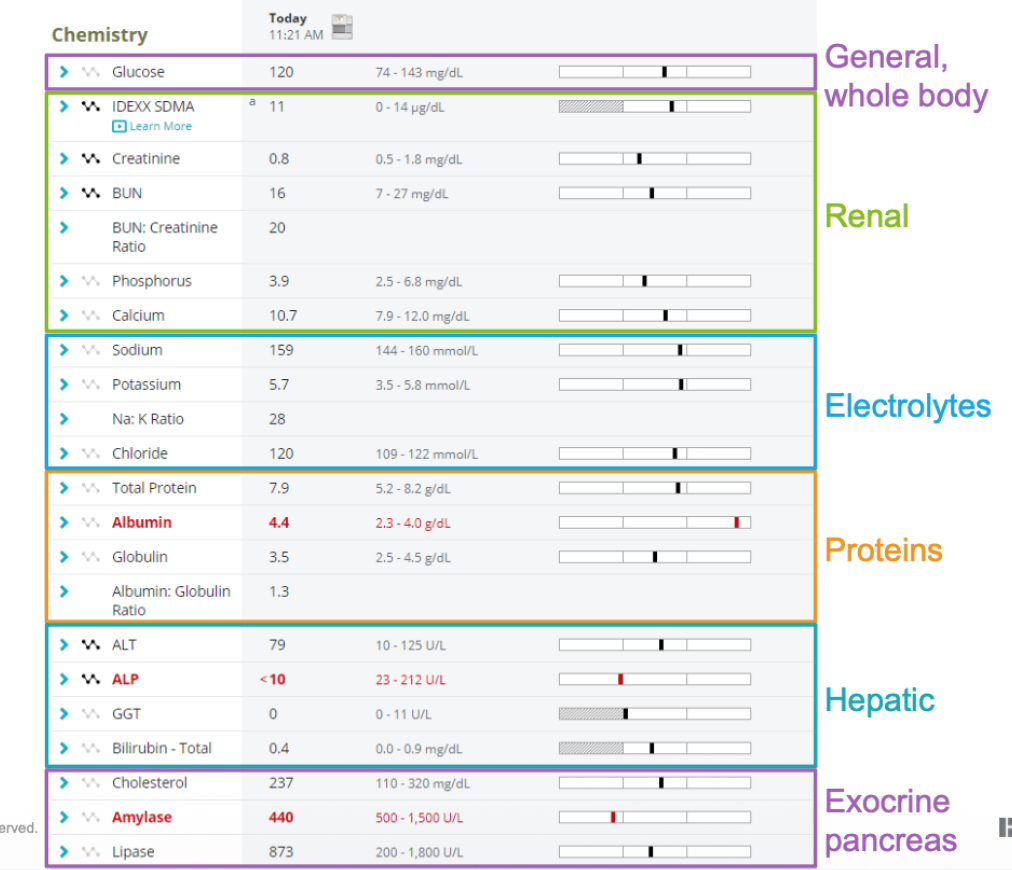
Chemistry (Blood test that measures different substances in the blood to evaluate organ function)
Lytes (Electrolytes - a blood test that measures electrolytes)
UA (Urinalysis - a urine test that evaluates urine concentration, glucose, protein, & cells)
ECG (Electrocardiogram - a test that measures the electrical activity of the heart)
CBC:
RBC
Hematocrit (measures % of RBCs in the blood)
Reticulocytes (IMMATURE RBCs)
Indicate that the body is responding to ANEMIA by producing more RBCs
WBC
Neutrophils
Eosinophils
Lymphocytes
Platelets
Chemistry:
Renal (KIDENY)
BUN
Creatinine
Phosphorus
Hepatic (LIVER)
ALT
SAP
Total Bilirubin
GGT
Protein
Protein
Many things
Glucose
Electrolytes
Sodium
Potassium
Chloride
Calcium
Phosphate
Magnesium
UA - Urinalysis:
Measures:
USG (Urine Specific Gravity - measures how concentrated or diluted the urine) - VERY IMPORTANT
Protein (Protein in urine)
Glucose (Sugar in urine)
Infection (Signs of a UTI)
Crystals (Mineral crystals in urine)

Pre-Surgical Bloodwork:
CBC
Chemistry (15, 17, etc)
Electrolytes
May be a “Mini-Panel”
Different panels for different AGED ANIMALS
UNDER 2 years old: May received a SMALLER panel
OVER 2 years old: May receive a LARGER panel
Be Aware:
Be aware of these blood values, especially when evaluating a PATIENT BEFORE SURGERY
BG
PCV
Platelet
Glucose:
Can be HYPO & HYPER
Who is most likely to be Hypoglycemic?
NEONATES & YOUNG animals
Clinical Signs of Hypoglycemia:
Weakness
Anorexia
Ataxia (loss of balance & coordination)
Blindness
Vomiting
Tremors
Seizures
Treatment for Hypoglycemia:
DEXTROSE
Needs to be DILUTED to < (less than) 10% before administering IV b/c:
Dextrose is HYPERTONIC & can cause VASCULITIS & RED CELL LYSIS
Seen Hyperglycemia with:
DIABETES
STRESS hyperglycemia
What is LOW platelets called?
Thrombocytopenia
What is HIGH platelets called?
Thrombocytosis
Platelets:
Clumped platelets
Why is this a common finding?
When you DON’T have a CLEAN STICK (draw blood)
What will the platelet number read as?
LOW
Next Steps for Low Platelets:
BLOOD SMEAR if platelet count LOW
Manual count of platelets
100X - 1 platelet = 15-20,000 platelets
Sometimes need a CLEAN STICK
DO NOT draw blood in JUGULAR VEIN
Coagulation Panel:
What is it testing?
Tests the blood’s ability to CLOT & helps identify bleeding or clotting problems
What tube?
BLUE TOP TUBE (contains sodium citrate)
Where do you draw the blood?
Cephalic or Saphenous vein
NOT in the JUGULAR VEIN
What sign do you put on the cage?
NO JUG STICKS = DO NOT draw blood from the JUGULAR VEIN
Common sign of LOW platelets:
Petechiae
Found in mucous membrane, eyes, ear, & under belly
Concern when it becomes ecchymosis (bruising)
Stress Leukogram:
Stress leukogram can cause LEUKOCYTOSIS (INCREASED WBC count)
Neutrophilia (INCREASED neutrophils)
Eosinopenia (DECREASED eosinophils)
Lymphopenia (DECREASED lymphocytes)
Monocytosis (INCREASED monocytes)
When do we see this?
STRESS
What disease would have this?
Cushing’s disease (too much cortisol in the body - CORTISOL is a STRESS HORMONE)
PCV:
Manual PCV/TS if HCT (hematocrit) LOW
Why would you have a HIGH PCV/TS?
When an animal is DEHYDRATED
Hematocrit vs. PVC:
PVC = PHYSICALLY configure it
Hematocrit = Measurement that the MACHINE makes
Hemoconcentration/Hemodilution:
Hemoconcentration
INCREASE in CONCENTRATION of BLOOD CELLS resulting from the LOSS of PLASMA or WATER
Example: DEHYDRATION
Result: INCREASES PCV & TS
Hemodilution
INCREASE in PLASMA or WATER
BLOOD CELLS become MORE DILUTED
Example: FLUID OVERLOAD
Result: DECREASES PCV & TS

Dehydration vs. Renal Disease:
USG (Urine Specific Gravity)
DOG 1.015-1.045 (ADEQUATE 1.030)
CAT 1.035-1.060 (ADEQUATE 1.040)
Dehydration = INCREASED USG
Renal Disease = DECREASED USG
Alkaline Phosphatase:
A LIVER ENZYME found in LIVER, BONES, & BILE DUCTS
HIGH in YOUNG animals due to GROWING BONE
Also, HIGH with BONE CANCER
Albumin:
A COLLOID protein that draw fluid in the body made by the LIVER
LOW ALBUMIN in YOUNG animals b/c the LIVER is still DEVELOPING
Renal Panel:
BUN
CREAT
PHOS
NA+
K+
SDMA
Electrolytes
Liver Panel:
ALBUMIN
ALT
SAP/ALP
GGT
AST
TOTAL BILIRUBIN
High bilirubin = icterus or jaundice
GLUCOSE
NSAID Panel:
ALKP/ALP
ALT
AST
BUN
CREA
What panel should we look for in a YOUNG puppy?
BLOOD SUGAR - especially when SLOW to wake up from surgery
Temperature belongs in:
Objective
What is 4.5 pounds?
4 pounds 8 ounces
(16)(0.5) = 8
A MDB is same for all patients:
FALSE
A renal panel should include:
Creatine
Petechiae is a sign of:
LOW PLATELETS