Unit 1 AP PSYCH
 Call Kai
 Learn
 Practice Test
 Spaced Repetition
 Match
 Flashcards
 Knowt Play
1/38

There's no tags or description
Looks like no tags are added yet.
39 Terms
Heredity
Transfer of characteristics from parent to offspring
Nature
Internal biological factors you inherit from your parents.
What are some examples of Nature?
genetic code, brain structure, physical traits.
Nurture
environmental influences that shape an individuals life
What are some examples of Nurture?
family upbringing, culture, education, and traumatic events.
Nature Vs. Nurture debate.. How do twin studies play a role in this?
Are our human traits present at birth or do they develop through expereince.
Identical twins raised in the same household should be the same, right? Not always. Just as identical twins separated at birth and raised in different environments often have many similarities.
Genetic predisposition
you have an inherited increased risk to developing a certain personality trait, behavior, or mental health condition, rather than a guaranteed outcome
What do Evolutionary Psychologists study?
Focus on what makes us humans alike by exploring principles established by Charles Darwin
Evolutionary Perspective
our thoughts, feelings, and behaviors exist the way they do because they helped our ancient ancestors survive and reproduce
Natural Selection
Inherited traits that better enable an organism to survive and reproduce in a particular environment will most likely be passed on to the succeeding generations.
eugenics
the discredited and harmful idea of trying to improve the human population through selective breeding
Identical Twin Studies ( monozygotic)
Develop from a single fertilized egg that splits ( all genes are the same, most share a placenta)
Faternal Twins (dizygotic twins)
developed from separate eggs that were fertilized simultaneously- share the same genes but are not identical.
For behavior geneticists, adoption creates 2 groups:
Genetic relatives- biological parents/siblings'
environmental relatives-the normal range of environments shared by a family’s children has little impact on their personalities.
Nervous System
made up of neurons, or nerve cells that communicate via chemical messengers called neurotransmitters.
Central Nervous System
The brain and the spinal cord- the bodies decision maker
Peripheral Nervous System ( every thing else besides brain and spinal cord)
Is responsible for gathering info and for transmitting CNS decisions to other body parts
Peripheral Nervous System-Somatic Nervous System
enables voluntary control of our skeletal muscles
ex: when a friend taps you on the shoulder, your somatic nervous system reports to your brain the current state of your skeletal muscles and carries instructions back
Peripheral Nervous System- Autonomic Nervous System
Operates on its own, controls our glands and our internal organ muscles.
ex: heart beat and digestion
Special nerve endings in your peripheral nerves detect harmful things—like extreme heat, a sharp cut, pressure, or inflammation. receptors send an electrical pain signal along your peripheral sensory nerves, through the spinal cord, and up to your brain.Your brain receives the message, figures out where it hurts, and tells you to pull your hand away or protect the injury
Autonomic Nervous System- Sympathetic Nervous System
arouses and expands energy, fight or flight
Autonomic Nervous System- Parasympathetic Nervous System
opposite of sympathetic- calming, stimulates digestion
Somatic Nervous System- Sensory neuron ( afferent)
carry messages from the bodies tissues and sensory receptors to the spinal cord for processing.
Somatic Nervous System- Motor ( efferent)
Carry instructions from the CNS outward toward the body’s muscles and organs.
Interneurons
neurons in the brain and spinal cord that serve as an intermediary between sensory and motor neurons; carry info around the brain for processing.
Reflexes
automatic responses to stimuli; sensory neurons take info up through spine to the brain. Some reactions occur when sensory neurons reach just the spinal cord.
Neurons
The basic functional unit of the nervous system
communicate by using electrical impulses and chemical signals to send info throughout the body
allow the central and peripheral nervous system to communicate and work together
Glial Cell
what an axon is protected by. Wraps around the axon and produces the myelin sheath.
helps insulate neurons to speed up signal transmission and facilitate communication between neurons, transport nutrients, and remove waste products.
myelin sheath
covers the axon and protects it from being damaged
increases how fast an action potential can travel down the axon
Reflex Arc
A nerve pathway that allows the body to respond to a stimulus without thinking
helps with our survival
All or nothing principle
A neuron will only fire if the threshold is met
threshold
the minimum amount of stimulation required for a neuron to fire and send an action potential. When enough neurotransmitters reach dendrites.
Depolorization
what action potential starts with.. positive sodium ions flood into the neuron, making the inside of the cell more positive. Allows for an electrical charge to move along the axon and to the next neuron.
refractory period
A brief period in which the neuron cannot fire again (neuron returns to its resting state)( maintains a internal negative charge)
Action Potential
The specific electrical charge that travels down the axon when the neuron fires. It's an "all-or-nothing" event.
resting potential
slightly negative charge
How does a neuron fire?

Reuptake
neurotransmitters are released by the neurons and travel back across the synapse to be reabsorbed by the axon terminals,

How do neurons exchange energy?
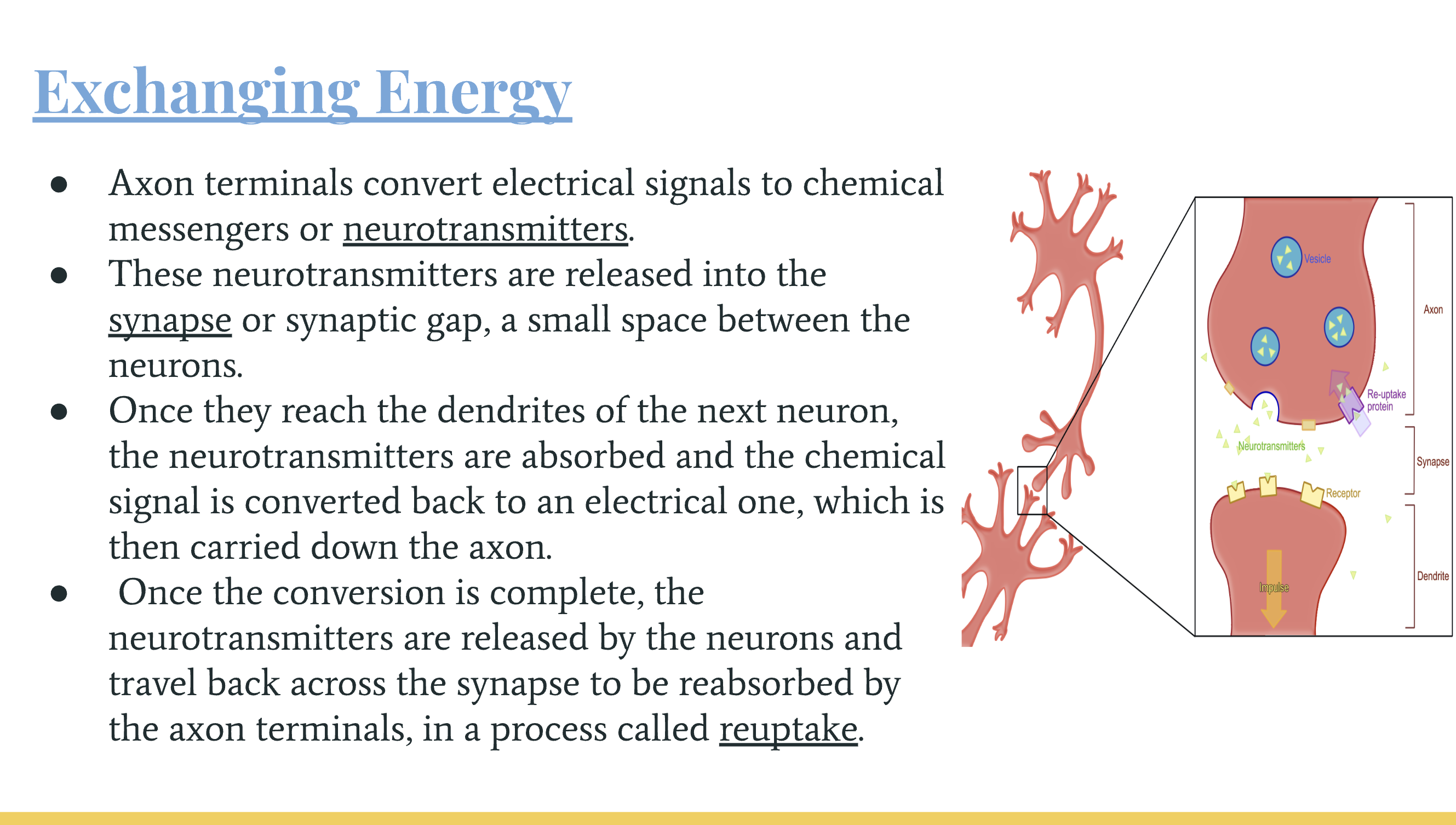
syaptic gap
between presaptic terminal of a neuron and postsaptic terminal of another neuron.