Cell Neuro Exam 2 -
 Call Kai
 Learn
 Practice Test
 Spaced Repetition
 Match
 Flashcards
 Knowt Play
1/65

Earn XP
Description and Tags
- Synaptic Transmission
66 Terms
What are the two classes of postsynaptic receptors?
Ionotropic - direct transmitter action
Metabotropic - indirect transmitter action
What are ionotropic receptors and give examples
ligand gated ion channels - allows ions to flow across membrane directly
nAChR, AMPAR, NMDAR
What are metatropic receptors
indirectly activates an ion channel through a cascade (through secondary messenger). they are not channels themselves.
where are ionotropic and metatropic neurons found?
postsynaptic terminal membrane
What is the neuromuscular junction (NMJ)
synapse where motor neuron meets skeletal muscle fiber
What happens at the junction in terms of neurotransmitters
acetylcholine is released at the motor neuron and binds to nAChR which excites the muscle.
what is the forward reaction of Acetylcholine (ACh) and what is the enzyme ivolved
Acetyl-CoA + Choline —> ACh
enzyme: ChAT
what is the reverse reaction for ACh and enzyme involved
Ach —> Acetyl Coa+Choline
enzyme: AChE
What Dale’s Law
A neuron only releases one type of neurotransmitter
How are neurons activity influenced by
many different inputsD
Does a neurotransmitter have the same effect on every post-synaptic neuron?
no —> determined by the type of postsynaptic receptor
How does nAChR work like molecularly to produce an excitatory contraction of the muscle
Ach binds to nAChR allowing it to ope
muscle membrane is usually negative and there is an inflow of K+ (depolarization) and flow out of Na+
Moves the membrane towards reversal potential of ~0mV causing muscle contraction
What happens to ACh after it is used to create contraction
on the synapse, ACh is broken down by AChE (acetylcholinesterase) and then the choline is transported back into the presynaptic neuron to create more ACh
How are synaptic activity quantified by?
recordings from the post synaptic membrane either an EPSP or EPSC
what is EPSP
EPSP (Excitatory Postsynaptic Potential): Measures the change in voltage across the membrane.
What is EPSC
EPSC (Excitatory Postsynaptic Current): Measures the actual flow of ions (current).
what is curare
competative antagonist of nAChR
blocks Ach from binding
what is sarin nerve gas
Acetylcholinesterase inhibitor (AChE)
blocks the breakodwn of ACh
What is competitive antagonist
binds to same site as agonist and blocks site from being activated
What is noncompetitve antagonist
binds to an allosteric (non-agonist) site ont he receptro to prevent activation of receptor
What does vesicle release depend on?
It is probabilistic and depends on Ca2+ levels —> more Ca —> more prob of release.
are there infinite vesicles?
no finate amt in releasable pool
Go through the steps of how vesicle release at the presynaptic neuron works (5)
Action potential moves down the presynaptic neuron
depolarization opens Ca2+ channels
causes Ca2+ to flow in a localized domain (in presynaptic neuron)
Ca2+ binds to synaptotagmin causing opening of fusion pore
glutamate flows out and binds to AMPAR —> AMPAR opens

How do vesicles dock to new membrane? (2)
V-SNAREs on the vesicle and T-SNAREs on pre-synaptic membrane wind together (coil-coil complex) to pull vesicle towards membrane (getting ready to release)
Munc-18 holds to SNARE proteins together
the incoming Ca binds to the Ca domains on the Synaptotagmin and is the last riger to release neurotransmitters into synapse
what does tetnaus and botox do
destroys SNAREs which blocks neurotransmitters from being bound and moved into post-synaptic neuron
what does botox specifially target/block
target NMJ and ACh
what is a sEPSP
spontaneous excitatory post synaptic potential —> MEASURES VOLTAGE of the POSTSYNAPTIC neuron once it recieves NT signal
spontaneous release of neurotransmitter vesicles that dont require an AP
what is the quantal hypothesis
quantal events are caused by the release of a single vesicle (quanta) of the NT
How is quantal analysis done?
reduce extracellular Ca2+ concentration so APs dont cause depolarization which would release a ton of NT (vesicle fusion)
What is mESPS
mini EPSP which is a type of sEPSP but it is the post-synaptic potential (voltage) following the release of a single vesicle
what is quantal size
amplitude of the post synaptic response (mV) in response to a single vesicle release (measures mEPSP)
what is quantal content
Average # of vesicles that are released following a single AP or stimultion
match presynaptic property and post synaptic property to quantal content or size
presynaptic property - quantal content
postsynaptic property - quantal size
how does phosphorylation impact quantal content
phosphorylation of Ca2+ channels leave them open for longer —> more vesicle release
how is quantal content (m) calculated with n and p
n (number of release sites) p (probability of release)
n * p = m
how is quantal size calculated/found?

its the mV that is generated by a single veiscle. look at peak of the first vesicle and see what mV it is at
How is EPSP amplitude calculated and what is it
EPSP amplitude - total post-synaptic potential change following an action potential (multiple vesicle releases)
EPSP amplitude (mV) = q*m
OR q*n*p
q = in mV and measures the potential change caused by one veiscle (quantal size)
m = average number of vesicles released following a single AP (quantal content)
what is q, m, n, p
q - quantal size, size of post synaptic potential following single vesicle release (mV) (basically mEPSP)
m - quantal content, average number of presynaptic vesicles released
n - number of vesicle release sites on membrane after single AP/stimulation
p - probability of vesicle release
how is q related to mEPSP
amplitude of mEPSP = q
what are the two ways that EPSP amplitude can increase
increase in m (quantal content and av number of vesicle release)
increase in q (quantal size and the actual impact in mV of each vesicle release)
What does an EPSP amplitude of 0mV mean? what does each peak represent?

0 mv - means that there was a failure to release any vesicles
each peak represents a the increase in one more vesicle release (peak 1 represents no veiscle peak 2 means 1 vesicle, ect)
what does a weak synapse mean (3) aka what are the factors that can make a synapse weak?
lower release probability (p)
lower number of release sites (n)
lower quantal size (q)
What is a paired pulse experiment
Delivering two back-to-back stimulations (AP) to cause two EPSPs and measure them
how does paired-pulse reveal high or low release probability
for low probability —> second EPSP amplitude is greater because the first EPSP releases very little vesicles and there is a lot of leftover Ca2+ on the membrane which causes more vesicle release on the second EPSP causing a higher amplitude
for high probability —> second EPSP is weaker because first EPSP release a lot of vesicles and there isnt enough time to replenish for the second EPSP
what is short term depression? and what kind of release probability does it correspond to
depletion of readily releasable vesicle pool, explains initial high release probability
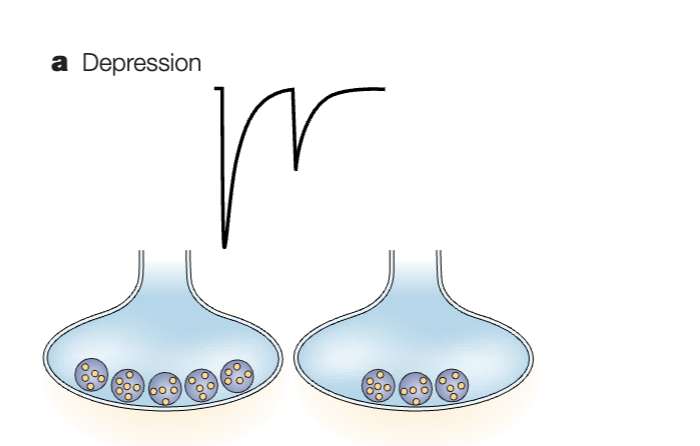
what is short term facilitation? and what kind of release probability does it correspond to
short-term facilitation: residual Ca2+ increases probability of release to second pulse
corresponds to initial low release probability

how do u find ppr
amplitude of EPSP2/amplitude of EPSP1
What does it mean if paired pulse ratio (PPR) is less than 1
indicates that EPSP2<EPSP1 so short term depression
what does PPR > 1 mean
EPSP2>EPSP1 so short term facilitation
What does botox and tetanus do to NMJ
destroy SNARE proteins which means that there is no ACh vesicle fusion and release —> paralysis of muscles (weakness)
what does a-Latrotoxin do
makes pores in the membrane for easier Ca2+ entry —> more Ach release —> more rigidity
what is myasthenia gravis (MG) and what does it attack
attacks the post synaptic AChR which means that ACh cant bind causing musle weakness
how is MG treated
treat by blocking AChE
what is lambert-eaton syndrome (LEMS)
attacks the presynaptic mechanism of voltage gated Ca2+ channels which causes no release of ACh and muscle weakness
What does curare do
blocks AChR so no inflow of Na+ at the post-synaptic neuron which means no depolarization and AP so no muscle contractions
what does a-BGt do
blocks AChR so no inflow of Na+ at the post-synaptic neuron which means no depolarization and AP so no muscle contractions
what does sarin nerve gas do?
blocks AChE so no degredation of ACh —> increased firing of muscle nueons and lots of muscle contractions
What is AMPA and what kind of IV plot does it create
linear IV plot
opens quickly when Glu binds and lets Na+ in K+ out (ionotrophic)
What are the antagonists of AMPA (3)
CNQX, DNQX, NBQX
What is NMDA and what kin d of IV plot does it produce
exponential IV plot
Glutamate and Glycine need to bind + depolarization to allow Mg plug to leave —> channel opens Na, Ca rush in K out
What are the antagonists for NMDA? (2)
APV, MK801
How do the kinetics of NMDAR compare to that of AMAPR
NMDAR is slower
Practice go


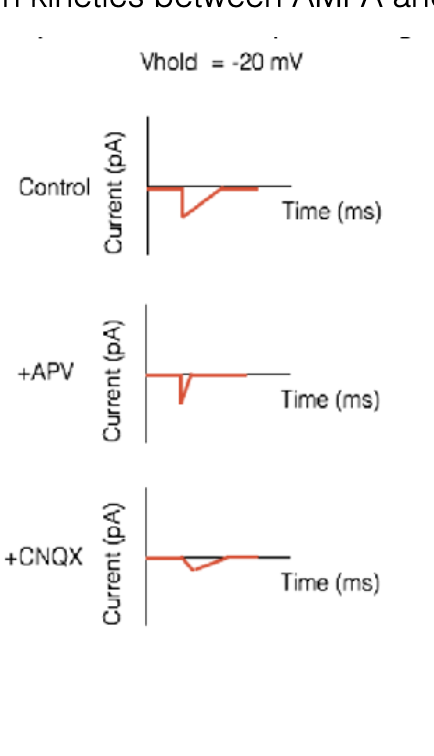
AT - 70MV NMDAR is blocked (cell needs to be depolarized to remov Mg+ ion block). So using APV to block NMDAAR wont do anything but using CNQX to block AMPA will
Practice gooooo

Vhold is less negative so smaller force that drives Na inwards is smaller. Blocking NMDAR (using APV) shows the fast spike of the AMPAR and blocing AMAPR (using CNQX) shows the smaller and slower spike of the NMDAR
practice gogogogogo

Vhold = +70mV means realllyyyy deplarized so bye bye Mg+ block!
blocking NMDAR (APV) shows peak from just the AMAPR (sharp and fast)
blocking AMAPR (CNQX) shows peak from just NMDAR (slower and weaker)
