7C - Muscles of the superficial back + pectoral region
 Call Kai
 Learn
 Practice Test
 Spaced Repetition
 Match
 Flashcards
 Knowt Play
1/15

There's no tags or description
Looks like no tags are added yet.
16 Terms
External Intercostals
O: inferior border of rib above
In: superior border of rib below
A: contraction creates inhalation by elevating ribs; relaxation depresses the ribs resulting in exhalation
I: intercostal nerves

Internal Intercostals
O: superior border of rib below
In: inferior border of rib above
A: contraction draws adjacent ribs together during forced exhalation
I: intercostal nerves

External Oblique
O: inferior 8 ribs
In: iliac crest and linea alba
A: Together: compress abdomen and flex vertebral column; Singly: laterally flex vertebral column to the same side and rotate to the opposite side
I: intercostal nerves

Internal Oblique
O: iliac crest, inguinal ligament, and thoracolumbar fascia
In: cartilage of last four ribs and linea alba
A: Together: compress abdomen and flex vertebral column; Singly: laterally flex and rotate vertebral column to the same side
I: intercostal nerves

Transverse Abdominis
O: iliac crest, inguinal ligament, lumbar fascia, and cartilages of inferior six ribs
In: xiphoid process, linea alba, and pubis
A: compress abdomen
I: intercostal nerves

Rectus Abdominis
O: pubic crest and pubic symphysis
In: cartilage of 5th-7th ribs and xiphoid process
A: flexes trunk and compresses abdomen
I: intercostal nerves

Quadratus Lumborum
O: iliolumbar ligament and iliac crest
In: inferior border of 12th rib and transverse processes of L1-L4
A: Together: stabilize rib 12 during respiration; assist with lumbar extension; Singly: laterally flex vertebral column
I: T12 thoracic nerve and nerves of L1-L3

Diaphragm
O: xiphoid process, cartilage of the lower 6 ribs, and lumbar vertebrae
In: central tendon
A: contraction causes it to flatten and increase vertical dimension of thoracic cavity (inhalation); relaxation causes it to move superiorly and decrease the vertical dimension of thoracic cavity (exhalation)
I: phrenic nerve

Trapezius
O: superior nuchal line of occipital bone, ligamentum nuchae, and spines of C7 and T1-T12
In: Clavicle, acromion, and spine of scapula
A: Upper trap: elevate scapula, upwardly rotate the scapula and extend head; Middle trap: retract scapula; Lower trap: depress scapula and upwardly rotate the scapula
I: spinal accessory nerve

Latissimus Dorsi
O: spines of T7-T12 and L1-L5, sacrum and ilium, inferior 4 ribs
In: bicipital groove
A: extends, adducts, and internally rotates the arm at the shoulder joint; draws arm inferiorly and posteriorly
I: thoracodorsal nerve

Rhomboid Major
O: spines of T2-T5
In: medial border of scapula inferior to spine
A: elevation, retraction, and downward rotation of the scapula
I: dorsal scapular nerve

Rhomboid Minor
O: spines of C7-T1
In: medial border of scapula superior to spine
A: elevation, retraction, and downward rotation of the scapula
I: dorsal scapular nerve

Levator Scapulae
O: transverse processes of C1-C4
In: superior medial border of scapula
A: elevation and downward rotation of the inferior angle of scapula
I: dorsal scapular nerve

Pectoralis Major
O: clavicle, sternum, and costal cartilages of ribs 2-6
In: greater tuberosity and bicipital groove
A: shoulder adduction and internal rotation and assists with flexion
I: medial and lateral pectoral nerves

Pectoralis Minor
O: ribs 3-5
In: coracoid process
A: scapular protraction and downward rotation
I: medial pectoral nerve

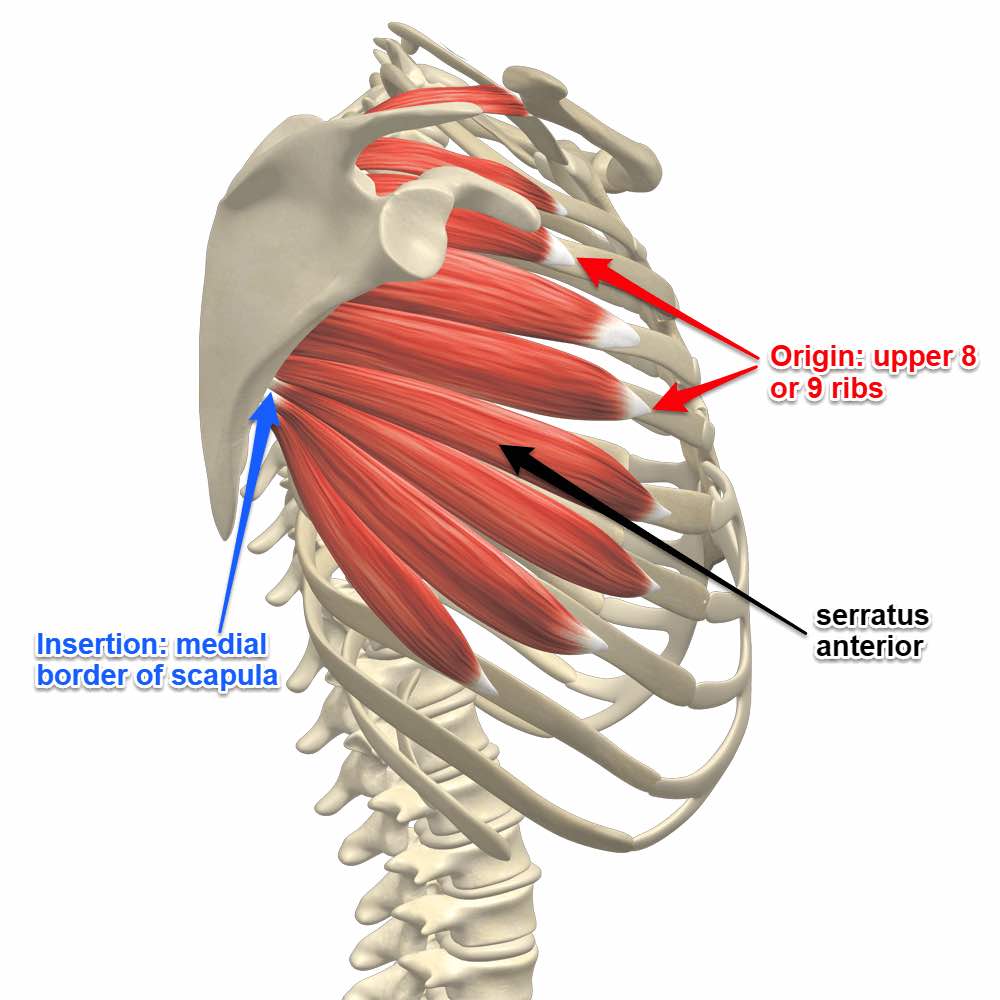
Serratus Anterior
O: superior 9 ribs
In: anterior (costal) surface of the medial border of the scapula
A: protraction and upward rotation of the scapula
I: long thoracic nerve