Chapter 5: the phylum Platyheminthes, class Cestoda
 Call Kai
 Learn
 Practice Test
 Spaced Repetition
 Match
 Flashcards
 Knowt Play
1/41

There's no tags or description
Looks like no tags are added yet.
42 Terms
true tapeworms
Eucestoda
scolex (head)
On the extreme anterior end of a true tapeworm is the holdfast organelle known as the ?.
suckers
hold onto the lining of the small intestines
not associated with intake of food, just an organ attachment
4
how many suckers do eucestoda have?
rostellum
some tapeworms possess an anchorlike organelle called the ?
which are backward-facing hooks that allow a tapeworm to further anchor itself into the mucosa of the small intestine
neck
Just posterior to the head is germinal (growth) region called the ?.
strobila
The remaining of the body is called a ? composed of individual glottids.
glottids
what make up the strobila?
proglottids
can be immature, mature, or gravid depending on location on the body
hemaphroditic
can be seen with the naked eye in the feces of the definitive host feces.
complete set
Each proglottid contains a ? of male and female reproductive organs (hermaphroditic).
Immature proglottids
? are located closet to the scolex (head)
Mature proglottids
? are located in the middle portion of the strobila (body).
Gravid proglottids
? are located farthest from the scolex and are filled with eggs.
hexacanth
Eggs found in the gravid proglottids contain the larval stage known as the ? (six hooks).
4 egg types that contain hexacanths
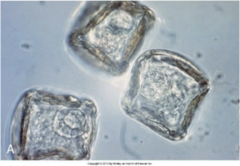
Pyriform apparatus (ex. Moniezia spp.)
Dipylidium (ex. Dipylidium caninum)
Taenia (ex. Taenia spp. / Echinococcus spp.)
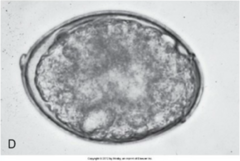
Pseudophyllidean - (ex. Diphyllobothrium spp.)
Pyriform apparatus
Ex. Moniezia spp.
Pseudophyllidean
Ex. Diphyllobothrium spp.
Dipylidium
Ex. Dipylidium caninum

Taenia eggs
ex. Taenia spp. /Echinococcus spp.

Eucestoda life cycle
can have 2 intermediate hosts: arthropod or mammal
the gravid proglottid passes out into the environment, rupture, and release thousands of hexacanth embryos
The egg is then ingested by an intermediate host and becomes a larval tapeworm
The definitive host then ingests the intermediate host that contains the larval stage
The tapeworm emerges from the larval stage, attaches to the lining of the small intestine, and begins to produce the strobila (body)
what decides the larval stage form
There are several forms of the larval stage; depends on the choice of host, their structure, their predilection site, and the pathogenicity to the intermediate host
main forms of larval stage
cysticercoid, cysticercus, and hydatid cyst
arthropod intermediate host
cysticercoid larval stage
mammal intermediate host
cysticercus larval stage
human host
hydatid cyst larval stage
cysticercoid
The intermediate host may be an arthropod like a flea or grain mite
-In the arthropod, the larval stage is known as a ?
-It is tiny an contains a fluid filled space
Dipylidium caninum
example of cysticercoid larval stage
cysticercus
The intermediate host can be a mammal like a rabbit
In the mammalian host, the larval stage is known as a cysticercus "bladder worm"
This is a fluid filled larval stage within the tissues of the intermediate host
Taenia pisiformis
example of cysticercus larval stage
pseudotapeworms
Cotyloda
Cotyloda
These tapeworms resemble true tapeworms
The anterior end has a scolex
They absorb their nutrients through their tegument too.
The strobila of these tapeworms is like that of the true tapeworms
bothria
for psuedotapeworms, instead of 4 suckers, there are 2 slit-like organelles called ? to attach them
operculum
pseudotapeworm eggs have an ? unlike true tapeworm eggs
long chains
psuedotapeworms proglottids pass to the outside in ? unlike true tapeworms that are broken chains
West coast animals and dogs that catch fish
what is most commonly known to get pseudotapeworms?
copepod and fish
2 intermediate host of pseudotapeworms
small crustacean
what is a copepod?
Cotyloda life cycle
The operculated eggs pass to the environment
The larvae are ingested by an intermediate host which is an aquatic crustacean called a copepod
The copepod (small crustacean) then ingested by a second intermediate host (fish), where it develops into the infective stage for the definitive host
The definitive host then ingests the second intermediate host, it then attaches to the lining of the small intestine and starts the cycle again
coracidum
Psuedotapeworm larvae
If they contact water, they hatch and release a ciliated hexacanth called a ? (larvae), which must be ingested by an intermediate host
Diphyllobothrium latum and Spirometra mansonoides
what are the two important species for Phylum Platyheminthes, Class Cestoda
Diphyllobothrium latum
broad fish tapeworm

Spirometra mansonoides
zipper tapeworm
