Comfort, Sedation, and Anesthesia | NURS 318
 Call Kai
 Learn
 Practice Test
 Spaced Repetition
 Match
 Flashcards
 Knowt Play
1/121

There's no tags or description
Looks like no tags are added yet.
122 Terms
what are the commonly used ICU pain scales? (describe briefly what they are)
critical-care pain observation tool (CPOT): a behavioral pain assessment tool for critically ill patients unable to reliably self-report pain, including intubated patients
pain in advanced dementia (Pain-Aid): a behavior pain assessment tool for patients with advanced dementia who cannot reliably communicate their pain
what are the main difference between analgesics and anesthetics?
both can be use to relieve pain but analgesics do so without producing loss of consciousness or loss of reflexes while anesthetics can cause a loss of consciousness and/or reflexes!
what are opioid agonist and how do they work? (brain dump example medication too!)
medication that are used to relieve acute or chronic severe pain or to supplement anesthesia by binding to opioid receptors (mu, delta, and kappa) and block pain-causing neurotransmitter
treat acute or chronic severe pain: acute injury, post-op pain, MI, and cancer
examples: (morphine class: codeine, hydrocodone, hydromorphone) | (meperidine-like: fentanyl, meperidine, alfentanil), (other: Methadone, tramadol)
What is codeine commonly used for?
mild to moderate pain
cough suppression
how does CYP2D6 affect codeine’s analgesic effect?
CYP2D6 is a liver and brain enzyme that convert codeine to morphine
people with too little CYP2D6 would have inadequate pain relief when using codeine
people with too much CYP2D6 will experience a stronger and potentially affect from codeine in same amount as a person with the average amount of CYP2D6 (monitor for risk of toxicity!)
what is fentanyl commonly used for?
severe acute pain, including trauma and surgery; IV fentanyl is ONLY used in monitored settings → high risk for abuse
what distinctive complication can rapid IV fentanyl cause?
chest wall rigidity (wooden chest syndrome) → a rare complication that can impair ventilation
patients experience sudden respiratory failure, breath-holding, facial cyanosis, a rigid/tense abdomen, a locked jaw, and stiff limbs
what is hydromorphone (Dilaudid) used for?
moderate to severe pain
available in oral and injectable formulations
which opioid is classically associated with treating postoperative shivering?
meperidine
why is meperidine generaly avoided for routine pain unlike other opiate agonist?
it is generally avoided due to its tendency to be neurotoxic and high risk for delirium and seizures
why is meperidine associated with seizures and delirium?
its metabolites normeperidine can accumulate and cause neurotoxicity especially with renal impairment
what is oxycodone commonly used for?
oral treatment of moderate to severe pain; extended-release forms may treat selected chronic pain
what is a major safety risk shared by opiate agonist?
respiratory depression
sedation
monitor respiratory status and level of consciousness
which medication reverses opioid-induced respiratory depression?
naloxone (narcan); administer incrementally and continue to monitor respiratory status
what are the adverse effect of naloxone (narcan) that the nurse should watch out for?
acute opioid withdrawal symptoms like agitation, anxiety, sweating, N, V, D, muscle aches, and tachycardia
cardiovascular effects: hypertension, tachycardia (only on rare occasion serious arrhythmia or pulmonary edema)
pain returning suddenly
what is the critical care nursing priority after administering naloxone for an opiate agonist overdose?
continue to monitor respiratory status and level of consciousness after administration because naloxone can wear off before the opioid dose, causing recurrent respiratory depression
what is the general distinction between COX-1 and COX-2 inhibitors?
both relieve pain and inflammation but COX-1 supports gastric protection and platelets, while COX-2 promotes pain, inflammation and fever through prostaglandin
why can inhibiting COX-1 cause GI injury and bleeding?
COX-1 supports gastric mucosal protection and platelet aggregation so inhibiting it reduces stomach protection and may impair clotting which increases GI injury and bleeding risk
why does inhibiting COX-2 relieve pain and inflammation?
COX-2 produces prostaglandin involved in pain, inflammation and fever thus inhibition reduces their production, relieving these symptoms
why are nonselective NSAIDS (block both COX-1 and COX-2) still used instead of COX-2 selective inhibitors?
they effectively relieve pain and inflammation and may suit some patient as although COX-2 inhibitors generally cause less GI injury, they still carry cardiovascular and kidney risk
what is the MOA/available route, indications, contraindications, drug interactions and adverse effect of Ketorolac (Toradol)?
nonselective NSAIDs (block both COX-1 and COX-2)
MOA: inhibits prostaglandin synthesis to reduce inflammation
available route: IV and IM (most common), intranasal
Indication: severe to moderate pain postoperatively
contraindication: active PUD (peptic ulcer disease), recent GI bleeding (GIB), advanced kidney disease (COX-2 effects kidney), third trimester pregnancy, pt with high risk for HF (the med can cause body to retain water and sodium)
drug interactions: furosemide (can reduce diuretic effect), phenytoin (potentially increase phenytoin level) and carbamazepine (may increase risk of adverse effect like GI irritation), ACE inhibitors (can lead to kidney injury and reduced anti-hypertension effect), lithium (reduce renal lithium clearance lead to toxicity), methotrexate (reduce clearance of methotrexate leading to toxicity), SSRIs (since SSRIs affect platelet function, ketorolac also impairs platelet aggregation)
adverse effects: GI bleeding, formation of peptic ulcers, increased bleeding, acute kidney injury (reduced prostaglandin can decrease renal blood flow), fluid retensiona and hypertension (NSAIDs can affect renal sodium), nausea and abdominal discomfort
when should Ketorolac SHOULDNT be given?
within 6 hours of another NSAIDs → high risk for GI irritation, bleeding risk
intraoperatively - BLEEDING!
post-op - BLEEDING
how can ketorolac increase both bleeding and clotting risk?
bleeding: COX-1 inhibition reduces platelet TXA2, impairing aggregation
clotting: reduced COX-2-derived prostacyclin can favor thrombosis, increasing cardiovascular risk
what is the MOA, indication, contraindication, drug interaction, and adverse effects of celecoxib (Celebrex)?
selective COX-2 NSAIDs
MOA: inhibits COX-2 to prevent prostaglandin synthesis and inhibit the pain and inflammation pathway/response
indication: osteoarthritis, rheumatoid arthritis, ankylosing spondylitis, acute pain, primary dysmenorrhea (menstrual cramps)
contraindication: CABG (coronary artery bypass graft - because COX-2 inhibitors is associated with cardiovascular complication like MI), third trimester pregnancy, sulfa allergies
drug interaction: not on slide…do I need to know?
adverse effects: abdominal pain, N, V, increase AST/ALT, increased BUN, GI bleeding (while COX-2 does not affect the stomach lining the risk of GI injury is still there!), perforation, MI, stroke, thromboembolism, HTN, anaphylaxis
what are local anesthetics (LAs)? how do they work?
drugs that temporarily eliminate sensation or pain in a specific area without causing unconsciousness | used to provide localized anesthesia for procedures that doesn’t need the patient to be unconscious
block voltage-gated sodium channels, preventing action potential initiation and propagation in nerves
what is the common ending of local anesthetics?
-caine (e.g., benzocaine, procaine, cocaine, lidocaine)
what is the MOA, indication, contraindication, drug interaction, and adverse effects of lidocaine?
local anesthetics; antiarrythmic
MOA: blocks voltage-gated sodium channels, preventing nerve depolarization and blocking pain-signal conduction | in cardiac tissue, suppresses certain ventricular arrhythmia
indications: local/regional anesthesia; treatment of certain ventricular arrythmias, especially in acute ischemic settings
contraindications: hypersensitivity
drug interaction:Other local anesthetics or antiarrhythmics may increase toxicity or cardiac effects. Certain drugs, such as cimetidine, may increase lidocaine levels.
adverse effect: injection site pain,
what are the administration tip of lidocaine injection?
administer slowly
perpendicular needle insertion
injection pain may be reduced by warming the solution to body temperature
injection tend to last around 30 minutes
true or false: ointment lidocaine last shorter than injection
true
A 48-year-old patient is recovering in the PACU following an open abdominal hysterectomy. The patient reports
incisional pain 7/10 and all other vital signs are within normal limits. The patient has a history of mild asthma and
stage 3 chronic kidney disease. The primary care provider has left the following PRN orders for pain:
● hydromorphone (Dilaudid) 0.5–1 mg IV push q3–4h PRN severe pain
● ketorolac (Toradol) 15 mg IV push q6h PRN moderate-to-severe pain
● lidocaine 4% patch Apply topically once daily to clean, intact skin near the surgical site PRN localized pain
Which initial nursing action is most appropriate for managing this patient's pain?
1. Administer ketorolac 15 mg IV push as ordered to avoid opioid-related respiratory depression.
2. Hold the ketorolac and administer hydromorphone 0.5 mg IV push after verifying baseline vital signs.
3. Apply the lidocaine patch directly over the surgical incision site to minimize systemically absorbed analgesics.
4. Administer both ketorolac 15 mg IV push and hydromorphone 1 mg IV push simultaneously to achieve multimodal
pain relief.
2. Hold the ketorolac and administer hydromorphone 0.5 mg IV push after verifying baseline vital signs. (ketorolac increases bleeding risk since the pt is post op)
you never apply lidocaine patch directly over surgical site
is wrong because you shouldnt administer the ketorolac
1 is wrong because you shouldnt administer the ketorolac
A nursing student is caring for a patient who underwent an outpatient orthopedic procedure. The patient is discharged with instructions to use a multimodal pain management approach at home consisting of short-term oral oxycodone, oral ibuprofen, and a 5% lidocaine patch.
The nursing instructor asks the student to review the teaching plan for these three drug classes.
Which statement by the nursing student indicates a correct understanding of these medications?
1. "The lidocaine patch can be kept on continuously for up to 48 hours per application to ensure
constant nerve blockade."
2. "Toradol and oral NSAIDs like ibuprofen can be taken together safely to enhance inflammatory
blockade."
3. "I should advise the patient to increase fluid and fiber intake while taking oxycodone and to
monitor for dark or tarry stools while taking ibuprofen."
4. "Topical anesthetics enter the systemic circulation and requires continuous cardiac monitoring to avoid unintended cardiac effects.”
3. "I should advise the patient to increase fluid and fiber intake while taking oxycodone and to monitor for dark or tarry stools while ibuprofen.”
2 is wrong because pt should not be taking two medications that will affect their stomach lining and increase risk of GI bleeding
1 is wrong because lidocaine patch usually only last for 8-12 hours
4 is wrong because topical anesthetic does not enter the systemic circulation
why is pain management important for preventing delirium and agitation? Define agitation and delirium, including the key sign and three delirium type…
pain is a primary, modifiable driver for delirium and agitation
agitation is aggression, intense unease, disorganized thinking, and inability to cope with overstimulation
delirium is acute, temporary mental status change (inattention is a key characteristic!!!)
mental status: hyperactive (aggression/confusion), hypoactive (dissociating), mixed (both)
what are the 4 CAM-ICU assessment features, and how do you determine whether delirium is present?
acute change/fluctuating mental status
inattention
altered consciousness (RASS ≠ 0 meaning that the patient is not at the normal calm-and-alert level, +1 to +4 = agitated and -1 to -5 = drowsy or sedated)
disorganized thinking (to screen positive for delirium the patient must meet Feature 1 AND Feature 2 AND either Feature 3 OR Feature 4)
Features for delirium screening
Feature 1: The patient has a new or fluctuating change in mental status.
Feature 2: The patient has trouble paying attention.
Feature 3: The patient's level of consciousness is abnormal (RASS is not 0).
Feature 4: The patient has disorganized thinking.

what are the 5 key strategies to prevent and manage ICU delirium? include the main nursing intervention for each…
modify ICU environment: reduce nighttime noise/light, bundle care to maximize patient rest
reorient patient by providing patient what they need like glasses/hearing aids, clock/calendar, frequent reminder of date/place/situation, involve family
detect delirium by screening regularly and document findings
evaluate reversible causes: check electrolytes, infection, dehydration, constipation, pain, ventilator synchrony, and medications
minimize medication impact: avoid unnecessary delirium-causing medications; generally avoid medication solely to treat hypoactive delirium; use antipsychotic cautiously when needed for severe agitation

what does each letter in the ICU ABCDEF Bundle stand for, and what is the key nursing intervention for each?
A - assess, prevent and manage pain: assess pain and treat appropriately
B - both SAT and SBT: coordinate spontaneous awakening (SAT) and breathing trials (SBT) to make sure the patient are getting break in their sedation; assess mental status after waking the patient
C - choice of analgesia and sedation: choose appropriate pain and sedation medications
D - delirium: assess, prevent, and manage delirium
E - early mobility and exercise: mobilize patients safely as early as appropriate
F - family engagement and empowerment: involve family in the patient’s care

what is sedation, what are its uses and levels, and what is the goal of sedation management?
sedation uses medication to calm patients, relieve anxiety, and support painful procedures
levels: minimal (responds normally), moderate (purposeful response to voice/touch), deep (responds only after repeated/painful stimulation)
goals: use the lowest effective dose to limit excessive sedation and assess sedation objectively using a scale such as RASS
true or false: the target level of sedation varies due to disease process, therapeutic interventions
true
true or false: for surgical procedures, sedation is preferred because patients recover in 1-2 hours
true
do I need to know the riker sedation agitation scale?
what is the RASS score range, and what does each range mean? what is the ideal goal for most patient?
+4 to +1: increasing agitation/restlessness
0: alert and calm (goal for many patients)
-1 to -3: increasing drowsiness/sedation but responds to voice
-4 to -5: deep sedation to unaroused; respond only to physical stimulation or not at all

how does the benzodiazepines work? what is the common endings for it?
binds to GABA sites to cause sleep, muscle relaxation, anti-anxiety effects, and anticonvulsant activity
-lam
-pam
true or false: benzodiapzepines can cause anterograde amnesia
true; the patients may not remember events after administration
which benzodiazepine has the fastest onset and is short-acting
midazolan (Versed)
how does diazepam (valium) compare with midazolam (Versed)?
diazepam (Valium) is long-acting and can have a rapid onset; midazolam (Versed) is short-acting and have faster rapid-onset
what are lorazepam (Ativan) and alprazolam (Xanax) generally classified as?
intermediate-acting benzodiazepines; onset varies by drug and route
what is the reversal agent of benzodiazepines and what are some consideration for this medication?
flumazenil
can trigger seizure (because it reverse the depressant effect which can cause a heavy waves of neurotransmitter activity and overload neurons) or withdrawals in dependent patients or certain mixed overdose - use cautiously
how do Versed, Valium, Ativan, and Xanax differ in onset and duration?
Versed (midazolam): rapid onset, short-acting
valium (diazepam): rapid onset, long-acting
Ativan (lorazapam): IV onset relatively rapidly; longer duration
Xanax (alprazolam): relatively rapid oral onset; intermediate duration
what is the MOA, indications, contraindications, interactions, and adverse effect of dexmedetomidine (Precedex, Igalmi)?
selective alpha-2 adrenergic agonist; sedative
MOA: activates alpha-2 receptors in the central nervous system, decreasing norepinephrine and sympathetic activity
indications: procedural sedation, alcohol, withdrawal syndrome, shivering, acute agitation, pre-anesthesia
contraindications: hypersensitivity
interactions: potentiates effects of anesthetics, sedatives, hypnotics, and opioids
adverse effects: hypotension, bradycardia, dry mouth
what are the nursing considerations for dexmedetomidine (Precedex)?
monitor HR/BP for bradycardia and hypotension
assess sedation with RASS
monitor airway/oxygenation despite relatively little respiratory depression (true as it require little respiratory support
IV onset is within 5 minutes; duration varies with infusion and dose (60 - 120 minutes)
what are the nursing considerations for ketorolac (Toradol)?
monitor renal function (BUN/creatinine), urine output
monitor for signs of GI bleeding and assess bleeding risk and avoid in active peptic ulcer/GI bleeding or advanced renal impairment
avoid combining with other NSAIDs
limit total treatment to 5 days in adults
use cautiously after surgery due to bleeding risk
what are the nursing consideration for Celecoxib?
monitor renal function (BUN/creatinine - the drug blocks prostaglandins that maintain normal blood flow and filtration in the kidneys), urine output
monitor liver enzymes
assess for GI bleeding (not completely safe just because it only inhibit COX-2)
monitor for cardiovascular symptom (chest pain, sudden weakness)
avoid about CABG surgery and in late pregnancy
check sulfonamide allergy history per course guidance
use the lwoest effective dose for the shortest duration
what are the nursing consideration for lidocaine (all route)?
monitor ECG, BP, and HR when given IV
watch for toxicity (circumoral numbness, metallic taste, tinitus, confusion, seizures, arrhythmia)
assess allergy history and dose carefully
for local injection, administer slowly and make sure the injection have a perpendicular needle insertion
for local injection, warming the medicatin up to body temperature may reduce pain when injecting
monitor airway and circulation if toxicity occurs
can patient with hypertriglyceridemia get propofol (Diprivan)?
yes but with caution! since propofol is formulated with a lipid emulsion, patient with severe hypertriglyceriedmia are at an increased risk of acute pancreatitis
nurse should check baseline triglyceride levels when approriate, especially if prolonged infusion is anticipated
monitor for abdominal pain or other signs of pancreatitis if triglycerides become markedly elevated
notify the provder if triglycerides rise significantly
what is the MOA, indications, contraindications, interactions, and adverse effect of propofol (Diprivan)?
MOA: enhances the effects of GABA which depresses CNS activity and produce rapid sedation and general anesthesia (rapid onset of 30 seconds but short duration of 8-10 minutes)
indication: induction and maintenance of general anesthesia, procedural sedation and monitored anesthesia care, sedation of intubated, mechanically ventilated adults in the ICU
contraindications: hypersensitivity (allergic to eggs, soybeans, or soy products)
interactions: opioids, benzos, other anesthetics or sedatives
adverse effects: hypotension, bradycardia, respiratory depression/apnea, myoclonus, hypertriglyceridemia
what are BIS and PSI, and what should you know about continuous sedation monitoring?
no single ideal monitoring technology exists
BIS (bispectal index) and PSI (patient state index) are bedside EEG-based tools that estimate brain activity to help assess sedation depth
A 62-year-old mechanically ventilated patient in the Intensive Care Unit (ICU) is currently receiving a continuous IV infusion of midazolam (Versed) for sedation. Over the last 24 hours, thenurse notes that the patient has become increasingly restless, intermittently pulling at lines, and demonstrating fluctuating attention during nursing assessments. The patient's Confusion Assessment Method for the ICU (CAM-ICU) score is now positive for delirium.
After assessing for underlying physiological causes (such as hypoxia, pain, and metabolic disturbances), which interprofessional action is most appropriate to address the patient's
delirium?
1. Increase the rate of the midazolam infusion to ensure deeper continuous sedation and prevent self-extubation.
2. Request a provider order to transition from midazolam to a non-benzodiazepine sedative such as dexmedetomidine or propofol, paired with daily sedation interruptions.
3. Administer IV diphenhydramine at night to assist with the patient’s sleep-wake schedule and maintain the midazolam infusion.
4. Initiate physical soft wrist restraints immediately and maintain continuous deep sedation until mechanical ventilation is discontinued.
2. Request a provider order to transition from midazolam to a non-benzodiazepine sedative such as dexmedetomidine or propofol, paired with daily sedation interruptions. → changing the benzos to non-benzos can help optimize sedation while also making the patient less delirious and violence due to confusion
1 is wrong because more benzos will just make the patient sedation worse
3 is wrong because benadryl will not help with ICU delirium or combativeness and it can actually make delirium worse
4 is wrong because immediate restraint and continuous deep sedation do not treat the underlying delirium and may make the situation worse
a patient receiving IV lidocaine develops a metallic taste, ringing in the ears, and circumoral numbness. What should the nurse suspect?
local anesthetic systemic toxicity
expected therapeutic effects
hypoactive delirium
opioid withdrawal
local anesthetic systemic toxicity
ưhich nursing considerations are important for a patient receiving ketorolac? Select all that apply.
a. combine freely with other NSAIDs for better pain relief
b. keep total adult treatment to no more than 5 days
c. assess for GI bleeding
d. monitor renal function and urine ouput
b, c, d
Which statement best describes dexmedetomidine's sedation profile?
a. reverses benzodiazepine overdose
b. it is an alpha-2 agonist that can cause bradycardia and hypotension
c. is an NSAID used for postoperative pain
d. it causes profound respiratory depression in nearly all patients
b
diphenhydramine is a preferred first-line medication for treating ICU delirium because it improves sleep.
true or false
false; its anticholinergic effects can worsen confusion, particularly in vulnerable older or critically ill patients
review the key steps in preoperative care…
Starts in surgeon’s office: preadmission testing/evaluation, education, then day-of-surgery review, focused exam, tests/consults, meds, anesthesia consent, and documentation. Screen for substance use and personal/family anesthesia reactions, including postoperative nausea/vomiting.
what are the ASA Physical Status (PS) classification I-IV?
used to describe a patient’s overall health before surgery and help the anesthesia team assess their preoperative risk
I: Healthy
II: Mild disease—e.g., pregnancy, social smoking/drinking, well-controlled diabetes
III: Severe disease or poorly controlled conditions
IV: Disease posing constant life threat—e.g., severe HFrEF
V: Moribund; unlikely to survive without surgery (e.g., ruptured aorta, ischemic bowel)
VI: Brain-dead organ donor. ESRD/dialysis classification depends on stability and context.

what does STOP-Bang assess, and how is it scored?
Screens for obstructive sleep apnea (OSA):
S—Snoring
T—Tiredness
O—Observed apnea
P—high blood Pressure
B—BMI >35
A—Age >50
N—Neck >40 cm
G—male Gender.
Score 0–3 = low risk; ≥4 = high risk. Ask the healthcare team about further evaluation if high risk | sleep apnea is important in the ICU because it can make airway managemen, oxygenation, and breathing more dangerous
STOP-Bang is usually done before surgery who may have undiagnosed OSA before anesthesia or surgery, so the team can plan appropriate airway management, medication choices, and postoperative monitoring | a high STOP-Bang score is not a confirmed diagnosis
what is mallampati score help identify?
it help predict the ease of intubation for patient before surgery
Class I: complete visualization of the soft palate
Class II: complete visualization of the uvula
Class III: visualization of only the base of the uvula
Class IV: soft palate is not visible at all

what are the absolute vs. relative contraindications to anesthesia, and why?
absolute
Patient refusal: No consent to proceed.
Severe cardiovascular disease: High risk of cardiovascular instability.
Anesthetic allergy: Risk of severe allergic reaction.
Increased ICP: Some anesthetic techniques may worsen intracranial pressure.
relative
Severe hypovolemia: Anesthesia can worsen hypotension; restore volume when appropriate.
Infection, sepsis, bacteremia: May increase complications; treat and stabilize when feasible.
Coagulopathy/prolonged clotting: Increased bleeding risk, especially with spinal or epidural anesthesia → reversal/correction examples: Vitamin K for certain causes of coagulopathy; protamine reverses heparin. Blood products or other treatments may be needed depending on the cause.
review the 10 goals of preoperative premedication…
Reduce anxiety — Decrease fear and nervousness.
Sedation — Promote calmness and drowsiness.
Analgesia — Reduce pain.
Amnesia — Reduce recall of perioperative events.
Prevent nausea/vomiting — Reduce postoperative nausea and vomiting (PONV).
Reduce gastric volume/acidity — Lower aspiration risk and the severity of lung injury if aspiration occurs.
Facilitate induction — Help make the transition to anesthesia smoother.
Reduce allergic-reaction risk — Use appropriate preventive measures when indicated.
Decrease secretions — Reduce oral and airway secretions when needed.
Prevent infection — Give prophylactic antibiotics when indicated.
what does general anesthesia entails and how is it delivered?
general anesthesia refer to the loss of memory (amnesia), loss of consciousness (hypnosis), analgesia, and skeletal muscle relaxation
it is delivered through inhalation and IV injection
what are the main types of general anesthesia, and what is TIVA?
IV technique: induction agent + gas; amnesic, analgesic, and muscle relaxant drugs.
Inhalation technique: induction agent + gas.
TIVA: total IV anesthesia, maintained with IV medications without inhaled anesthetics.
review the factors determine anesthesia type and medication choice…
patient age
patient wishes
comorbidities
surgical position
surgeon’s requirements
type/duration of surgery
discharge Plans
patient Airway
anesthesia History
current Medications
what is the typical sequence of general anesthesia, including its three phases?
Before anesthesia
start IV infusion.
begin monitoring.
pre-oxygenate to prevent desaturation.
administer opioids and benzodiazepines as indicated; short-acting barbiturates may also be used (this is to provide pain relief, reduce anxiety, and rapidly induce unconciousness for the start of the general anesthesia)
Three phases of general anesthesia
Induction: Start the anesthetic; continue until the patient is ready for positioning and intubation, if needed.
Maintenance: Begins with the first surgical incision and continues through most of the surgery.
Emergence: Begins as surgery nears completion, as anesthesia is reduced and the patient wakes up.
Remember: extubation occurs last, when the patient meets appropriate criteria for safe tube removal.
what is emergence delirium? What are its signs, causes to rule out, and risk factors?
emergence delirium is a transient state where patient is unable to recognize familiar people and object as they are acutely confused when waking up from anesthesia
signs: combative or inconsolable, often self-resolving (meaning it fades away on its own without leaving permanent damage as the anesthetic drug wears off)
must rule out the following as ED can mimic, hypoxia, hypercarbia/hypercapnea (high CO2), hypoglycemia, increased ICP, bladder distention - a full bladder can cause a patient to become restless, agitated, or difficult to console (because all of these can cause confusion so it might not be emergence delirium but one of these
risk factors: children, preoperative benzodiazepines, sevoflurane, longer procedures, faster awakening, ENT/ophthalmology/breast/abdominal procedures (because these procedures need direct anesthesia that impact cranial nerves
what are the different type of regional anesthesia and and part of the body does it target?
spinal (subarachnoid block) - hip down
epidural - breast/chest down
peripheral nerve block - a limb where the anesthesia is given
true or false: local, regional, and general anesthesia are all temporarily reversible, though they wear off or are metabolized differently
true
what is a common regional anesthesia use as adjunct for post-op pain relief?
peripheral nerve block
review the common sites of nerve blocks…
axillary/brachial plexus block
hip or knee
abdomen (TAP block)
femoral
ankle
bier block (hand/arm)
intercostal

what is spinal anesthesia, and how long can it last? what are the major adverse effects of it?
spinal anesthesia is when local anesthesia is injected into the subarachnoid space mixing with CSF to block nerve conduction
typically last 4-8 hours depending on the meds and dosage
adverse effects: high spinal block (when local anesthetic spreads above the T4 causing severe cardiovascular, respiratory, and neurological effects like severe hypotension, bradycardia, and respiratory depression), post-spinal headache, N, V
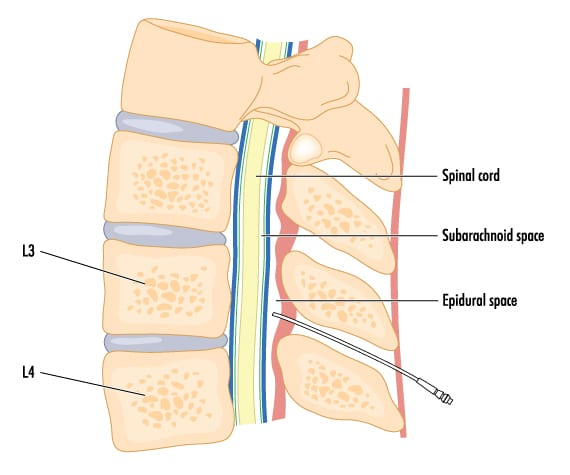
why can a post-spinal headache occur from spinal anesthesia?
a dural puncture can allow CSF to leak reducing CSF volume/pressure which causes traction on pain-sensitive meninges and typically a positional headache that worsens upright and improve lying down since the meninges is sagging and is pulled down by gravity

what is an epidural blood patch, and how does it work?
autologus blood (the patient’s own blood) is injected into the epidural space to seal the dural leak and relieve a persistent post-dural-puncture headache
where is epidural anesthesia administered vs. spinal anesthesia?
epidural anesthesia - in the epidural space outside the dura with a catheter remain for repeated/continuous dosing
spinal anesthesia - in the subarachnoid space where medication is injected into the CSF, producing a typically rapid, dense nerve block (spinal does not ultilize catheter and is usually a one time administration)
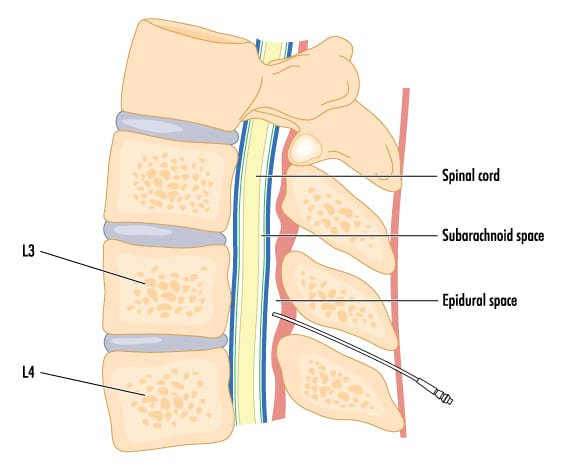
why is an epidural catheter useful after surgery?
it allows ongoing or repeated analgesia for postoperative pain control without repeated needle placement
what are common epidural medications?
morphine
hydromorphone
fentanyl
bupivacaine
why combine epidural opioid and local anesthetic
pioids reduce pain transmission; local anesthetics block nerve conduction. Together they can improve analgesia and reduce the dose needed of each.
what is a key risk of epidural anesthesia in patient taking anticoagulants?
bleeding can cause an epidural hematoma, compressing the spinal nerves and potentially causing permanent neurologic injury. Assess anticoagulant use/coagulation and follow timing guidelines for placement and catheter removal.
how does an epidural differ from a spinal in onset and dosing?
epidural onset is generally slower and dosing can be titrated through a catheter. Spinal onset is typically rapid because medication is injected directly into CSF.
what is the difference between an epidural blood patch and an epidural analgesia catheter?
a blood patch injects the patient's own blood into the epidural space to seal a CSF leak after dural puncture and treat a persistent post-dural-puncture headache.
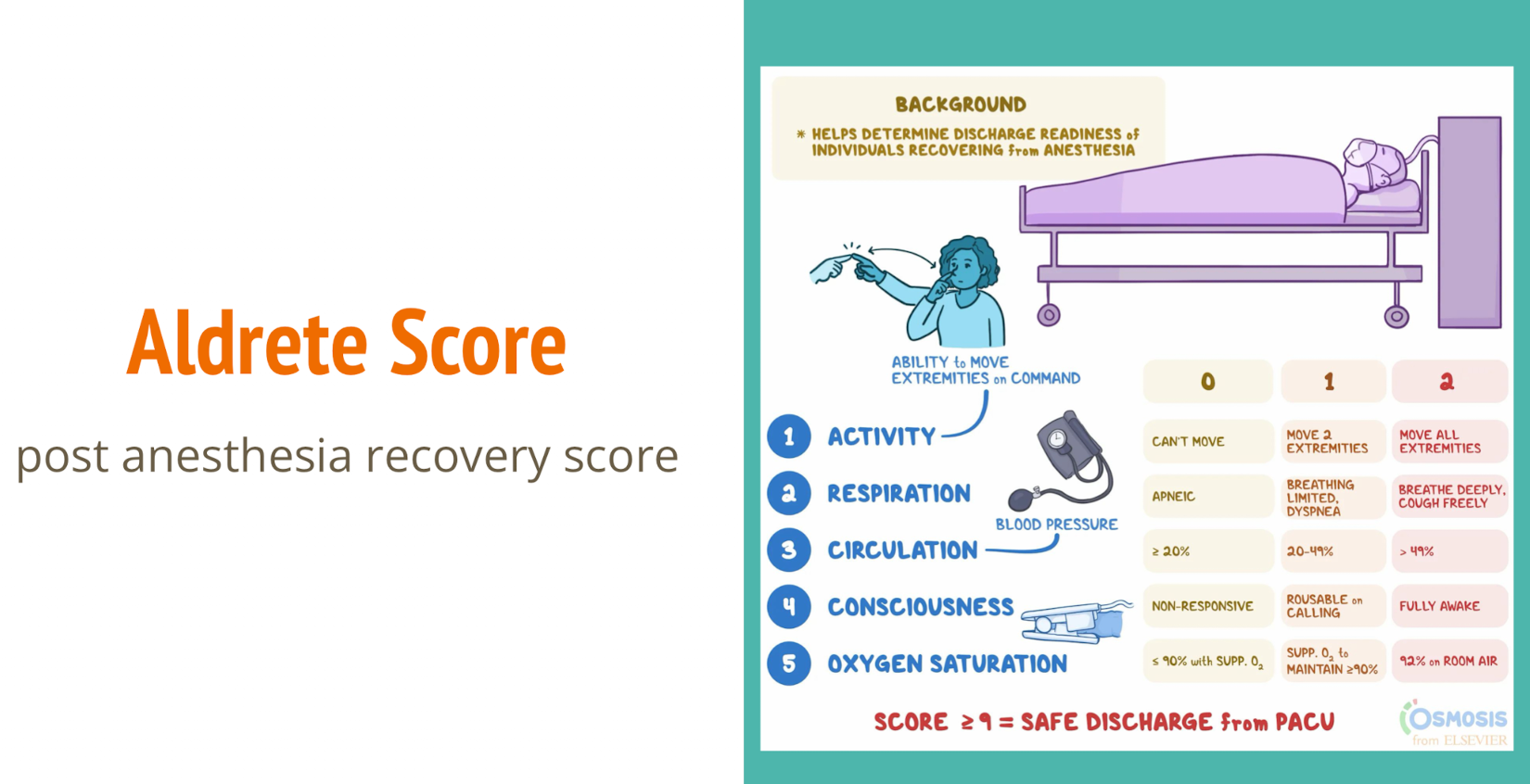
what is the Aldrete Score?
assesses post-anesthesia recovery across 5 categories (0–2 each; total 0–10): Activity, Respiration, Circulation (BP vs. baseline), Consciousness, and Oxygen saturation. A score ≥9 generally supports PACU discharge, alongside clinical stability and facility criteria.
what are the 5 components of general anesthesia?
hypnosis
analgesia
muscle relaxation/reversal
sympatholysis
amnesia
what is the common suffix for neuromuscular blockers (NMBs)?
-urium and -onium
cisatracurium (Nimbex)
atracurium (Tracrium)
pancuronium (Pavulon)
rocuronium (Zemuron)
vecuronium (Norcuro)
what are neuromuscular blockers (NMBs), and what are they used for? key difference between depolarizing and non-depolarizing NMBs?
paralytics that cause skeletal muscle relaxation/paralysis for intubation, treating laryngospasm, and surgical muscle relaxation
they do NOT cause unconsciousness, amnesia, or pain relief—ensure adequate sedation/anesthesia and analgesia (hence they are NOT peripheral nerve block)
when administering NMBs make sure the patient is receiving some form of sedation as the total paralysis can be extremely traumatic and scary
key difference between depolarizing and non-depolarizing NMBs…
depolarizing (e.g., succinylcholine) activates nicotinic receptors, causing brief fasciculations then paralysis
non-depolarizing drugs (e.g., rocuronium) competitively block receptors to prevent contraction.
how do neuromuscular blockers (NMBs) differ from peripheral nerve blocks?
NMBs (e.g., rocuronium): Act at the neuromuscular junction to cause skeletal muscle paralysis. They provide no sedation, unconsciousness, or pain relief
peripheral nerve blocks (e.g., bupivacaine): Block nerve conduction in a targeted nerve or plexus, providing regional numbness and pain relief.
key difference: NMBs cause paralysis; peripheral nerve blocks provide localized anesthesia/analgesia.
nursing priority: With NMBs, ensure adequate sedation, analgesia, and ventilatory support. With nerve blocks, assess sensation, motor function, and safety of the affected limb.
what are the reversal agent for neuromuscular blockade?
there are no routinely used reversal agent for depolarizing NMBs (succinylcholine)
neostigmine - non-depolarizing reversal agent
pyridostigmine - non-depolarizing reversal agent
sugammadex - non-depolarizing reversal agent - reverses specifically rocuronium and vecuronium | does not have cardiac effects but can decrease efficacy of oral contraceptive
what is the depolarizing neuromscular blockers? how does it cause paralysis?
succinylcholine, an acetylcholine receptor agonist
this NMB cause paralysis by keeping nicotinic receptor activated (“gate open”), causing persistent depolarization of the muscle and flaccid paralysis
true or false: all NMBs are highly reversible
FALSE; that only applies to non-depolarizing NMBs as depolarizing muscular agent (succinylcholine) are irreversible
does succinylcholine cause sedation or pain relief?
no. It causes paralysis only; adequate anesthesia, sedation, and analgesia are essential.
why should the nurse check potassium before succinylcholine
it can release K⁺ from muscle cells, causing dangerous hyperkalemia and ventricular arrhythmias.
why is succinylcholine a malignant hyperthermia trigger?
in susceptible patients, it can trigger uncontrolled skeletal-muscle metabolism and a life-threatening hypermetabolic crisis.
can succinylcholine be reversed with neostigmine or sugammadex?
no routine reversal agent
support ventilation until it wears off; it is metabolized by plasma pseudocholinesterase.
why must the nurse be cautious and aware of patient who have pseudocholinesterase before administering succinylcholine?
succinylcholine breakdown is delayed, causing prolonged paralysis and possible need for extended ventilation (can last days to weeks)
what are key succinylcholine adverse effects?
hyperkalemia
bradycardia
muscle fasciculations
postoperative myalgia
prolonged paralysis.