BIO (Chapter 7: Biotechnology)
 Call Kai
 Learn
Learn Practice Test
 Spaced Repetition
 Match
Match Flashcards
 Knowt Play
1/32

There's no tags or description
Looks like no tags are added yet.
Name | Mastery | Learn | Test | Matching | Spaced | Call with Kai | Chat |
|---|
No analytics yet
Send a link to your students to track their progress
33 Terms
What is biotechnology?
The use of other living organisms and biological processes and systems in order to produce technologies and products that improve the quality of human life.
How can biotechnology improve agriculture?
Increase crop yield
Pest resistant crops
Drought resistance
How can biotechnology improve human health?
Creation of medicines such as insulin
Gene therapy (altering genes in attempt fix the defective ones)
How can biotechnology improve forensic sciences?
DNA fingerprint and identification
Detecting biological evidence
Describe the function and goal of Chopping up DNA from a donor organism…
Cutting around a desired DNA sequence that codes for a specific (desirable) amino acid.
The goal is to obtain this DNA sequence/ target gene in order for it to be transformed, amplified and/or inserted into another organism DNA.
Restriction Enzyme
Enzyme produced by bacteria that is used to cut double stranded DNA at certain recognition sites.
(Protein isolated from bacteria)
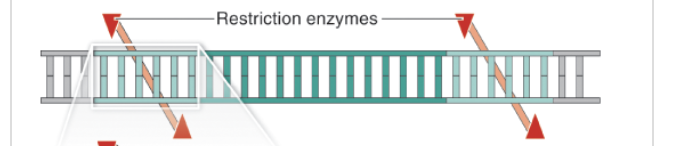
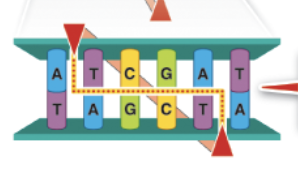
Recognition Sites
Specific DNA sequences that the enzyme is signaled to bind to.
Describe the function and goal of Amplifying DNA…
Usually only a small sample of the DNA is available therefore it is necessary to be able to multiply it (create multiple copies) using PCR to copy the DNA multiple times through cycles of heating and cooling.
What is PCR (Polymerase Chain Reaction)? and how does it work?
Polymerase Chain Reaction is a process that rapidly produces copies of a certain sample of DNA through three steps…
Denaturation: DNA is heated up (typically in a solution), the hydrogen bonds between the bases will break and the strands will separate.
Annealing: Temperature is lowered and primers attach onto specific DNA sequences as well as adding along DNA polymerase
Extension: Temperature rises again and DNA Polymerase is now able to add corresponding bases to the DNA stand.
What is the function of primers in PCR?
They provide a starting point ( a 3’-hydroxyl group) in order for the DNA polymerase to start synthesizing the new DNA strands.
Defining the specific region of DNA that will be copied.
Describe the goal and function of Inserting DNA into another organism?
After the gene is copied it must be inserted into another organism’s genome therefore the new host will be able to express the trait. (Producing a certain protein etc.)
Process called Genome Editing
Transgenic Organism
Organism that has been genetically modified to contain DNA/gene from a different species.
To create transgenic organisms… (Insertion)
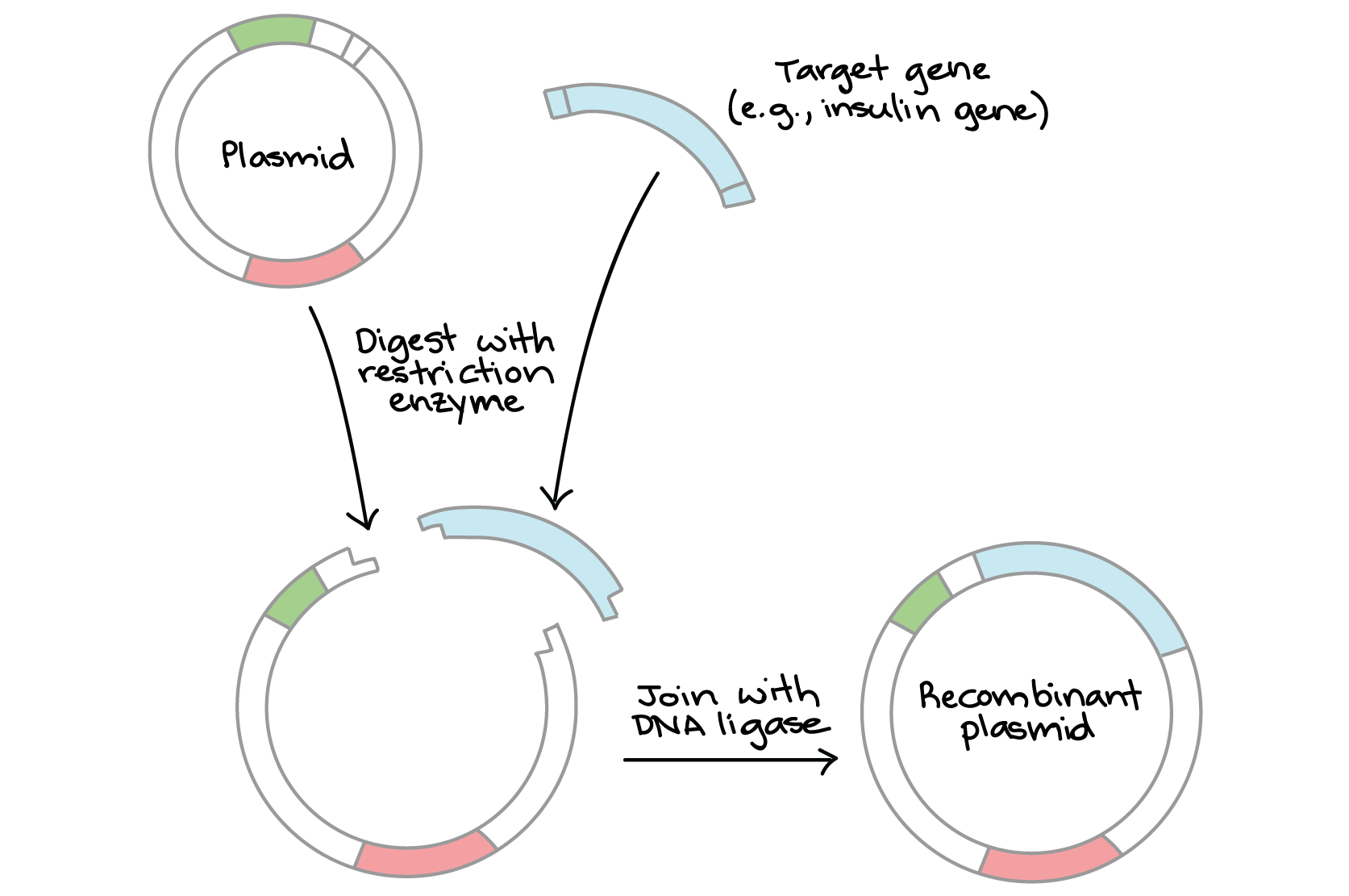
The organism must be inserted with the DNA and in order to deliver the DNA there must be a vector (plasmids: circular pieces of DNA)
Restriction enzyme will bind to certain sequences, cut and then allow fo insertion of foreign DNA
Will allow for insertion and matching of the DNA as it was cut with the same restriction enzyme
Creating matching “sticky ends”
What is the purpose and goal of Growing?
Foreign DNA has been inserted inside the organism and now everytime it divides it creates clones, genetically identical cells containing the implemented DNA.
Can create a clone library or gene library
What does CRISPR stand for?
Clustered Regularly Interspaced Palindromic Repeats
What is the function and usage of CRISPR?
Gene-editing technology that allows for changed to be made to a organism genome by cutting,removing or adding genes.
What is CRISPR based on?
It is based on the natural defense mechanisms that bacterium uses when a virus infects it.
Copies and integrates some of the virus DNA
permanent genetic record of past infections
Will use DNA to produce RNA as a homing device
RNA will bind to virus DNA (uses Cas9 Enzyme to cut it up)
Rendering it harmless
CRISPR (1)
Synthesizing RNA guide with the matching sequence to the desired gene to be cut.
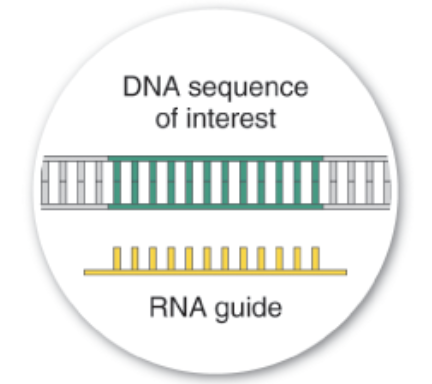
(CRISPR 2)
Sequences for Cas9 enzyme and the RNA guide is introduced with a plamid as a vector into target cells.
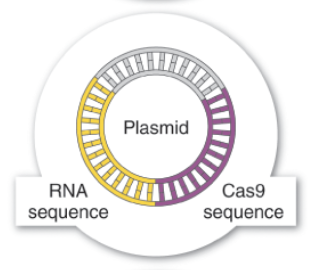
(CRISPR 3)
The RNA guide and Cas9 enzyme are produced. RNA guide will lead the Cas9 enzyme to the desired sequence and will cut at that locus.
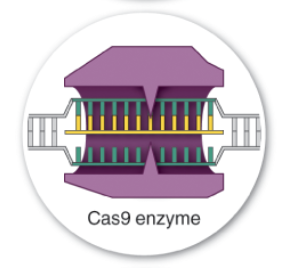
(CRISPR 4)
New DNA sequence can be inserted, one that changes or repairs the host cell’s DNA.
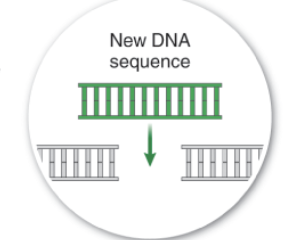
Genetic Engineering
Manipulation of a species genome in ways that does not naturally occur in nature.
(e.g., Food products with more nutritional value)
Recombinant DNA
Combination of DNA from two or more sources into one product.
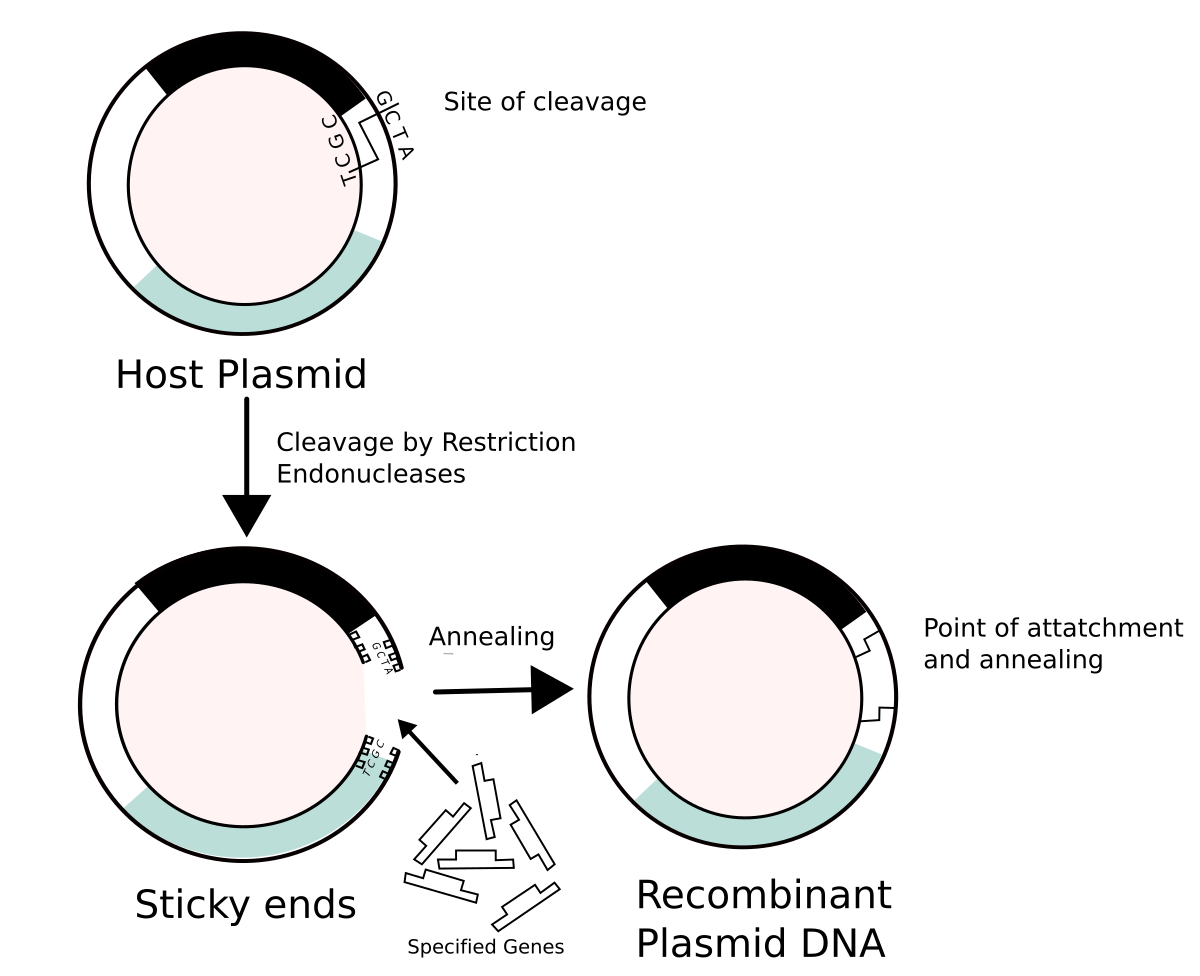
GMOs
Genetically Modified Organisms (Organism produced with recombinant DNA tech)
Examples of improvements in farm practices and food nutrition due to biotechnology…
Nutrient rich “Golden Rice” (Insertion of 3 genes into the rice genome including vitamin A from beta-ceratone)
Insects and Herbicide resistance (Bacillus thuringiensis produces crystal like spikes that kill insects harmful to the plant)
Faster growth and bigger bodies in animals (Transgenic atlantic salmon that carries a growth hormone gene)
Gene therapies
Inserting, altering and deleting one or more genes in an individual’s cells to correct the defective versions.
Stem Cells
Cells that are undifferentiated and that have the ability to produce and develop into any type of cell.
Gene therapy difficulties…
Getting the working gene into the specific cells where it’s needed
Getting placed into enough cells at the appropriate rate
Transferred genes into unintended cells
Challenges in regulating gene expression
What is cloning?
Refers to a variety of techniques including the creation of new individuals that have the exact genome as the donor individual. (e.g., Whole organism cloning)
Cloning process (1)
Remove nucleus from from both egg cell and mammary cell.
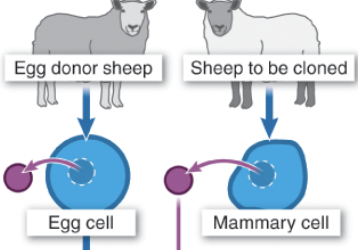
Cloning process (2)
The egg cell will act as a host and the genetic information will come from the mammary cell form the sheep that will be cloned. Nucleus from the sheep will be placed into the egg cell.
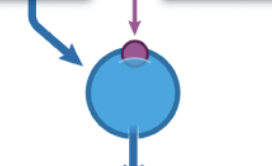
Cloning process (3)
Induce the cell division and grow the dividing cells in culture until they reach the embryo stage.
Transport the embryo into the uterus of a surrogate mother sheep. Surrogate mother will give birth to cloned sheep.