Week 7: Microscopic Anatomy of the Urinary System
 Call Kai
 Learn
 Practice Test
 Spaced Repetition
 Match
 Flashcards
 Knowt Play
1/37

There's no tags or description
Looks like no tags are added yet.
38 Terms
excretory
___________ function of the urinary system is urine production (nephrons of the kidney)
collecting
____________ portion of the urinary system is urine collection via the collecting ducts, ureters, and urinary bladder
kidney
function are to maintain blood chemistry, remove waste, balance salt and pH
renal artery
blood, waste, and water enter the kidney through the ______________
renal vein
filtered blood and excess water leave the kidney through the ______________
ureter
toxic waste and excess water leave as urine through the ___________________
cortex, pyramid, minor, major, pelvis, ureter, bladder, urethra
flow of urine:
1) renal __________
2) renal __________
3) ___________ calyx
4) ___________ calyx
5) renal __________
6) ___________
7) ___________
8) ____________
renal cortex

renal medulla

major calyx

minor calyx

renal pelvis

ureter
muscular tubes that transport urine from the kidneys to the bladder

nephron
functional unit of the kidney
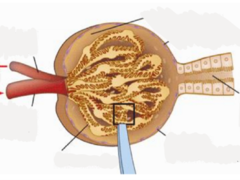
renal corpuscle
ball of fenestrated capillaries enclosed by a membrane; the first part of the nephron, functioning in filtration
renal tubules
small channels that transmit filtrate from the blood that will eventually become urine; function in resorption and secretion
vascular pole
the side of the renal corpuscle where arterioles (afferent and efferent) enter and exit the corpuscle

urinary pole
the side where urine exits the corpuscle to enter the proximal convoluted tubule

glomerulus
ball of fenestrated capillaries surrounded by podocytes within the renal corpuscle

bowman's capsule (glomerular capsule)
membrane surrounding the glomerulus
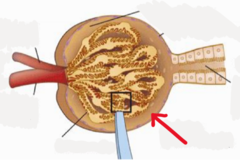
urinary space
between the layers of Bowman's capsule where filtrate collects after exiting the blood

proximal convoluted tubule

distal convoluted tubule
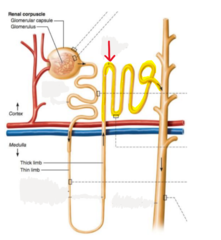
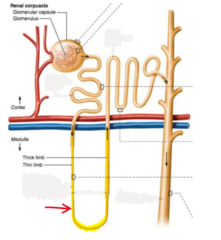
Loop of Henle (nephron loop)
collecting duct

peritubular capillaries
course alongside the proximal convoluted tubule

vasa recta
capillaries running alongside and surrounding the loop of Henle

macula densa
composed of special epithelial cells within the wall of the distal convoluted tubule; regulates blood pressure and glomerular filtration rate
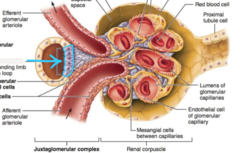
nephron-associated blood vessels
afferent glomerular arteriole --> glomerulus (capillaries) --> efferent glomerular arteriole --> peritubular capillaries and vasa recta

urinary bladder
muscular sac that stores urine

mucosa
innermost histological layer of the ureters and urinary bladder that is composed of transitional epithelium and lamina propria
transitional epithelium
stratified epithelium where apical cells stretch and flatten to accommodate fluid in the lumen

lamina propria
connective tissue underlying the epithelium that contains the basement membrane

muscularis
middle histological layer of the ureter and urinary bladder that is composed of smooth muscle; contains longitudinal and circular layers of muscle
adventitia
outermost histological layer of the ureters and urinary bladder that is an outer layer of connective tissue
detrusor muscle
smooth muscle layer located within the wall of the bladder (composes the muscularis)
relaxed
_______________ transitional epithelium
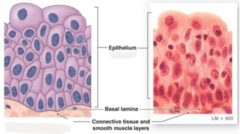
stretched
_____________ transitional epithelium
