HGE COMPRE 2024
 Call Kai
 Learn
Learn Practice Test
 Spaced Repetition
 Match
Match Flashcards
 Knowt Play
1/26

Earn XP
Description and Tags
Name | Mastery | Learn | Test | Matching | Spaced | Call with Kai | Chat |
|---|
No analytics yet
Send a link to your students to track their progress
27 Terms
SITUATION. Smooth vertical wall 5m high retaining sand of unit weight 17 kN/m^3 for which ø=35 degrees and c=0; the surface of the sand is horizontal and the water table is below the bottom of the wall. Consider 1m width of wall
Calculate the total active thrust on the wall.
a. 59.9
b. 57.6
c. 64
d. 46.1
For sandy soil, a direct shear test performed as vertical normal force was 12.49 kPa and the measured shear force was 7.92 kPa. Determine the angle of internal friction of the soil.
a. 57.6 degrees
b. 32.4 degrees
c. 28.11 degrees
d. 23.4 degrees
350mm diameter and 12m long concrete pile is driven into the ground where Cu=100kPa, α= 0.47 and Nc= 9. Estimate the shaft load capacity.
a. 527
b. 474
c. 422
d. 620
57.6 kN
32.4 degrees
620
An airplane flying at an altitude of 10km dropped to a height of 6km. What is the corresponding change in pressure? Unit weight of air is 12 N/m^3.
a. 24
b. 48
c. 36
d. 12
48
Atmospheric pressure is equal to water column head of
a. 9.81
b. 5
c. 10.3
d. 7.5
10.3
A fireman has to put out a fire but is blocked by a fire wall. To reach over the wall, he directed the water jet from the nozzle at an angle of 30 deg to the horizontal. Evaluate the velocity of the water, in meters/sec, leaving the nozzle of his hose to reach over the wall if he stands 30 meters away from the wall and the wall is standing 2 m higher than the nozzle of the hose. Neglect friction in the jet.
a. 16.8
b. 20.6
c. 18.2
d. 19.6
19.6
A barge weighing 359 kN when empty is 6m wide, 15m long and 3m high floating upright. Evaluate the draft of the barge (meters) when transporting 5000 bags of cement along a river. Each bag has a mass of 40kg. Assume specific gravity of the water to be 1.02.
a. 2.14
b. 3.05
c. 1.98
d. 2.57
2.57
SITUATION. A concrete dam of trapezoidal cross section with one face vertical has a thickness of 0.60m at the top and 4.2m at the bottom. It is 7m high and has a horizontal base, the vertical face is subjected to a water pressure, the water standing 6m above the base. The weight of concrete is 24 kN/m^3 per meter length of the dam, evaluate:
The total hydrostatic force:
a. 163.28
b. 176.58
c. 133.24
d. 149.14
The resisting moment of the dam to overturning in kN-m:
a. 1118.50
b. 1231.52
c. 1018.36
d. 1378.121
Factor of safety after overturning:
a. 2.513
b. 2.92
c. 3.17
d. 3.54
176.58
1118.50
3.17
A closed cylindrical tank 4 meters long having a radius of 1.5 meters is fully filled with water is placed on a car moving at an acceleration of 2.5 m/s 2. How much force is acting on the back side of the tank?
a. 69.34 kN
b. 9.81 kN
c. 2.5 kN
d. 17.67 kN
69.34 kN
From a nozzle of diameter 30mm, water flows out vertically under a constant head of 25m. The coefficient of velocity and the coefficient of discharge of the issuing jet are equal to 0.98. Evaluate at what constant height, in meters vertically from the top of the nozzle, would the jet of water support a load of 300 N.
a. 5.3 m
b. 2.5 m
c. 1.6 m
d. 4.5 m
4.5 m
A vessel has a circular orifice 6m in diameter located at its vertical side under a head of “h”. The jet strikes a horizontal plane 10m below the center of the orifice at a point 24m measured horizontally from the vertical plane of the orifice. If the friction is neglected and Cv = 0.98, determine the value of h.
a. 12 m
b. 14 m
c. 5 m
d. 13 m
5 m
What will be the discharge in L/s through a 25mm orifice (C = 0.61) in the bottom of a tank moving upward with an acceleration of 3 m/s 2 if water stands 2.50m over the orifice?
a. 2.10
b. 2.62
c. 2.32
d. 2.40
2.40
SITUATION: A triaxial shear test was performed on a well-drained sand sample. The normal stress on the failure plane and the shearing stress on the failure plane were determined to be 63 kPa and 42 kPa, respectively.
Determine the angle of internal friction of the sand, in degrees.
a. 42.17°
b. 33.69°
c. 48.15°
d. 39.84°
Determine the angle in degrees, on the failure plane with respect to the horizontal plane.
a. 61.58°
b. 68.91°
c. 46.84°
d. 53.53°
Determine the axial stress applied to the specimen, in kPa.
a. 112.36 kPa
b. 128.11 kPa
c. 138.42 kPa
d. 141.48 kPa
33.69°
61.58°
141.48 kPa
Select the correct statement from the following:
a. Soil is the substance existing on the earth’s surface, which grows and develops plants
b. Soil is the material in a relatively thin surface zone within which roots occur, and the rest of the crust is termed rock irrespective of the hardness.
c. Soil is the unaggregated and uncemented deposits of minerals and organic particles covering the earth’s crust
d. All of these
All of these
Void ratio of the soil mass can
a. Never be greater than unity
b. Be zero
c. Take any value greater than zero
d. Take values between 0 and 1 only.
Take any value greater than zero
SITUATION: A thick layer of clay underlies a sand formation having a thickness of 5m. The groundwater is located 2m below the ground surface. Specific gravity of sand and clay is 2.65 with sand having an average void ratio of 0.52. The clay has a water content of 42%.
Compute the saturated unit weight of clay.
a. 10.18 kN/m3
b. 11.30 kN/m3
c. 12.46 kN/m3
d. 17.47 kN/m3
Compute the total stress at a depth of 10m below the ground surface.
a. 171.10 kN/m3
b. 182.93 kN/m3
c. 120.46 kN/m3
d. 105.81 kN/m3
Compare the effective stress at a depth of 10m below the ground surface.
a. 153.5 kN/m3
b. 115.2 kN/m3
c. 169.1 kN/m3
d. 147.3 kN/m3
17.47 kN/m3
182.93 kN/m3
153.5 kN/m3
SITUATION. A column is to be supported by a square footing 2.00m on a side on a founding depth of 1.00 into cohesionless soil deposit. The unit weight of the soil is 16 kN/m3 and the angle of friction is 25 degrees. Using Terzhagi’s Formula for shear failure.
Evaluate the contribution of the depth of embedment to the ultimate bearing capacity of soil. In kPa.
a. 193.2
b. 203.5
c. 197.8
d. 209.4
Contribution of the footing distribution to the ultimate bearing capacity of the soil, in kPa.
a. 80.1
b. 93.6
c. 133.4
d. 106.8
Concentric load in kn, that the footing can surely support, using a factor of safety of 3 against bearing capacity failure.
a. 449.2
b. 364.4
c. 413.7
d. 388.5
203.5
106.8
413.7
Evaluate the plastic settlement in meter(s), or a layer of plastic due to an increase of pressure caused by loads above it under the following conditions.
Initial intergranular pressure = 200
Increase in intergranular pressure = 120 kPa
Thickness of the clay layer = 8m
Coefficient of consolidation = 0.315
Void ratio of the clay = 1.132
a. 0.197
b. 0.204
c. 0.241
d. 0.269
0.241
SITUATION. According to the Westergaard’s Theory, the vertical stress at a point below the surface of a semi- infinite homogeneous, isotropic soil mass due to appoint load “A” applied at the ground surface is given by the equation.
𝑃 = 0. 318𝑄𝑁/𝑧 2
𝑁 = 1/(1 + (𝑟/𝑧) 2 )^1.5
Evaluate the vertical stress in kPa, at a point below the ground for Q= 1500kN if:
the point is 2, directly below the point of application of the load
a. 103.24 kPa
b. 119.25 kPa
c. 124.36 kPa
d. 116.09 kPa
the point is 4, directly below the point of application of the load
a. 21.33 kPa
b. 29.81 kPa
c. 32.14 kPa
d. 27.15 kPa
the point is 4, directly below the point of application of the load but 2m horizontally from the application of the load
a. 21.33 kPa
b. 29.81 kPa
c. 32.14 kPa
d. 27.15 kPa
119.25 kPa
29.81 kPa
21.33 kPa
A wall footing is to be constructed in a uniform deposit of stiff clay and must support a load of 152 kN/m of wall length.
Angle of friction of clay = 0
Unconfined compressive strength of soil, qu = 145.8 kPa
Unit weight of soil = 18.82 kM/m3
Footing depth = 1.2m
Nc = 5.7 Nq = 1 Ny = 0
Determine the allowable bearing capacity using a FS= 3
a. 284.55
b. 146.04
c. 192.21
d. 99.87
146.04
The permeameter in a permeability test setup involves a cylindrical soil sample in 40mm diameter and a height of 180mm. The hydraulic head of the test was held constant at 300mm in a duration of one minute; the water collected in the graduated cylinder was recorded at 1.5 liters. Evaluate the coefficient of permeability of the soil sample, in cm/sec.
a. 1.19
b. 2.08
c. 0.12
d. 1.09
1.19
A 450 kN is transmitted by a column footing onto the surface through a square footing 1.5m. on a side. Assuming that the force exerted on the underlying soil formation spreads on 2 vertical to 1 horizontal, evaluate the pressure (kPa) exerted in footing on a soil 2.7m below it.
a. 35.05
b. 25.51
c. 200.0
d. 55.40
25.51
SITUATION. A square footing, 0.9m on a side, is embedded 1.00m into a cohesive soil deposit. The unit weight of the soil is 18 kN/m3 and the angle of the internal friction is 30 degrees. The soil cohesion strength = 15 kPa. Using Terzaghi’s Formula for local shear failure and TABLE SMBC.
Evaluate the contribution of the depth of embedment of ultimate bearing capacity of the soil, in kPa.
a. 209
b. 306
c. 405
d. 510
Evaluate the contribution of the footing dimension to the ultimate bearing capacity of the soil, in kPa.
a. 96
b. 87
c. 135
d. 124
405
124
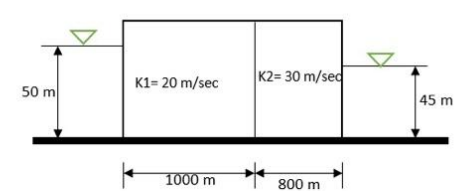
SITUATION. The figure shown an unconfined non-homogeneous aquifer between two water bodies at a depth of 50m and 45m respectively.
Compute the average coefficient of permeability of the aquifer.
a. 23.48
b. 12.25
c. 24.44
d. 15.97
Compute the time required for the water to pass through the soil if it has a porosity 0.24.
a. 6624
b. 6246
c. 4662
d. 2466
23.48
6624
SITUATION. Water is flowing in a 9m wide rectangular channel at 7.65m3 and a depth of 0.9m.
What is the specific energy in meters?
a. 0.82
b. 1.24
c. 1.12
d. 0.95
What is the critical depth in meters?
a. 0.42
b. 0.53
c. 0.64
d. 0.75
What is the critical velocity?
a. 2.03
b. 2.28
c. 2.51
d. 2.71
0.95
0.42
2.03
SITUATION. A container holds two layers of different liquids, one having a specific gravity of 1.2 and the other having a specific gravity of 1.5. A solid spherical is on the top layer and the other half in the bottom layer of liquid.
Evaluate the buoyant force acting on the sphere, in kN.
a. 0.03
b. 0.02
c. 0.09
d. 0.06
Tension in the cable attached to the sphere to normal position.
a. 0.25
b. 0.52
c. 0.64
d. 0.46
Buoyant force in the sphere if both liquids are water.
a. 0.04
b. 0.07
c. 0.08
d. 0.10
0.06
0.25
0.04
SITUATION: An open cylindrical tank 2m in diameter and 4m high contains water to a depth of 3m. It is rotated about its own vertical axis with a constant angular speed, w.
What is the maximum w (in rpm) so that there is no liquid spilled?
a. 61.3
b. 67.1
c. 59.8
d. 55.6
What is the w (in rpm) when the vortex touches the bottom of the cylinder?
a. 89.3
b. 80.7
c. 84.6
d. 81.2
What is the volume spill in liters when w=8 rad/s?
a. 1.41
b. 1.98
c. 1.61
d. 1.84
59.8
84.6
1.98
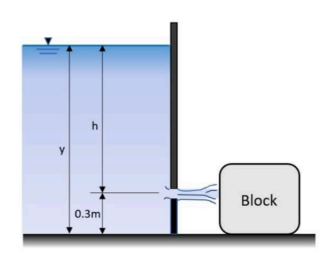
SITUATION: Water flows from a tank through an orifice of 75mm diameter and against a block, as shown in the figure. The water strikes the block at the vena contracta. The block weighs 220 N, and the coefficient of friction between the block and the floor is 0.55. The orifice coefficient of discharge is 0.6, and its coefficient of contraction is 0.62.
Determine the actual velocity needed (m/s)?
a. 6.64
b. 5.54
c. 4.56
d. 2.45
What is the required height from the orifice to the liquid surface?
a. 2.7m
b. 2.4m
c. 1.8m
d. 3m
What is the minimum height to which water must rise in the tank in order to start the block moving to the right.
a. 2.7m
b. 2.4m
c. 1.8m
d. 3m
6.64
2.4 m
2.7 m
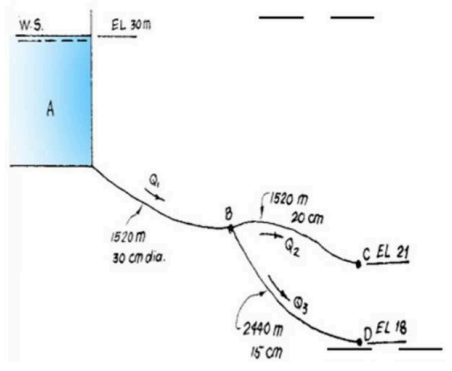
SITUATION: The pipe system shown in figure serves two towns C and D. The highest building in town C is at EL 21m and that in town D at EL 18m. If f = 0.020 for all pipes and the per capita consumption in the two towns is 0.0035 liters/s.
Determine how many persons can be served in Town C.
a. 7000
b. 8600
c. 7500
d. 6200
Determine how many persons can be served in Town D.
a. 3000
b. 4000
c. 3500
d. 3800
8600
4000