ACCT 321- Exam 2 (chapters 2,3, & 7)
 Call Kai
 Learn
Learn Practice Test
 Spaced Repetition
 Match
Match Flashcards
 Knowt Play
1/29

There's no tags or description
Looks like no tags are added yet.
Name | Mastery | Learn | Test | Matching | Spaced | Call with Kai | Chat |
|---|
No analytics yet
Send a link to your students to track their progress
30 Terms
Limitations of using a plantwide overhead rate
It is often overly-simplistic and incorrect to assume that direct-labor hours is a company’s only manufacturing overhead cost driver.
If more than one overhead cost driver can be identified, job cost accuracy is improved by using multiple predetermined overhead rates.
Underapplied overhead
exists when the amount of overhead applied to jobs during the period using the predetermined overhead rate is less than the total amount of overhead actually incurred during the period.
Overapplied overhead
exists when the amount of overhead applied to jobs during the period using the predetermined overhead rate is greater than the total amount of overhead actually incurred during the period.
Purchased 80,000 of raw materials on account
Raw materials 80,000
Accounts Payable 80,000
71,000 in raw materials were used in production. Of this amount, 62,000 was direct materials and the remainder was indirect materials
WIP 62,000
MOH 9,000
Raw Materials 71,000
Paid employees 112,000 cash. Of this amount, 101,000 was direct labor and the remainder was indirect labor
WIP 101,000
MOH 11,000
Cash 112,000
Depreciation of 175,000 was incurred on factory equipment
MOH 175,000
Accum. Dep. 175,000
Employee time tickets included $60,000 recorded for direct labor and $15,000 for indirect labor.
WIP 60,000
MOH 15,000
Sal & Wage/P 75,000
Assume that a company incurred $40,000 of general factory costs (utitlities, rent, misc)
MOH 40,000
Accounts/P 40,000
750 of 1,000 gold medallions were shipped by the end of the month. Total sales revenue was $225,000 and total cost of the job was $158,000, and unit product cost was $158.
Accounts/R 225,000
Sales 225,000
COGS 118,500
Finished Goods 118,500

Know how to calculate the predetermined overhead rate
Estimated total manufacturing overhead / Estimated total direct labor hours= Predetermined overhead rate


Know how to apply overhead costs to jobs using a predetermined overhead rate
Actual direct labor-hours x Predetermined overhead rate= Manufacturing overhead applied


Know how to calculate the total cost of a job using a predetermined overhead rate
Direct labor cost / Direct labor wage rate per hour=Total direct labor hours
Direct materials + Direct labor + Manufacturing overhead applied ($14 per DLH × 9 DLHs)= Total manufacturing cost


Know how to calculate the unit product cost of a job using a predetermined overhead rate
Total manufacturing cost / Number of units in the job= Unit product cost


Know how to calculate the total cost using multiple predetermined rates
Direct labor cost / Direct labor wage rate per hour= Total direct labor hours
Direct materials + Direct labor + Assembly Department + Testing & Packaging Department= Total manufacturing cost
Total manufacturing cost / Number of units in the job= Unit product cost


Know how to calculate unused capacity and the predetermined overhead rate based on hours at capacity
Amount of the allocation base at capacity - Actual amount of the allocation base= Unused capacity in hours
Unused capacity in hours x Predetermined overhead rate=
Cost of unused capacity

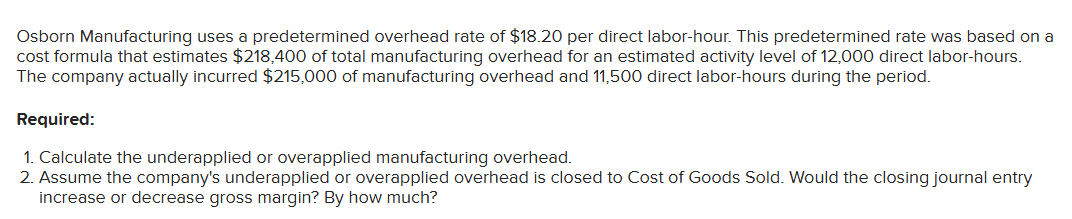
Know how to calculate underapplied or overapplied overhead- Ex. The POHR is $18.20/DLHs. The company actually incurred $215,000 of MOH and 11,500 DLHs were recorded. How much overhead was under/overapplied?
Underapplied by $5,700
(also means the gross margin decreased by $5,700)

Schedule of COGM
Beginning WIP inventory
+Manufacturing Costs
-Ending WIP inventory
Manufacturing Costs
DM Used
DL
MOH Applied
DM Used
Beg raw materials inventory
+purchases of raw materials
-End raw materials
Schedule of COGS
Beginning finished goods Inventory
+COGM
-Ending finished goods Inventory
Know the mechanics of how to use the Excel approach to record financial transactions

Unit-level activities
performed each time a unit is produced.
Ex. providing power to run processing equipment, rough milling work on products
Batch-level activities
performed each time a batch is handled or processed, regardless of how many units are in the batch.
Ex. placing purchase orders, setting up equipment, arranging shipments to customers, receiving raw materials from suppliers
Product-level activities
performed for specific products regardless of how many batches are run or units produced.
Ex. designing a product, advertising a product, maintaining a product manager and staff, managing parts inventories
Customer-level activities
performed for specific customers and do not relate to specific products.
Ex. sales calls, catalog mailings, customer meetings, general tech support
Organization-sustaining activities
performed regardless of which customers are served, which products are produced, how many batches are run, or how many units are made.
Ex. heating the factory, cleaning executive offices, providing a computer network, arranging for loans, preparing annual reports, interview and process new employees in the personnel department

Know how to calculate the activity rate for an activity cost pool
Total cost/Total Activity= Activity Rate


Know how to allocate costs in the first-stage allocation
Category percentage given x given overhead costs of category


Know how to calculate the cost of a product in activity-based costing
Activity Rate= total cost/total activity
ABC cost = activity rate x activity
