Lecture 8: Consumer-resource Dynamics
 Call Kai
 Learn
Learn Practice Test
 Spaced Repetition
 Match
Match Flashcards
 Knowt Play
1/13

There's no tags or description
Looks like no tags are added yet.
Name | Mastery | Learn | Test | Matching | Spaced | Call with Kai | Chat |
|---|
No analytics yet
Send a link to your students to track their progress
14 Terms
Resources
things animals need to eat, survive, and reproduce. Eg. food, nesting sites, water, shelter. Consumption by one individual will make it unavailable to others
When is a resource pre-emptive?
temporarily lost to others. Eg. Nest boxes
When is a resource consumptive?
individuals use of resources reduces levels available to others. permanently unavailable. Eg. food
How are resources characterized/measured?
Amount of food available. Eg. dry mass of food per hectare
Suitability of that food to animals requirements. Eg. how much nutrients the animal gains from the food and often combine 2 metrics
Resource relationships
Interactive relationship → level of resource influences rate of increase of the population and vice versa. Eg. Bison and food
Reactive relationship → level of resource influences rate of increase of the population, but density of animals has no reciprocal influence on the rate of renewal of the resource. Eg. salt licks for herbivores, won’t effect rate of renewal.
Components of consumer-resource dynamics
Functional response of the consumer
Numerical response of the consumer
growth rate of the resource in relation to resource abundance
Benefits
Provide summary of dynamic ecology. Seeing how interactions change over time and how they influence each other
Summarizes causation instead of correlation. What causing the change in density
Multi-consumer systems
Critical Thresholds → gives indication a level of resource that cause population to increase or decrease
general theory of consumer resource dynamics
Want to understand density of resources and density of consumers

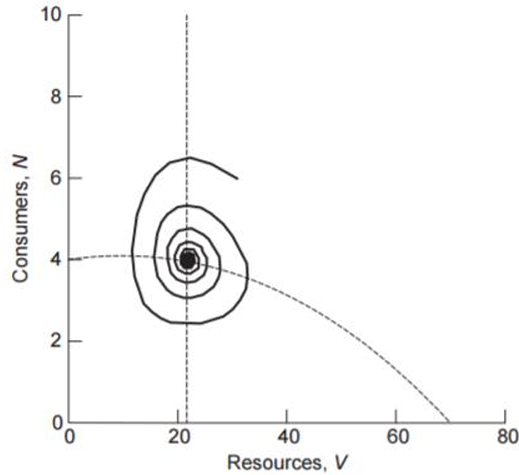
Phase Plane diagrams
Plot density of consumers against density of resources
Isoclines indicate when density does NOT change
Where the two isoclines cross is where equilibrium occurs

Stabilizing influences
self regulation by resources. Population regulation makes sure population doesn’t change too much. Carrying capacity changes.
Destabilizing influences
consumption of resource. overconsuming or disruption in environment or population.
Dynamically unstable equilibrium
outward spiral, reaches a point where it repeats. Stable limit. Eg. Hare and Lynx. big jump and drop more likely to be driven by destablizesinfluences. Easily fluctuates. The dark line is when we see population falling into sharp up and downs, straying away from equilbrium.

Stable Equilibrium
Inward spiral, stays around same number. Stabilizing influences. How they self-regulate. Eg. Lagged/delayed density response. Deer and Wolves
Paradox of Enrichment
increasing resource availability can lead to destabilization of consumers. Too much of a good thing can be a bad thing. Eg. Overpopulation of koi pond → not good, too little oxygen