Psych 2 Exam
 Call Kai
 Learn
Learn Practice Test
 Spaced Repetition
 Match
Match Flashcards
 Knowt Play
1/59

There's no tags or description
Looks like no tags are added yet.
Name | Mastery | Learn | Test | Matching | Spaced | Call with Kai | Chat |
|---|
No analytics yet
Send a link to your students to track their progress
60 Terms
Pavlov was a Russian ______
physiologist
The responses involved in what we term fear, disgust, love, etc. that are acquired through pavlovian conditioning are called what?
Conditioned emotional responses (CER)
John B Watson studied what and on who?
CER- phobias
study was on Little Albert, a baby and they tried to get a phobia out of him by ringing a gong while showing him a white rat, and eventually the white rat scared him without the loud sound
how to get rid of a fear
Extinction
Ex: for Little Albert– show the white rat without the loud noise repeatedly
Exposure therapy
Type of exposure therapy: Systematic desensitization
Make a list of least scary to terrifying situations
Couple each CS situation with relaxation technique and keep going all the way down the list
Generally speaking, the SHORTER the NS-US interval= interstimulus interval the ____
Faster the learning
Which phenomena suggest that we are less likely to develop phobias to familiar objects
Latent inhibition
With respect to the Donahoe and Vegas study what did the results say about conditioning?
The critical pairing was between the NS and the UR, not NS and the US
You present a dim flash of light and a loud bell followed by food. When tested both elicit a strong CR this is called:
a) blocking
b) overshadowing
c) latent inhibition
d) none of the above
none of the above
not overshadowing because that is when the dim flash would cause a weaker CR
Who was the first person to study human emotions systematically? Who was the first person to use Pavlovian conditioning to treat emotional problems?
John B. Watson was the first person to study human emotions systematically and Mary Jones was the first person to use Pavlovian conditioning to treat emotional problems.
Describe, in Pavlovian conditioning terms, the "experiments" by Watson and Rayner on the Pavlovian conditioning of fear (also called conditioned emotional responses—CERs).
The experiments that Watson and Rayner used were looking at the study of fear with an infant. They tested infants to see their reactions to all sorts of different stimuli. They saw no innate fear but then used a sudden loud noise as the unconditional stimulus (US) for crying and other fearful responses. They then used that to test an 11 month old boy to become afraid of the white rat by making that loud noise while showing the boy a rat. After a few pairs of that, eventually when the rat was shown alone without the noise, the baby would cry.
Describe, in Pavlovian conditioning terms, the "experiments" Mary Cover Jones on the Pavlovian counterconditioning of fear, as well as more recent approaches to treating fears such as systematic desensitization, including those procedures involving virtual reality.
Mary Jones did a study on how to overcome fears called counterconditioning of fear. This is where she reversed the unwanted effects of previous conditioning. In her experiment she used a 3 year old, Peter who was scared of rabbits. She first brought the rabbit in Peter’s view but far away while Peter ate crackers and milk. So she paired CS for fear, the rabbit, with a positive US, the milk and crackers. Everyday she would bring the rabbit closer and closer while Peter ate his snack. Eventually Peter let the rabbit sit on him. Jones counterconditions is also considered exposure therapy because it exposes a person to fear evoking stimulus while they feed relaxed.
Systematic desensitization is a type of exposure therapy. The therapist works with clients to arrange a list of frightening scenes. For example a fear or public speaking and they would list situations related to that and arrange the situations from little discomfort to terrifying. They tell you to imagine these scary scenes and then tell you ways on how to relax. The therapist pairs the scene, CS for fear with a positive US which is relaxation. They keep replaying each scene until it doesn’t involve any discomfort and then they move onto the next scary scene and so on. They then can involve virtual reality (VR) to make those scary scenes seem realistic and the client would be able to feel like they are really in it making it practical for real life.
Explain how knowledge of Pavlovian conditioning can help us understand the origin of some prejudices. Describe the research of Staats and Staats and how the concept of higher-order conditioning is relevant.
Prejudice is when we judge before one has relevant facts and this can lead to hate or discrimination. Watson says hatred is another conditioned emotional response. The study with Staats and Staats is where college students were shown nationality names like “Dutch” and “Swedish” while hearing either positive or negative words. The students later rated the nationalities more positively when they had been paired with positive words and more negatively when paired with negative words. Overall suggesting that prejudice or attitudes toward groups can be learned through associations, even when people do not have direct experiences with those groups. The concept of higher-order conditioning is relevant because the study shows how a previously neutral stimulus (NS), such as the word “Dutch,” became associated with positive or negative emotions (CS) because it was repeatedly paired with positive or negative words.
What are paraphilias? Describe the study by Pavlov and explain how it might help us understand the development of paraphilias.
Any intense and persistent sexual interest that’s not typical is referred to as a paraphilia. Some of the paraphilias are voyeurism (viewing a nude or partially clothed person or a person engaging in sexual
activity), exhibitionism (displaying one’s genitals to another person without their consent), fetishism (an attraction to certain objects or body parts, such as the feet), sadism (inflicting pain on a sexual partner), masochism (having a sexual partner humiliate or hurt them), pedophilia (sexual activity with a prepubescent child), and frotteurism (touching or rubbing one’s genitals against another person without their consent). Pavlov paired an electric shock with food. The dogs eventually salivated in response to the shock, suggesting that the painful stimulus had become associated with the pleasurable or biologically significant stimulus of food. This may help explain how some paraphilias develop. If an unusual or normally unpleasant stimulus is repeatedly paired with sexual pleasure or arousal, that stimulus could eventually become sexually arousing on its own through classical conditioning.
Describe conditioned taste-aversion learning in terms of (a) the taste-aversion experiments (e.g., Garcia, 1955); (b) the two important ways it differs from typical Pavlovian conditioning procedures; (c) how latent inhibition may help us to understand some instances of taste-aversion learning, including the aversion to novel tastes.
Taste aversion is when eating some substances kills you instead of giving you nutrients. In one of the experiments, he gave rats a choice between regular or sweet water. Since all of those chose the sweet water, he took some of the rats and exposed them to nausea-inducing gamma radiation while they drank the sweet water. This caused the rats to eventually dislike the sweet water and the higher the radiation level the the more aversion to the sweet water. sweet water had become a CS for nausea.
The two important ways it differs is one, the CS and the US occurred together only once. Whereas compared to other studies where there are multiple pairings. Second, the interval between CS and US lasted several minutes, where in other studies their intervals are successful within seconds.
Latent inhibition helps explain why animals are more likely to develop a taste aversion to a novel taste than to a familiar one. If an animal has previously tasted a food without getting sick, it learns that the taste is safe, making it harder to develop an aversion later. In contrast, a new taste followed by nausea can quickly become associated with illness, even after one pairing. This helps animals avoid potentially dangerous foods.
Describe, in general, how advertisers make use of Pavlovian conditioning techniques to sell their products.
Advertisers aim to associate products with fondness. So they use Pavlovian conditioning by repeatedly pairing a product with a stimulus that elicits positive feelings, such as attractive people, enjoyable music, beautiful scenery, or happy experiences. Over time, the positive feelings can become associated with the product itself, making consumers like it more and potentially increasing their willingness to buy it. They can also pair competitors’ products with negative images or emotions to make those products seem less appealing compared to theirs. Or they will cobrand and pair new products with one of their popular products. They can also use blocking or overshadowing as a strategy.
Explain how Pavlovian conditioning can also provide a basis for treatment of paraphilia, and describe what aversion therapy is (how it is a form of counter conditioning), how it has been used to treat paraphilias, and the ethical problems associated with it.
Aversion therapy is one of the ways that can treat paraphilias. What they do is they have a noxious Us that follows a CS that elicits inappropriate sexual arousal. With Maletzky’s study he treated 10 men, he held a bottle of foul smelling acid under the patient's nose, and did this twice a month for three months. After 12 months of treatment there was a reveal of no occurrences of exhibitionism. However some resist all forms of treatment and relapse can occur. Also even when the treatment helps patients also need “booster” sessions to keep the gains. There are other treatments such as conditioning and drugs or surgery however the surgery can create controversy and the drug can be dangerous because individuals could use it wrong or irresponsibly.
Describe what tolerance and withdrawal are, and explain how Siegel’s compensatory response model, as an example of the preparatory-response model of Pavlovian conditioning, accounts for these as well as drug overdose.
Tolerance means when your body is used to the effects, so you need more to get the same effect.
Withdrawal is when you are not taking the drug and get strong cravings or discomfort.
The preparatory response is where the UR acts as an innate response designed to deal with a US, but the CR acts as a response designed to prepare for the US. Siegel’s compensatory response model relates to this by showing that the drug is the US, producing the UR (the drug’s effects). Environmental cues associated with the drug, such as a room, people, or drug paraphernalia, become CSs. Over repeated drug use, these CSs trigger a compensatory CR that prepares the body to counteract the drug’s effects. This explains tolerance because the CR reduces the drug’s impact and overdose because a new environment lacks the familiar CSs, so the compensatory CR is weaker and the drug has a stronger effect.
Two or more stimuli present together
compound stimulus
What was Pavlov mostly famous for before?
Digestion —> he won the noble prize and did surgical procedures on digestion processes
what were the two different measures Pavlov used to look at the strength of salivation
1. Recorded rate of salivation
2. Than looks at total amount of saliva in the period amount of time
Pavlovian conditioning involves ONLY what?
REFLEXES
Which of following terms does not belong:
Respondent
Operant
Classical
Pavlovian
Operant
because respondent, classical and pavlovian conditioning all is the same name- interchangeable
draw the Pavlovian diagram
unconditional reflex diagram:
US —> UR
NS +US —> UR
↓
Conditional reflex:
CS —> CR
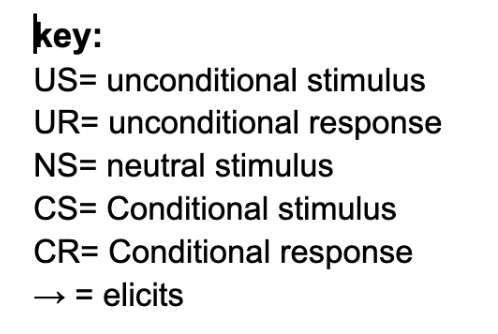
Draw the diagram using Pavlov's dog experiment:
Unconditional reflex:
US —> UR
Food in the mouth —> salivation
NS +US —> UR
Metronome + Food in the mouth —> salivation
Conditional reflex:
CS —> CR
Metronome → salivation (didn't produce as much salivation as it did with the US)
It is called ____ NOT conditioned
conditional
Its called a ____ NOT a bell
metronome
Ivan Pavlov is most famous for his studies with:
Dog
The notation that best describe the Pavlovian conditioning procedure is:
NS+ US → UR
In his original condition experiments, Pavlov used a _____ as the NS
Metronome
Delay Conditioning
US and CS
CS comes on BEFORE the US
US appears before the CS disappears
There's an overlap where US and the NS or CS is both still on
presentation is same duration for both US and CS
The length of time between when CS begins and US appears
Short delay- milliseconds-few seconds
Long-delay: seconds to minutes - CR latency gradually increases
Both short and long delay length times:
CR begins to appear soon after the CS
CR does not appear until just before the US
Can also occur outside the lab
Can produce conditional response
Trace Conditioning
CS begins and ends before US appears
CS comes on before US
NO OVERALP between CS and US
A time gap between CS and US called the “trace”
Can be used outside the lab: flash of lightening followed by crash of thunder
Works with a variety of reflex responders in a variety of species
Can produce conditional response
Simultaneous conditioning
CS and US coincide exactly
Both CS and US begin and end at the same time
Rarely occurs in the natural environment
A more of a weaker procedure for establishing a conditional response
Backward conditioning
CS follows the US
US comes on before the CS
US-CS can occur outside the lab
Researchers have more difficulty producing a CR
Can work under the right circumstances
which is the most and least effective conditioning
Best to use: Delay is the best one to use out of all of them
Worst to use: Backward, no leaning from that one because US is before the CS. You are putting the NS (CS) AFTER the UR has already happened when you don't mean to. US comes right after UR, can’t stick any stimulus between it
Describe, with examples, the basics of Pavlovian (also called respondent or classical) conditioning, including unconditional and conditional reflexes, stimuli, and responses (plus all appropriate abbreviations).
Pavlovian conditioning, also called respondent or classical conditioning, has an unconditional reflex and conditional reflex. In the unconditional reflex, it is a permanent and inborn reflex in all members of species. The unconditional reflex is where there is unconditional stimulus (US) which elicits an unconditional response (UR). For example when food is in the dogs mouth that is the US which elicits the dog to salivate which is the UR. Then it can also add the neutral stimulus (NS) which gets paired with the US and still causes a UR. That means the metronome (NS) paired with food in the mouth (US) causes salivation (US). The next step is called a conditional reflex, that is where the NS becomes a conditional stimulus (CS), and the CS then elicits a conditional response (CR). A conditional response is acquired through experience and varies from individual. This reflex can fade and is not permanent. So now the metronome becomes the CS and elicits salivation which is the CR.
unconditional reflex diagram:
US —> UR
NS +US —> UR
↓
Conditional reflex:
CS —> CR
Describe the procedure and outcome of higher-order conditioning and explain how it “greatly increases the importance of Pavlovian conditioning,” especially in humans.
This is where you are pairing a NS with a well established CS. These NS will become CS and will then elicit a CR. There can be second order conditioning which is where CS moves one step away from the US and third order conditioning which is where the NS pairs with a CS2. The further away from a pairing with a US, the weaker the CR. An example is that at first the dog was trained to salivate at the sound of ticking metronome which is the well established CS. Then they added a black square, which is the NS that gets added to the ticking (CS1). After several repetitions of pairing the two stimuli, the black square and the metronome, the dog would then salivate at just the black square. This “greatly increases the importance of Pavlovian conditioning” because it means that many more stimuli can come to elicit conditional responses (CR). It’s more useful in humans because a study was done on how words often become conditional stimuli (CS) when paired with an established conditional stimuli so overall the results of higher order conditioning plays an important role in the emotional meaning of words.
Define and explain contingency. What is Rescorla’s main point about the role of contiguity versus contingency? How do Rescorla’s experiments with rats and shock illustrate his point?
Contingency is an “if–then” relationship between two events, meaning one event depends on another. For example, thunder is contingent on lightning because thunder occurs only when lightning occurs. Rescorla distinguished contiguity, which is the closeness in time or space between two events or stimuli, and contingency, which is how reliably a conditioned stimulus (CS) depends on an unconditioned stimulus (US). Rescorla argued that Pavlovian learning depends more on contingency than simply on contiguity. In Rescorla’s 1968 rat-and-shock experiment, this was where he exposed rats to a tone followed by a mild shock. All rats received the same number of tone–shock pairings ( CS-US pairings) but some received trials in which the shocks (US) occurred without the tone. The 10% group had the highest CS predictiveness, the 20% group had moderate predictiveness, and the 40% group had the lowest. Rats showed stronger conditioning when the tone reliably predicted the shock but there was little or no conditioning when shocks occurred frequently without the tone. The results showed that the amount of learning depended on how reliably the tone (CS) predicted shock (US). When the US nearly always followed the CS, conditioning occurred.
Explain what is meant by contiguity in Pavlovian conditioning, how it is realized in the different kinds of pairing.
Contiguity refers to the closeness in time or space between two events. In Pavlovian conditioning it refers to the interval between the CS and US and this is called interstimulus interval (ISI). In trace conditioning, the ISI represents the interval between the termination of the CS and the onset of the US. In delay conditioning, it refers to the interval between the onset of the CS and the onset of the US. The shorter the ISI the faster the learning
Describe the procedure and outcome of Pavlovian extinction, as well as the distinction between extinction and forgetting.
Pavlovian extinction occurs when the conditioned stimulus (CS) is repeatedly presented without the unconditioned stimulus (US). As a result, the conditioned response (CR) gradually becomes weaker and may eventually disappear. However, extinction does not necessarily erase the original learning, because the CR can reappear after a rest period, a phenomenon called spontaneous recovery. Extinction differs from forgetting because extinction involves continued practice with the CS without the US, that is different from forgetting which is the weakening of a learned response simply because there has been a period without practice.
What is spontaneous recovery?
Spontaneous recovery is the reappearance of a conditioned response (CR) after it has been extinguished, usually following a period of rest. Multiple extinctions can eliminate spontaneous recovery. This does not mean the effects of conditioning disappeared. For example, after a dog stops salivating to a metronome, its salivation may return when the metronome is presented again after some time.
Describe Siegel’s compensatory response theory and explain how it relates to drug use, abuse, and overdose.
Siegel’s compensatory response theory states that the conditioned response (CR) prepares the body for the effects of a drug by producing a response that opposes or fights back the drug’s effects. For example, with morphine, the unconditional response to morphine, for instance, includes decreased sensitivity to pain, but the CR to stimuli associated with morphine is increased sensitivity to pain. In this case, the person prepares for the drug by suppressing the body’s response to it. This means that when people repeatedly take a drug in a particular setting, aspects of the setting may become CSs for reduced responses to the drug. This helps explain drug overdose because taking a familiar dose in an unfamiliar setting may remove the cues that trigger the compensatory response, causing the drug to have a stronger effect and potentially leading to overdose.
ON EXAM FOR SURE: Explain how the research by Donohoe and Vegas on the delayed swallowing reflex in pigeons calls into question what we think we know about stimulus-stimulus pairings in Pavlovian conditioning.
The research by Donohoe and Vegas was about how they were able to do this experiment with backward conditioning on a pigeon. This is where they looked at a pigeon drinking water and where they shot the water in back of pigeons throat and then they noticed there was a delay in the UR which is the pigeon swallowing water, so this experiment is able to see if they can add in a NS to become a CS before the UR happens.
Danhoe experiment with regular one:
US → UR
NS + US → UR
CS → CR
Backward conditioning:
US → UR
US → UR +NS
CS → CR
Danhoe experiment with backward pairing:
US→ UR
US +NS →UR
CS +CR
Describe, with examples, the phenomenon of overshadowing, including what a compound stimulus is.
Overshadowing occurs when two stimuli are presented together which is a compound stimulus and one stimuli becomes a stronger CS than the other. For example, if a bright light and a tone are paired with food, the dog may learn to respond more strongly to the bright light if it is more noticeable. The brighter light is the stimulus that overshadows the weaker stimulus which is just tone.
Pair | test | result |
Light, TONE= low light paired with LOUD tone | L | Weak CRs |
T | Strong CRS |
Explain, with examples, how prior experience with either a CS or US can affect conditioning. What does the term latent inhibition mean in this context, and what does it suggest about novel stimuli?
Prior experience with a CS can slow later conditioning. For example, if a dog repeatedly hears a tone without food, it may learn more slowly when the tone is later paired with food. This is called latent inhibition, the appearance of a stimulus without the US interferes with the ability of that stimulus to become a CS later. In other words, prior exposure to a stimulus without the US makes it harder to condition later. This suggests that novel stimuli are more easily conditioned because they attract more attention. Prior experience with the US can also affect how quickly conditioning occurs.
Define and explain blocking. How can previous exposure to a stimulus “block” conditioning to a novel stimulus? How is blocking similar to and different from overshadowing?
Blocking is like overshadowing. It is similar because one stimulus interferes with the ability of another to become a CS. In overshadowing, the effect occurs because of differences between the stimuli in characteristics such as intensity; however, in blocking, the effect occurs due to prior experience with one part of a compound stimulus. However, overshadowing occurs when stimuli are conditioned together from the beginning, while blocking occurs when one stimulus has already been conditioned before the second is introduced. It occurs when prior conditioning to one CS prevents a new stimulus from becoming strongly conditioned. For example:
Group | Phase 1 | Phase 2 | Test phase | Result |
Blocking | L + | LT+ | T | T elicits no CR |
control | No light | LT+ | T | T elicits CR |
L= light
T= tone
+ = paired with food
Control group: wasn’t exposed to any light in the first phase, so tone predicted delivery of food because of contingency between tone, light and food
Blocking: the contiguous was always food with light in phase 1 which is why tone doesn’t matter
If the US follows the NS very close in time, we say there is a ____
Contiguous relationship:
Closeness in time, between two stimuluses or stimulus and response etc
Contingent:
Learning occurs when there is “if this than this”
—> if the NS or the CS than US= learning, ex: food is contingent on neutral stimulus
Interatrial interval:
time between one pairing or trial
Longer interval is better, you want a few minutes to pass= learning
Interstimulus interval:
ISI represents the interval between the termination of the CS and the onset of the US
shorter the ISI, the more quickly conditioning occurs
shorter ISI intervals successfully result in learning
In _____ pairing the CS begins and ends before the US is presented
Trace
In __ pairing the CS and US do not begin at the same time, but they do overlap
Delay
CS comes first before the US
On the EXAM FOR SURE:
An essay question!! explain why the cartoon is funny? the cartoon: “Pavlov dog labs please don’t ring the bell”
The answer:
1. Generalization: if you ring the bell the dog is going to salivate
2. Extinction: because your going to ruin conditional response
3. Latent inhibition: ringing the bell makes it difficult to establish bell as a CS
Generalization:
dog will salivate to other bells expect it salivates the most to 1000 Hz tone
When an already-conditioned CS is paired with a NS without any US, resulting in a new CS-CR relationship, it is called _____
Second-order conditioning or higher order conditioning
Second order conditioning
CS- the bell was already paired the food before= salivation
Starts here: CS= bell (already causes dog to salivate) + NS= black square —> CR= salivation
CS2= black square —> CR= salivation
Can keep going… can add a light etc.
If CS is repeatedly presented without the US, the CR will weaken and eventually disappear. This is known as ___.
Respondent Extinction
still learning
Following extinction, the CR will again be observed following the first few presentations of the CS. This is____
spontaneous recovery
The more prior experience an organism has with the NS, the more difficult the conditioning. This is known as _____
Latent Inhibition
What's being influenced by prior exposure?
Contingency
contingency is necessary for learning to occur, US has to be more likely following appearance of a NS when the NS is not there