Family Medicine: Pulmonary
 Call Kai
 Learn
Learn Practice Test
 Spaced Repetition
 Match
Match Flashcards
 Knowt Play
1/55

There's no tags or description
Looks like no tags are added yet.
Name | Mastery | Learn | Test | Matching | Spaced | Call with Kai | Chat |
|---|
No analytics yet
Send a link to your students to track their progress
56 Terms
Asthma
Chronic, reversible inflammatory airway disease characterized by episodic bronchoconstriction, airway hyperresponsiveness, and mucus production. This can be triggered by allergens, exercise, respiratory infections, and irritants
-Presentation: episodic wheezing, cough, chest tightness, and dyspnea. May have prolonged expiration, wheezing, and accessory muscle use on exam
-Dx: monitor with peak flow, PFTs increase in FEV1 >12% and > 200 mL after bronchodilator
-Tx: albuterol PRN, ICS, LABA
Chronic Bronchitis
Subtype of COPD, defined as a chronic cough that productive of phlegm occurring on most days for 3 months of the year for 2 or more consecutive years
-Patho: excess mucus production narrows airways leads to a productive cough, which can scar and cause obstruction. Called the “Blue Bloaters”
-Presentation: productive cough, dyspnea on exertion / at rest, prolonged forced expiratory time, wheezes on expiration + decreased breath sounds + crackles on inspiration, tachypnea, cyanosis, hyperresonance to percussion
-Dx: chronic cough productive sputum > 3 months at least 2 years in a row, FEV1/FVC ratio of less than 0.7, elevated Hgb and HCT are common because of chronic hypoxic state
-Tx: smoking cessation, long-term oxygen, SABA/LABA + ICS if frequent exacerbations/eosinophilia, systemic corticosteroids for exacerbations
Emphysema
Form of COPD due to the enlargement of air spaces and destruction of alveoli
-”Pink puffers”
-Presentation: minimal cough, quiet lungs, thin, barrel chest, dyspnea, wheezing, tachypnea, hyperresonance to percussion
-Dx: permanent enlargement of airspaces distal to terminal bronchioles on CXR, PFTs, flattened diaphragm
-Tx: Smoking cessation, home O2, steroids + abx for acute exacerbations
Alpha-1 Antitrypsin Deficiency
If emphysema presents in a young non-smoker, what should you be considering?
Cystic Fibrosis
Most common fatal autosomal recessive disease in white populations, due to mutations in the CFTR gene on chromosome 7. This causes defective chloride transport and abnormally thick, viscous secretions
-Presentation: chronic productive cough, recurrent pulmonary infections, bronchiectasis, hemoptysis. Associated with Pseudomonas infections, as well as meconium ileus in newborns, steatorrhea, male infertility, and hepatobiliary issues
-Dx: sweat chloride test > 60, newborn screening, PFTs show obstructive pattern
-Tx: CFTR modulators, airway clearance therapy, mucolytics, pancreatic enzyme replacement therapy, fat soluble vitamin supplementation, lung transplant
Foreign Body Aspiration
Aspiration of a foreign body that occurs most commonly in children ages 1-3 and is the leading cause of accidental death in infants
-Seen most often in the right main bronchus
-Presentation: sudden onset cough, wheezing, decreased breath sounds
-Dx: CXR shows unilateral hyperinflation, air trapping. Need inspiratory/expiratory films. Rigid bronchoscopy is diagnostic and therapeutic
-Tx: rigid bronchoscopy

Acute Bronchiolitis
Common lower respiratory tract infection in infants/children, most often due to RSV
-Presentation: URI prodrome, cough, tachypnea, wheezing, crackles, retractions, poor feeding, nasal flaring, grunting
-Dx: clinical, PCR if needed
-Tx: supportive care (nasal suctioning, humidified oxygen)
32-36 weeks
When should the maternal RSV vaccine be given?
Bronchitis
Cough > 5 days with or without sputum production, lasting 2-3 weeks
-Presentation: cough, chest discomfort, shortness of breath, fever (±)
-Most often due to viral infection
-Dx: CXR if suspected pneumonia
-Tx: symptomatic based treatment
Epiglottitis
Rapidly progressive, life-threatening inflammation of the epiglottis and surrounding supraglottic structures due to Haemophilus B or Strep/Staph
-Presentation: drooling, dysphagia, dysphonia, distress, tripod positioning, high fever, stridor, muffled “hot potato” voice
-Dx: lateral neck x-ray shows thumbprint sign
-Tx: airway management in OR, ceftriaxone
Influenza
Highly contagious viral respiratory illness caused by influenza A or B viruses, which is transmitted via respiratory droplets and direct contact
-Presentation: abrupt onset of fever, chills, severe myalgias, headache, malaise, respiratory symptoms, GI symptoms
-Dx: rapid flu swab, RT-PCR is most sensitive and specific
-Tx: Oseltamivir if within 48 hours of symptom onset but treat high-risk and hospitalized patients regardless of timeline
6 months
When can children start getting the flu vaccine?
2-49 years
What age range can receive the life attenuated flu vaccine if they are not pregnant or immunocompromised?
Croup
Most common cause of infectious upper airway obstruction in children, which is typically caused by Parainfluenza virus type 1
-Presentation: URI prodrome then abrupt onset of barking “seal-like” cough, hoarse voice, and inspiratory stridor. Low grade fever and minimal drooling. Typically worse at night
Dx: clinical, AP neck x-ray shows “Steeple sign” from subglottic narrowing
-Tx: single dose of dexamethasone for mild, nebulized racemic epinephrine if moderate-severe
Pertussis
Highly contagious respiratory illness caused by Bordetella pertussis, a gram-negative coccobacillus
-Presentation: viral URI symptoms for 1-2 weeks (Catarrhal stage), paroxysms of cough + inspiratory whoop + post-tussive vomiting for 2-6 weeks (Paroxysmal stage), gradual improvement over weeks to months (Convalescent stage)
-Dx: marked lymphocytosis on CBC with diff, nasopharyngeal PCR is standard test of choice
-Tx: Azithromycin, post-exposure prophylaxis for household contacts, isolation for 5 days after starting therapy
Community Acquired Pneumonia
Pneumonia that occurs outside the hospital or within 48 hours of admission, which is most commonly due to S. pneumoniae
-Presentation: acute or subacute onset of fever, cough with or without sputum, dyspnea on exertion, fever, tachypnea, tachycardia, inspiratory crackles, bronchial breath sounds, dullness to percussion
-Dx: CXR shows patchy airspace opacities to lobar consolidation with air bronchograms
-Tx: Amoxicillin or Doxycycline
Pneumococcal Vaccine
What should be administered to patients > 65 years old during the winter season?
Atypical Pneumonia
Pneumonia with a more gradual onset and less severe symptoms, which is most commonly due to Mycoplasma pneumoniae
-Tx: macrolides (Azithromycin) or doxycycline
Itraconazole
What is the treatment of choice for pneumonia due to Histoplasma capsulatum?
-Exposure to bird/bat droppings
Fluconazole
What is the treatment of choice for pneumonia due to Coccidioides immitis?
-Exposure to SW United States
Bactrim
What is the treatment of choice for PCP pneumonia?
<200
A CD4 count of what puts a patient at risk for PCP pneumonia?
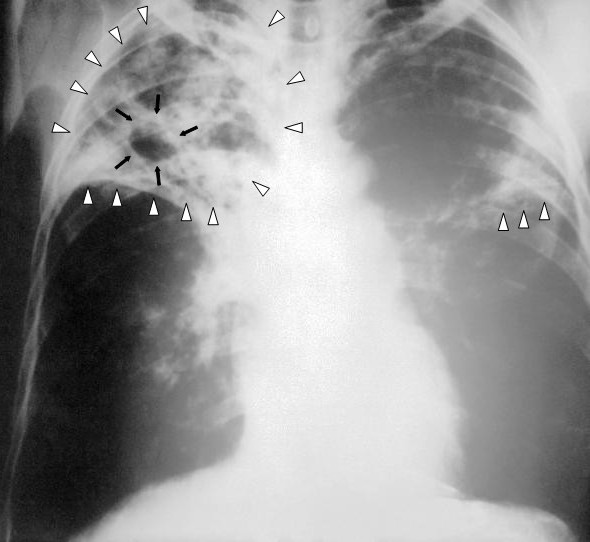
Tuberculosis
Bacterial infection due to Mycobacterium tuberculosis (acid-fast bacilli)
-Presentation: fatigue, productive cough, night sweats, weight loss, post-tussive rales
-RF: endemic area, immunocompromised, recent immigrants, prisoners, healthcare workers
-Dx: screen with TST or IGRAs but diagnostic is sputum for AFB smears/culture, CXR shows upper cavitary lesions, biopsy shows caseating granulomas
-Tx: RIPE therapy if active, baseline LFTs required, three months of isoniazid plus rifampin if latent
>5 mm, >10 mm, > 15mm
Mantoux test rules state that a screening TB test is positive if induration:
-____ at high risk: fibrotic changes on CXR, immunocompromised, or close contact with infectious TB
-_____: patients age < 4 or some risk factors like hospitals, IVDU, recent immigrant, renal insufficiency, prison, homeless shelter, diabetes, head/neck cancer, gastrectomy
-____: if there are no risk factors
Two negative smears and cultures
Therapy can be stopped in patients with active TB after they have what?
Vitamin B6
Patients on isoniazid should be given what supplement to help avoid neuropathy?
Interstitial Lung Disease
Heterogenous group of disorders characterized by inflammation and/or fibrosis of the lung interstitium, leading to restrictive ventilatory defect
-PFTs: reduced FVC and TLC, normal or elevated FEV1/FVC ratio, decreased DLCO
Idiopathic Pulmonary Fibrosis
Most common and most severe form of ILD, which is progressive and irreversible. Usually seen in males > 60 years with a history of smoking
-Presentation: insidious onset exertional dyspnea, dry cough, bilateral basal crackles, digital clubbing
-Dx: HRCT shows bilateral honeycombing with/without peripheral traction bronchiectasis pattern
-Tx: nintedanib or pirfenidone, lung transplant
Sarcoidosis
Non-caseating granulomatous disease of unknown etiology, which is typically seen in African American women aged 20-40
-Presentation: dyspnea, dry cough, fatigue, bilateral hilar lymphadenopathy, uveitis, skin lesions
-Dx: elevated ACE and calcium, CXR/CT shows bilateral hilar adenopathy and parenchyman infiltrates
-Tx: corticosteroids
Hypersensitivity Pneumonitis
Immune-mediated inflammatory response to inhaled organic antigens, which is commonly related to bird droppings and moldy hay
-Presentation: flu-like illness 4-8 hours after exposure, fever, chills, dyspnea, cough
-Tx: antigen avoidance
Small Cell
What type of lung cancer is being described?
-Seen mostly in smokers, does not respond to surgery, and typically presents with mets
-Presentation: recurrent pneumonia, anorexia, weight loss, weakness, cough
-Associated with SVC, Horner syndrome, Eaton-Lambert syndrome
-Dx: CXR, CT chest with IV contrast, tissue biopsy
-Tx: combo chemo
CT
What is indicated as an annual screening for adults aged 50-80 with a > 20 pack-year smoking history who currently smoke or have quit within the past 15 years?
Non-Small Cell
What type of lung cancer is being described?
-Types: squamous cell (hypercalcemia), large cell (gynecomastia), adenocarcinoma (MC)
-Dx: CXR, CT chest with IV contrast
-Tx: surgery ± chemo and radiation
Pleural Effusion
Accumulation of fluid in the pleural space, classified as a transudate or exudate using Light’s Criteria
-Presentation: dullness to percussion + decreased breath sounds + absent tactile fremitus
-Dx: CXR shows blunting of costophrenic angle/meniscus sign, thoracentesis is diagnostic and therapeutic
-Tx: therapeutic thoracentesis, chest tube + IV if empyema
Exudative
If any of the following of Light’s Criteria are met, what type of pleural effusion is this?
-Pleural fluid protein/serum protein > 0.5, pleural fluid LDH/serum LDH > 0.6, pleural fluid LDH > 2/3 the upper limit of normal serum LDH
-Protein rich, high LDH with parapneumonic effusion being the most common
Transudative
What type of pleural effusion is being described?
-Protein poor, low LDH
-CHF is the most common cause
Pneumothorax
Presence of air in the pleural space, causing lung collapse
-Dx: CXR shows visible pleural line with absent lung markings peripheral to it, CT is more sensitive
-Tx: observation + O2 (small <2), needle aspiration/chest tube (large > 2)

Tension Pneumothorax
Life-threatening emergency where air enters the lungs but cannot exit, leading to progressive lung collapse and mediastinal shift
-Presentation: tracheal deviation away from affected side, hypotension, JVD, absent breath sounds, tachycardia
-Dx: immediate needle decompression then chest tube

Pulmonary Nodule
Focal opacity measuring < 3 cm completely surrounded by aerated lung
-Presentation:
Benign Features → smooth borders, calcification pattern, stable on imaging x 2 years, age < 40, non-smoker
Malignant Features → spiculated or irregular borders, size > 8-10mm upper lobe location, growth on imaging, history of smoking
Sleep Apnea
Irregular breathing and snoring patterns which occur at night due to reduced tone in the muscles around the airway, with risk factors of obesity, alcoholism, and adenotonsillar hypertrophy
-Presentation: loud snoring, restlessness, apnea, fatigue, nocturia, insomnia, personality changes
-Dx: PSG
-Tx: CPAP + weight loss
SIDS
Sudden, unexpected infant death
-RF: prone sleeping position, soft sleep surface, maternal smoking, bed sharing, prematurity, overheating, second hand smoke, and young maternal age
-Prevention: safe sleep ABCs
Varenicline
What smoking cessation med has the best efficacy?
-Blocks nicotine’s reward aspects
Lupus Pernio
Chronic, violaceous, raised plaques and nodules commonly found on the cheeks, nose, and around the eyes
-Pathognomonic for sarcoidosis
Sarcoidosis
What is the most likely diagnosis?
-Sx: cough, dyspnea, fever, fatigue, skin lesions, arthralgias
-Physical Exam: lupus pernio
-Labs: hypercalcemia, hypercalciuria, elevated serum ACE
-CXR: bilateral hilar adenopathy
-Bx: noncaseating granulomas
-Tx: oral steroids if needed
Spirometry
What testing is used to diagnose COPD when there is no alternative explanation for the symptoms?
Decreased
How is the FEV1/FVC ratio affected in a patient with COPD?
Acid-Fast Stain
In a patient with suspected active tuberculosis, what should be ordered in addition to the culture?
LABA + LAMA
What are the two hallmarks of bronchodilator therapy in a patient with COPD, per the GOLD criteria?
PRN SABA
What is indicated in someone with exercise-induced asthma or exercise-induced bronchospasm?
>15
How many respiratory events per hour of sleep is consistent with a diagnosis of OSA?
Blood test
In an asymptomatic patient with one positive TB screen, what should be performed to confirm their status?
Pneumothorax
What diagnosis should be considered in this patient?
A 24-year-old man presents to urgent care with shortness of breath that started last night while he was sitting on the couch. The symptoms have since resolved. He also reports some intermittent mild chest pain on his right side. The patient currently smokes one pack of cigarettes per day. Vital signs are a BP of 120/80 mm Hg, oxygen saturation of 95%, pulse of 115 beats per minute, respiratory rate of 20 breaths per minute, height of 5'10", and weight of 160 pounds. The patient is well appearing and can speak in full sentences. Chest X-ray shows a visceral pleural line with the distance from the chest wall to the visceral pleural line < 2 cm at the level of the hilum.
Pancoast Syndrome
Shoulder and arm pain + Horner Syndrome + weakness and atrophy of hand muscles + cough / hemoptysis / dyspnea
-Tx: chemo + radiation
20-valent PCV
What is the recommended pneumococcal vaccination for patients aged > 50 years with no other risk factors and no prior history of vaccination?
Adenocarcinoma
What type of lung cancer is least likely to be associated with smoking?
Interstitial Lung Disease
What is the most likely diagnosis?
A 50-year-old man presents to the office for evaluation of progressive dyspnea on exertion and a persistent nonproductive cough. Symptoms began about 6 months ago. He has no significant medical history other than atrial fibrillation, which has been well-controlled on amiodarone for the past 12 months. He does not take any other medications. He reports no history of tobacco or nonmedical drug use or exposure to occupational agents. On physical examination, his heart rate and rhythm are regular, and no murmur or gallop is heard. Inspiratory crackles are noted diffusely in both lungs. His jugular venous pressure is normal, and he has no peripheral edema.